Kering awards jewelry innovation for traceability, upcycling and sustainability
A discarded-CD jewel and a gemstone-origin tool won Kering’s latest jewelry award, turning traceability and upcycling into luxury’s sharpest tests.
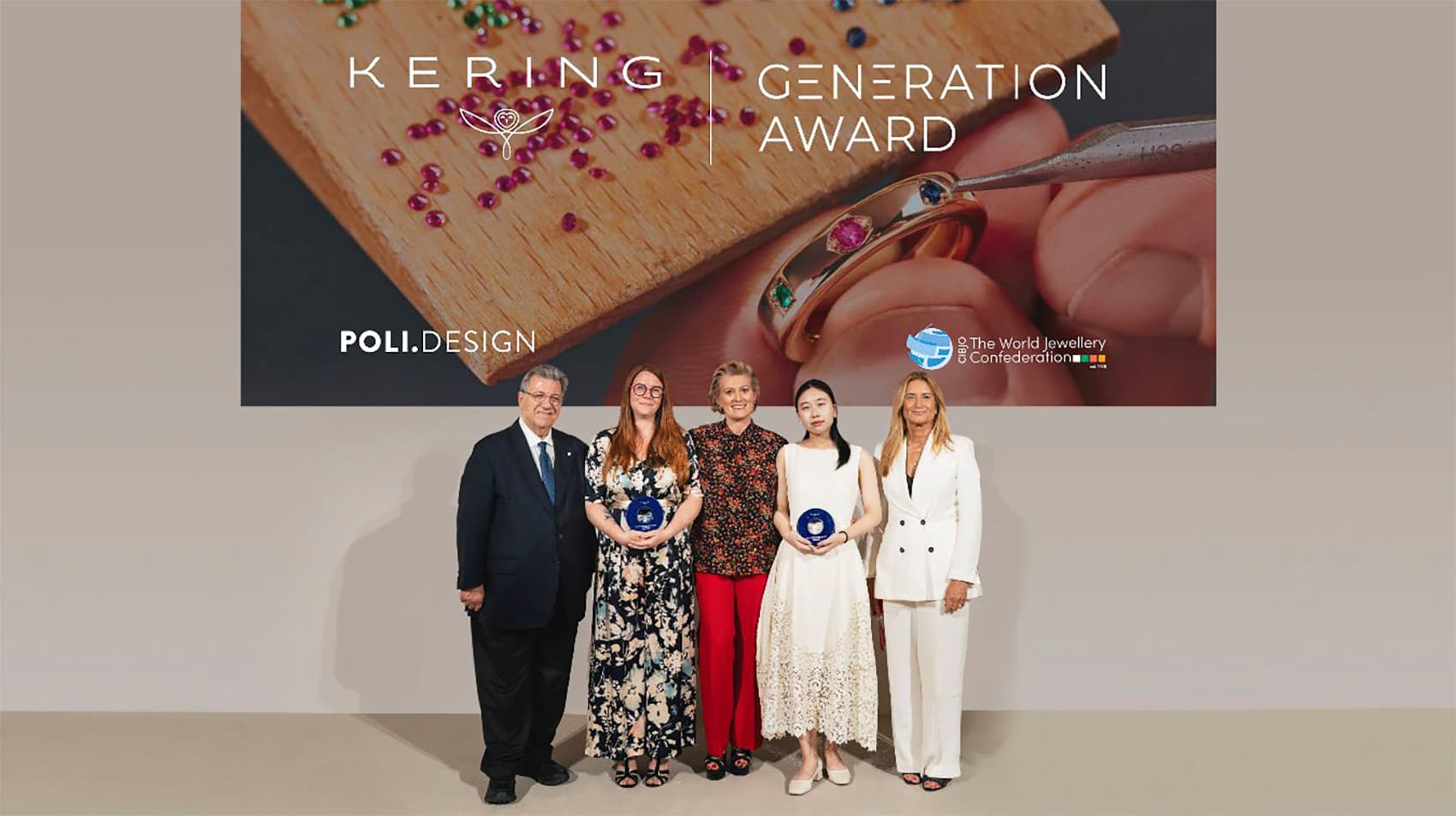
Kering and CIBJO used Paris Haute Couture Week to put two very different ideas of jewelry innovation under the same spotlight: one built from discarded compact discs, the other built to verify where a gemstone comes from. On July 9, 2026, at Kering’s headquarters in Paris, the second Kering Generation Award X Jewelry crowned Yang Yuchan of the Beijing Institute of Fashion Technology in the student category and Lauriane Pinsault of France in the startup category.
The winning student project, Perching Willow, turns old compact discs into fine jewelry through traditional craftsmanship, a neat collision of waste stream and atelier skill. Pinsault’s GeoGems project, OriGems, aims to make gemstone origin scientifically verifiable, a far more consequential bet for a sector where provenance increasingly shapes value as much as carat weight or polish. Those are the kinds of ideas that could change how gold and gemstones are designed, sourced and trusted, because they move sustainability from branding language into process.
The competition brought together 44 startups and students from 10 universities and academies, with finalists narrowed to two students and two startups. Jill Schmid of Rochester Institute of Technology was shortlisted for Acacia, a jewelry concept that elevates wood shavings, while Masanori Kirihara’s Novanoma was the other startup finalist. The student winner receives an internship with one of Kering’s jewelry maisons, while the startup winner receives mentorship from POLI.design.

The award was scientifically coordinated by POLI.design of Politecnico di Milano and backed by Kering’s jewelry maisons Pomellato, DoDo and Qeelin. Kering said the platform began in China in 2018 to support startups working on sustainable and innovative materials and processes, then expanded to Saudi Arabia and Japan before being extended to jewelry in 2024. The theme for this edition, “Second Chance, First Choice,” made the brief explicit: reduce the industry’s environmental footprint across products, processes, services and technology.
That framing is more than ceremonial. The inaugural jewelry edition, held at JCK Las Vegas on June 7, 2025, drew 22 startups and students from 10 universities and academies, and named Lee Min Seo and Ianyan as winners. A year later, the field was larger and the stakes clearer: the strongest entries were not decorative gestures toward sustainability, but working methods for making gold and gemstones easier to trace, easier to reuse and harder to doubt.
This article was produced by Prism’s automated news system from verified source data, official records, and press releases, then run through automated quality and moderation checks before publishing. The system is built and supervised by the people who set the standards it runs under. Read our full AI policy.
Did this article answer your question?