Alicia Hannah Naomi champions ruggedly romantic jewelry, textured gold, organic stones
Alicia Hannah Naomi turns imperfection into the new stacking code, using textured gold, organic stones and recycled metals to make layered jewelry feel personal.

Why imperfection reads as luxury now
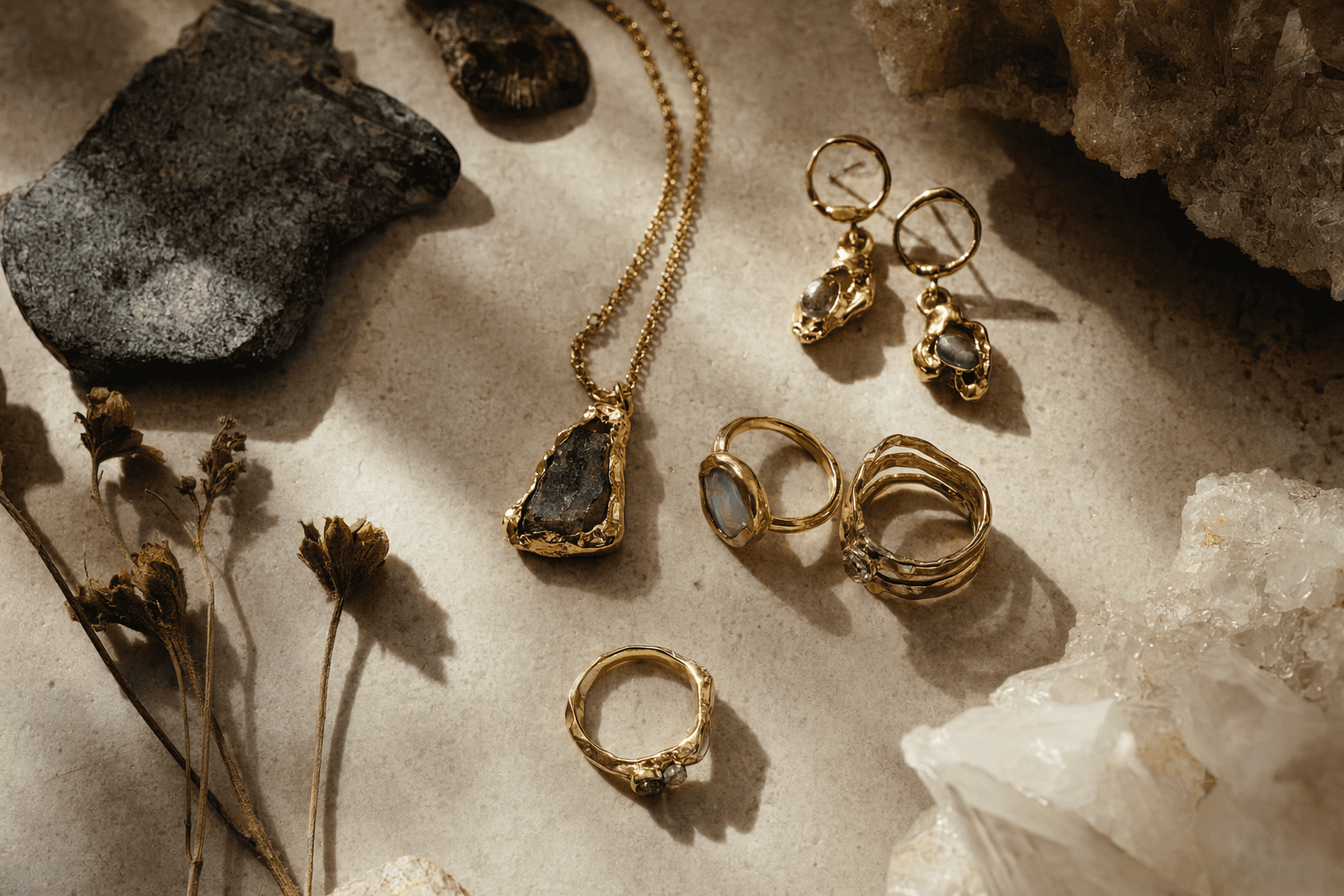
Alicia Hannah Naomi makes imperfection look deliberate. The Melbourne jeweler builds her work around tactile surfaces, irregular forms and the raw beauty of precious metals, then layers in unconventional stones so the result feels collected rather than coordinated. In a market where polished sameness can flatten a stack, her pieces offer a more personal answer: texture, movement and a sense that each ring or necklace was shaped by hand, not machine.
Her design language is rooted in nature, but not in a soft-focus way. Naomi’s artist statement points to environmental landmarks transformed by erosion, decay and human interference, while her 2022 profile described the work as inspired by weather-worn coastal rocks and mountains. That connection to landscape matters because it gives imperfection a logic. A rough edge or carved groove is not a flaw here, but a signal that the piece should sit beside other jewelry with the same easy confidence as a stone in a riverbed.
The maker behind the surfaces
Naomi is a contemporary jeweller from Melbourne, Australia, and her studio describes her practice as sculptural solid gold and sterling silver jewelry handcrafted in Melbourne. She was first introduced to contemporary jewelry in 2003 through work for the goldsmiths Francois and Nicholas Payet, then completed an Advanced Diploma of Engineering Technology, specializing in Jewellery, at Box Hill Institute of Technology in 2013. She also received the Most Outstanding Student Prize there and later completed a Jewellery Gem Setting course at Melbourne Polytechnic in 2019.
That technical background shows in the finish. Naomi uses lost-wax casting and hand-carved wax modeling to create deliberately irregular forms, which is why her pieces feel organic without becoming loose or vague. Her own description of the work as “perfectly imperfect” is more than a slogan. It is a fabrication method, a finishing choice and a styling instruction all at once.
What makes the pieces layering-friendly
Layering works best when every piece brings a different surface or silhouette to the stack, and Naomi’s jewelry is built for exactly that. Fashion Journal noted that she uses asymmetric forms and intricately carved textures that mimic weather-worn stone, while also describing the work as genderless, ageless and seasonless. That combination makes the jewelry adaptable: a rugged ring can sit beside a cleaner band, and a sculpted pendant can interrupt a row of fine chains without making the whole composition feel busy.
Her studio says most pieces are made to order, and all jewelry is made from recycled metals, with studio scrap recycled as well. Those are not vague sustainability claims; they are specific material choices that give the work a tighter production footprint and a stronger provenance story. In a category where green language can get slippery fast, recycled gold and silver, made-to-order production and reclaimed studio scrap are the kinds of details that actually matter.
The gold market is pushing the look forward
Naomi’s aesthetic also lands at a useful moment for the category. The World Gold Council reported that Q1 2026 gold demand, including over-the-counter transactions, reached 1,231 tonnes, while the value of quarterly demand hit a record US$193 billion. At the same time, jewellery demand volumes fell 23% year over year, a reminder that record prices change how both makers and buyers approach gold.
The pricing backdrop helps explain why designers like Naomi are making more 14k work. The World Gold Council said the LBMA (PM) gold price set a quarterly average record of US$4,873 per ounce and reached a historic high of US$5,405 in January 2026. In that environment, 14k becomes less of a compromise than a smart material decision, especially for layered pieces meant to be worn often. It preserves the feel of gold while helping stacks stay more accessible and more wearable.
How to build a stack that feels intentional, not messy
The best Naomi-style stacks rely on contrast, not clutter. Start with one piece that has obvious texture, such as a carved ring, a matte cuff or a pendant with an irregular surface, then let the rest of the jewelry do quieter work around it. A polished chain, a plain band or a slim hoop keeps the composition grounded so the handmade-looking element reads as the focal point rather than visual noise.
A few rules make the mix feel current:
- Keep one metal family dominant, especially yellow gold, then introduce sterling silver only if the contrast feels deliberate.
- Mix finishes instead of matching them, pairing brushed or raw surfaces with one smoother piece.
- Let organic stones do the heavy lifting where you want softness, because irregular shapes already create movement.
- Use spacing as part of the design, leaving a finger bare or a neckline open so the textured pieces breathe.
That approach also reflects the larger shift JCK has been tracking in its trend coverage, where gold and layering keep surfacing as core directions. The appeal is not only visual. A textured stack hides wear better, feels more lived-in over time and invites collecting without demanding perfection from the start.
Why Naomi’s philosophy feels so current
Naomi’s work sits at the intersection of craftsmanship and restraint. She uses recycled metals, makes most pieces to order and builds each form through lost-wax casting, yet the finished jewelry never feels overworked. Instead, it suggests a person who wants beauty with a trace of the hand, a little geology and enough irregularity to keep the stack from looking manufactured.
That is why her version of rugged romance resonates now. In a market shaped by record gold prices, shoppers are looking harder at what a piece is made of, how it was made and how often they will wear it. Naomi answers all three questions with texture, recycled material and designs that age into character rather than away from it.
This article was produced by Prism’s automated news system from verified source data, official records, and press releases, then run through automated quality and moderation checks before publishing. The system is built and supervised by the people who set the standards it runs under. Read our full AI policy.
Did this article answer your question?