Met Gala, MAD About Jewelry, and auctions spotlight layered accessories this week
Nearly 12,000 square feet of new museum galleries, 45 artists from 20 countries, and a Dallas auction floor make this a decisive week for layered jewelry.

A rare jewelry week with three different messages
Nearly 12,000 square feet of new museum galleries, 45 artists from 20 countries, and a Dallas auction floor turn early May into a concentrated lesson in how jewelry moves from red carpet to museum sale to market history. The Met Gala, MAD About Jewelry, and Heritage Auctions are not separate stories this week, they are three versions of the same one: how necklaces, cuffs, and mixed-material stacks become more sculptural, more personal, and more legible the moment fashion culture starts paying attention.
The Met Gala makes the body the setting
The Met Gala on Monday, May 4, 2026, is the clearest cue in the calendar. It celebrates the Costume Institute exhibition *Costume Art*, and the dress code, “Fashion Is Art,” asks guests to treat the body as a canvas for sculptural, artistic couture. That framing matters because it pushes jewelry away from decorative afterthoughts and toward pieces that can hold their own against disciplined tailoring, dramatic shoulders, and sweeping fabric.
The exhibition’s focus on depictions of the dressed body, and on the relationship between clothing and the body, suggests a powerful shift in how jewelry will be worn immediately after the gala. Expect necklaces that sit close to the neck and read almost like portable collars, along with cuffs that have the visual force of small objects rather than simple bracelets. This is the moment when a piece does not merely accessorize the look, it completes the silhouette.
The gala also inaugurates the museum’s nearly 12,000-square-foot Condé M. Nast Galleries, and that scale feels symbolic. Jewelry is being placed in conversation with architecture, not just with wardrobe, which is why the strongest pieces this week will likely feel built, not just made. In practical terms, that means streamlined forms, strong contours, and finishes that catch light without needing ornament piled on top.
What that means for necklaces and cuffs now
The best styling takeaway from the Met Gala is that the neckline and wrist are about to matter more than the full-body pileup of accessories. A single sculptural necklace can do more than three delicate strands if the profile is clean and the metal has enough presence. Cuffs work the same way, especially when they have width, volume, or an asymmetric line that looks intentional from across a room.
The yellow-gold revival is still the most visible thread to watch here, because warmth reads immediately against skin and photographs beautifully under flash. Gold also gives sculptural forms a softer edge than silver, which can be useful when the garment itself is already severe or monochrome. If the shape is bold, keep the construction lucid: a bezel-set stone, a polished surface, or a hinged cuff can carry the look without visual noise.
MAD About Jewelry turns layering into collectible design
If the Met Gala supplies the silhouette, MAD About Jewelry supplies the tactility. Running from May 5 through May 9, 2026, the event marks its 26th edition and brings together 45 artists from 20 countries, which is exactly why it matters to anyone tracking where jewelry is going next. Museum-backed artist jewelry has a way of collapsing categories: it can be precious and experimental, wearable and collectible, finished and visibly handmade all at once.
That mix makes layering feel less like a trend rule and more like an editorial language. A highly polished chain can sit beside a hand-textured pendant, a strand with organic beadwork, or a ring with an unconventional material story. The appeal is not in perfect matching, but in the dialogue between surfaces, which is why mixed metals and mixed media are becoming so compelling together.
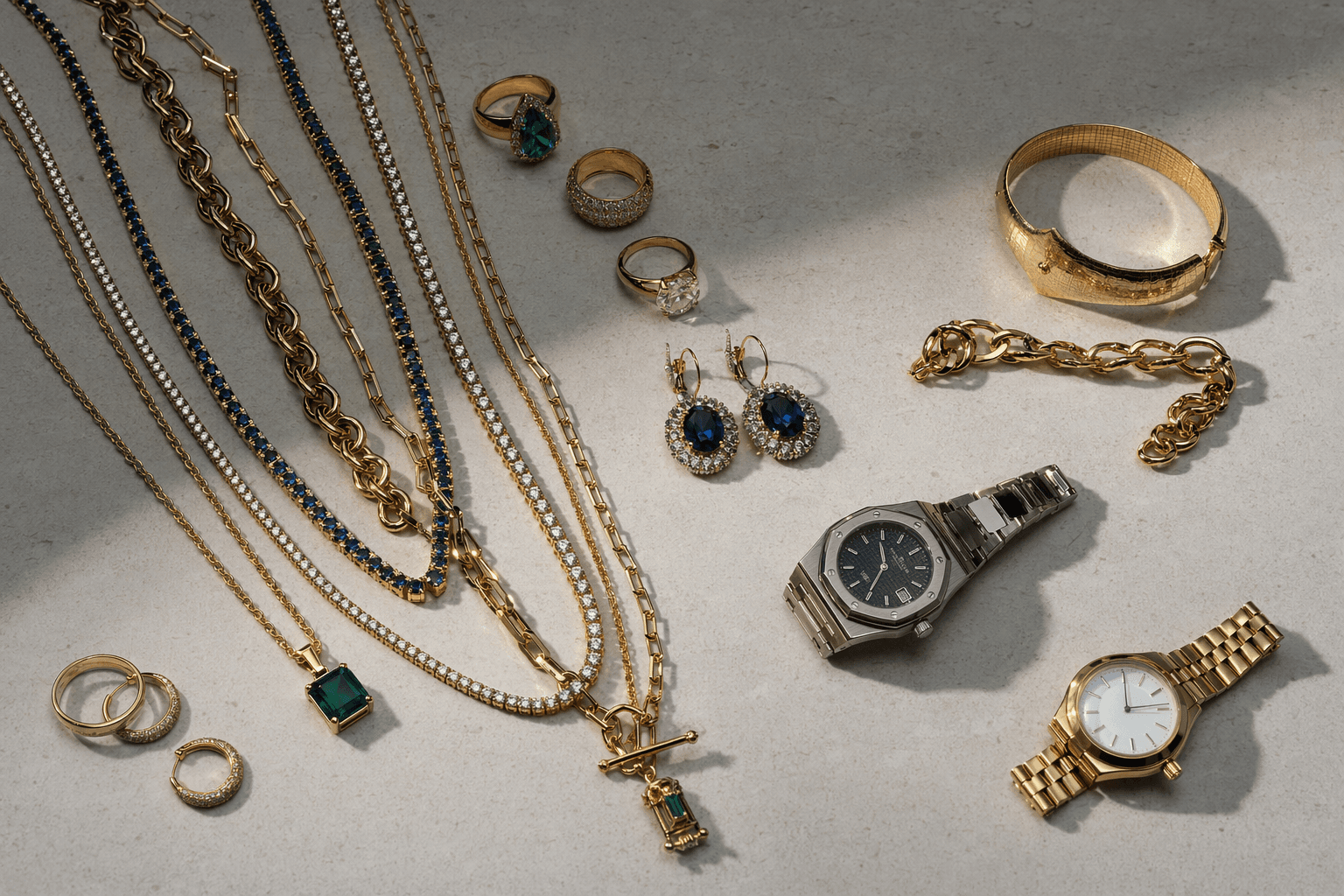
The point for readers is simple: one precise piece is often stronger when it is contrasted with one piece that feels more artisanal. Pair a refined gold collar with a handmade element in silver, enamel, textile, or carved stone, and the contrast gives both objects more authority. That is where layered jewelry stops looking decorative and starts looking collected.
The mixed-material stack to watch
The strongest stacks right now are not uniform. They move between polished and matte, warm and cool, rigid and flexible, because the eye wants variation more than repetition. Expect to see chains beside cords, metal beside beads, and hard-edged cuffs offset by softer rings or bracelets that break up the formality.
- Use one dominant metal, then add one contrasting texture to avoid a flat, overly coordinated look.
- Let one piece feel sculptural and one feel handmade, so the stack has tension instead of sameness.
- Keep the neckline and wrist from competing for attention by choosing a statement in one area and restraint in the other.
- If a timepiece is in the mix, treat it like jewelry, because its profile and metal tone can anchor the whole composition.
Heritage Auctions gives the stack provenance
Heritage Auctions adds the market’s memory to the week. Its jewelry sale in Dallas is listed for May 7, 2026, with additional jewelry auctions scheduled for May 21 and June 11, and that cadence is a reminder that luxury jewelry does not exist only in the present tense. Estate jewelry and timepieces, in particular, pull the conversation toward craftsmanship, condition, and scale, the very qualities that make layered pieces worth keeping rather than replacing.
Auction jewelry also tends to confirm one of the week’s most useful styling ideas: the best modern stacks often begin with an object that already has a life before the current season. A vintage bracelet with architectural heft, a watch with a slim case, or a ring with a strong mount can ground newer purchases and keep the look from drifting into trend fatigue. In that sense, the auction floor is not just a sales venue, it is a design archive.
How to wear the week’s jewelry language
The practical result of this crowded calendar is a new kind of clarity. Jewelry is moving toward pieces that can speak across contexts, from gala dressing to museum retail to auction provenance, and that favors forms with graphic lines and material confidence. Necklaces should frame the face or collarbone with purpose, cuffs should read as complete objects, and mixed-material stacks should feel edited rather than accumulated.
This is what makes the week useful beyond the event circuit. The Met Gala shows jewelry as structure, MAD About Jewelry shows it as art, and Heritage Auctions shows it as history. Put those together, and the direction is unmistakable: layering is becoming more sculptural, more mixable, and more tied to the individual identity of the pieces themselves.
This article was produced by Prism’s automated news system from verified source data, official records, and press releases, then run through automated quality and moderation checks before publishing. The system is built and supervised by the people who set the standards it runs under. Read our full AI policy.
Did this article answer your question?