Chunky engagement rings reshape wedding band layering trends
Chunky engagement rings are forcing wedding bands to curve, split, and sometimes disappear into one seamless stack. The new bridal formula is less matching set, more sculptural conversation.
The bridal stack starts with the center ring
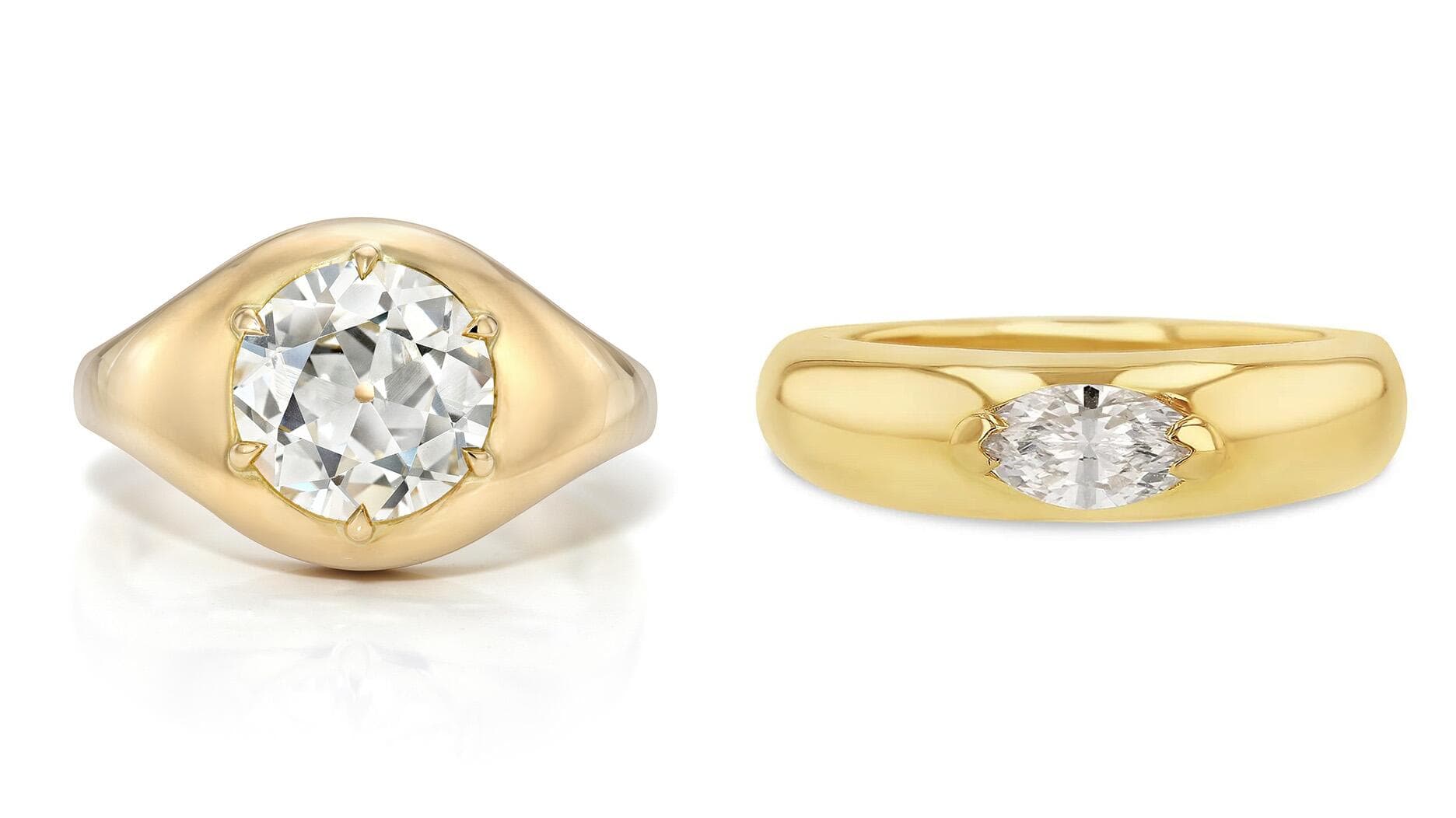
Chunkier engagement rings are changing the entire logic of bridal layering. A dome band, an east-west stone, or a semi-bezel setting no longer leaves much room for a straight wedding band to sit politely beside it, so the band has to become part of the design problem and the design solution. That is why couples are now building stacks around shape, height, texture, and contrast, not just around a metal match.
The clearest signal came from celebrity rings that looked deliberately nontraditional rather than ornamental for the sake of novelty. Dua Lipa’s chunky gold band with a round diamond in a semi-bezel setting helped push the bridal conversation toward cigar bands and substantial ring profiles, while Miley Cyrus later wore a thick yellow-gold band with an east-west cushion-cut diamond in a semi-bezel setting. Those rings did more than spark chatter; they helped move wedding jewelry away from dainty symmetry and toward sculptural presence, and they sent search interest in chunky ring settings climbing.
Why the wedding band is now a design problem
Once the engagement ring becomes bolder, the wedding band can no longer be treated as an automatic match. Jillian Sassone, founder of Marrow Fine Jewelry, says couples are thinking more intentionally about how the engagement ring and wedding band work together through contrast, shape, and texture. That shift has widened the brief for a wedding band: it may need to hug a low-set center stone, echo a dome’s curve, or intentionally break from the engagement ring’s finish so the whole stack feels edited rather than repetitive.
This is also why some clients are choosing a two-in-one engagement-and-wedding ring or building a stack over time instead of making one final, fixed decision on day one. The appeal is practical as much as aesthetic. When a center ring already has visual weight, a wedding band that is too flat or too conventional can create a gap, crowd the setting, or visually fade into the background. A curved band, a contour shape, or an open design solves that tension by making the negative space part of the look.
Contour bands, open shapes, and one-piece solutions
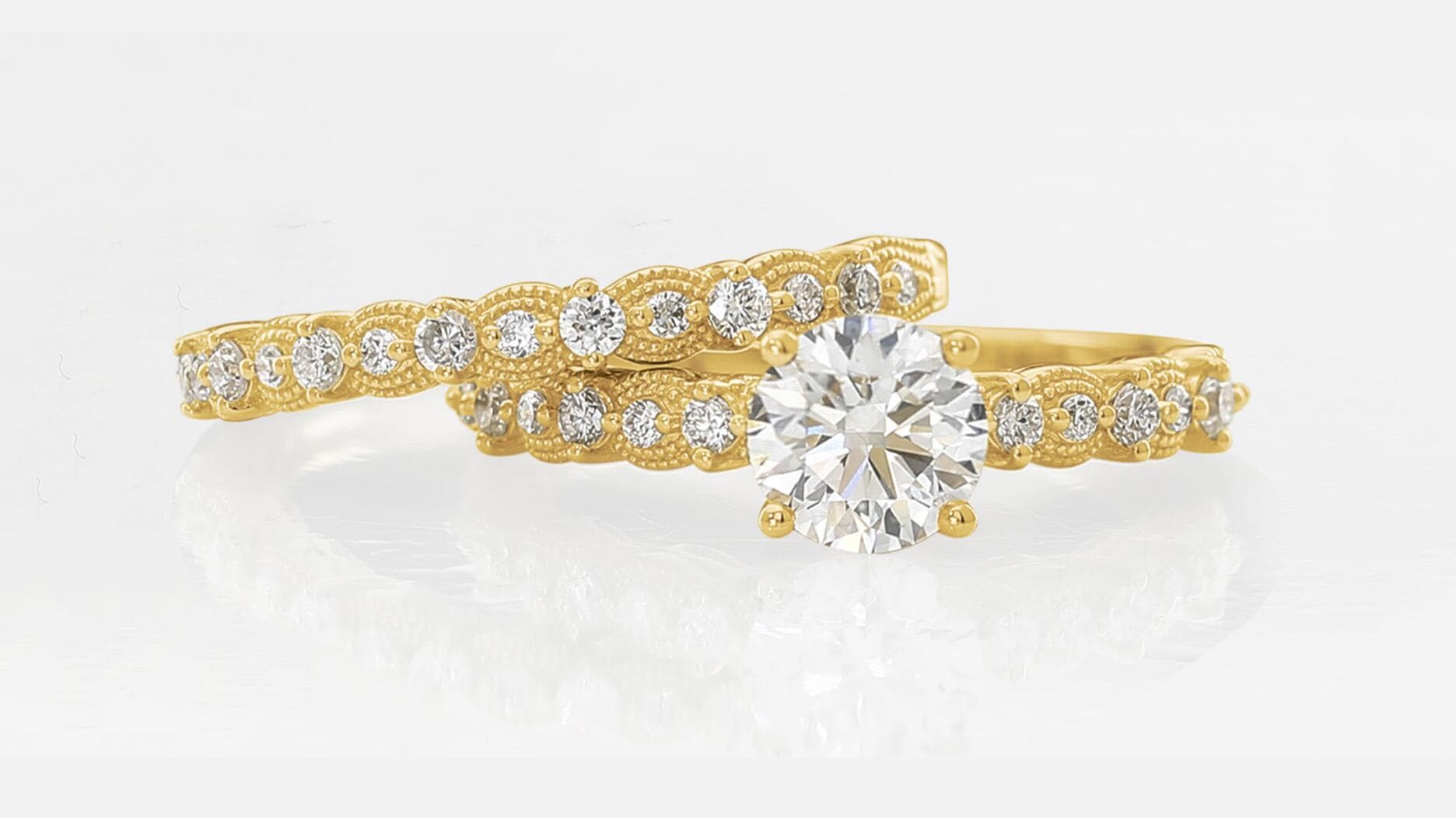
The new bridal band is often engineered to sit flush. Contour and curved bands are shaped to nestle around the engagement ring and reduce gaps between the two, which matters most with low-set solitaires, east-west stones, and chunky domes. Instead of a straight line that stops short of the center stone, these bands trace the ring’s perimeter, creating a more continuous silhouette on the hand.
That same logic has encouraged more open forms and intentionally mismatched stack partners. Enamel bands, mixed metals, and design-driven pieces that feel like everyday jewelry are gaining traction because they can add contrast without fighting the center ring. In practice, that means a bride might pair a thick yellow-gold east-west ring with a slimmer white-metal contour band, or offset a semi-bezel stone with an open band that frames rather than mirrors it. The result is less bridal uniformity and more personal composition.
Personalization is the bigger market shift
The move toward unusual bridal stacks fits inside a broader personalization boom. At JCK’s June 4, 2024 wedding-jewelry panel, personalization was the dominant theme, with experts stressing that there is no single type of engagement ring. Severine Ferrari pointed to custom details such as hidden birthstones or zodiac signs, while Isreal Morales and Trish Carruth emphasized the market’s drift toward more distinctive, story-driven jewelry.
That appetite shows up in the numbers. The Knot’s 2024 Jewelry & Engagement Study found that 77% of proposees had some involvement in their ring selection process, which helps explain why the final ring-and-band pairing now feels collaborative rather than predetermined. The same study showed that round center stones still led at 28% of designs in 2024, but oval stones had reached 25%, up 23% since 2015. The Knot’s trend forecast for 2025 pushed that direction further, naming maximalist multi-stones, half bezels, marquise shapes, east-west settings, vintage cuts, thoughtful toi-et-moi designs, blackened gold, architectural silhouettes, and bold color as major directions.

That forecast matters because the wedding band has to answer to all of it. A narrow pavé band that once felt like the default now looks underpowered next to a sculptural center ring. A band with a curve, a split, or an unexpected geometry reads as more current because it participates in the visual story instead of merely framing it.
Yellow gold, lab-grown diamonds, and the new bridal mood
JCK’s panel also made clear that the materials story has changed alongside the shapes. Carruth said yellow gold had been so hot that about 90% of her brides were choosing it, while New York was seeing a cooldown in white metals and renewed demand for platinum and white gold. Morales added that eight out of 10 rings he sold were lab-grown diamonds, a reminder that this style shift is happening in a market where value, scale, and design flexibility matter as much as tradition.
Morales also said that out of his last 20 engagement rings sold, only about two were halo settings. That is a striking sign of how far the market has moved away from a once-dominant look. The new bride is more likely to want a ring that feels architectural or collected over time, which is exactly why chunky engagement rings are pushing wedding bands toward contour profiles, open geometry, and stackable pieces that can evolve.
Why east-west feels new even when it is old
Part of the appeal of these rings is that they feel both disruptive and rooted in history. Rachel Boston has said east-west settings go back to the 15th century and had a large audience in the 1920s, when geometric design was central to the style of the moment. That lineage matters because it explains why the look feels contemporary without being purely trend-driven.
Zendaya’s public appearance with an east-west ring helped bring the setting back into the spotlight, but the style’s real strength is structural. Turning a stone horizontally changes the entire read of the ring, making the band around it part of the architecture. In that context, a wedding band is no longer just a partner piece; it is the finishing line of the composition.
The new bridal rule is compatibility, not conformity
The strongest wedding stacks now look designed from the center outward. A semi-bezel round diamond, a cushion cut set east-west, or a dome-shaped ring creates a profile that invites a curved band, an open shape, or a deliberate mismatch. Some couples will still choose a clean match, but the more expressive the engagement ring becomes, the more the wedding band has to earn its place.
That is the real shift: bridal jewelry is moving away from the old idea that the band should disappear into the set. Today, the best stacks have contrast, rhythm, and a little tension. They look assembled with the same care as a tailored wardrobe, which is exactly why the wedding band has become one of the most interesting design pieces in the room.
This article was produced by Prism’s automated news system from verified source data, official records, and press releases, then run through automated quality and moderation checks before publishing. The system is built and supervised by the people who set the standards it runs under. Read our full AI policy.
Did this article answer your question?