GoldZenn Details Necklace Types, Chain Weights and Layering Lengths
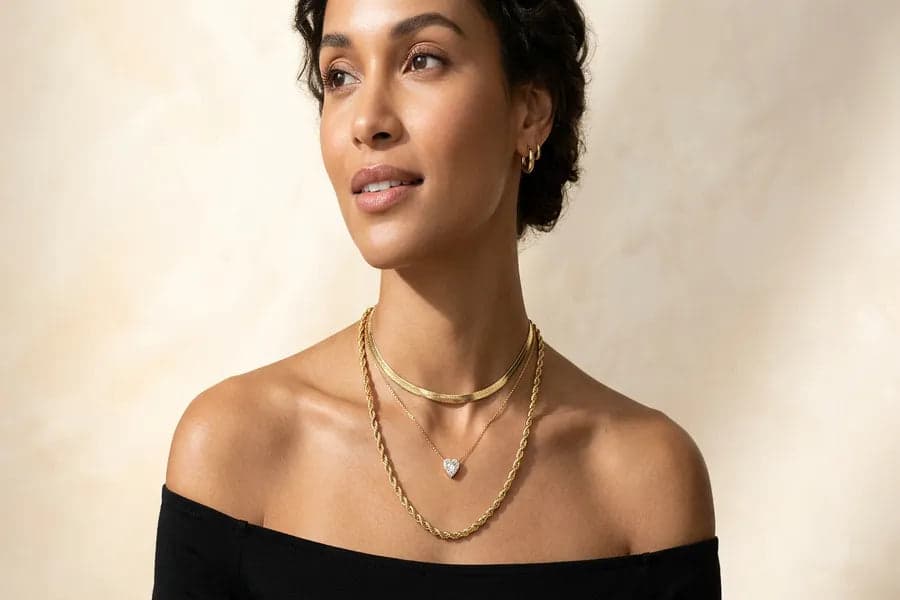
Layer necklaces using short (14–16"), mid (18–20") and long (24"+) pieces; balance scale, texture and face shape to make each layer feel intentional.
A necklace is a line drawn across the body and a sentence in a personal story. Below is a practical, gemological-minded guide to the necklace types, the layering lengths that work in the real world, and what the sources say about chain weights and pendant scale, so you can build a stack that is both beautiful and wearable.
1. Collar, 14 inches (fits snugly around the neck)
Collars sit high and close: Storicastudio describes the 14‑inch collar as one that “fits snugly around the neck, best suited for open-neck outfits like boatnecks or off-the-shoulder tops.” Because it occupies the highest plane, a collar reads as deliberate and architectural; wear it to frame the jaw and to punctuate a neckline that would otherwise feel empty. Collars are rarely used as pendants’ carriers, their role is sculptural, most often in plain metal or with small pavé details.
2. Choker, 16 inches (rests at the base of the neck)
Storicastudio calls the 16‑inch the choker: it “rests around the base of the neck, perfect for layering or making a subtle statement.” Gabrielny positions chokers in a long cultural line, “from Queen Cleopatra to the 1920s flappers and the grunge enthusiasts of the 1990s”, and offers immediate styling cues: “Wear a velvet choker with a slip dress for a grunge look or a delicate gold choker with an off-shoulder top for a touch of romance.” A choker is the most intimate layer; on its own it reads polished, but paired with longer chains it anchors the composition.
3. Princess, 18 inches (the everyday pendant length)
The 18‑inch princess is “the most popular and versatile length, sitting just below the collarbone. Great for pendants and everyday wear,” according to Storicastudio. It is the natural home for solitary gemstones, initials and small lockets, the pendants that become daily signatures. David Yurman’s layering advice begins here: “Begin with a standout piece that draws the eye, maybe an 18K gold toggle necklace, a diamond tennis necklace, or a striking gemstone pendant,” making the princess length a useful foundational choice.
4. Matinee, 20–24 inches (between collarbone and bust)
Storicastudio’s matinee (20–24") falls “between the collarbone and bust, adding elegance to casual and formal outfits alike.” This length adds verticality without overwhelming the torso, and it reads especially elegant under blazers or the higher necklines of structured dresses. For taller frames, matinee lengths reinforce proportion; for shorter torsos, Qevon advises wrapping or layering to avoid the necklace simply bisecting the line of the body.
5. Opera & Rope, 30+ inches (dramatic, convertible)
Opera and rope lengths, 30 inches and up, are the dramatic players: Storicastudio notes they are “a dramatic, longer style that can be worn as a single strand or doubled for a layered effect.” Long ropes do double duty, draped for drama, doubled for rhythm, and Qevon’s practical counsel is useful here: if a long necklace is too long for a short torso, “you can make it work by wrapping it to take in the length.” These strands invite improvisation and can read vintage or modern depending on metal and link weight.
- Start with a foundational necklace at princess length (18") or a signature choker.
- Add one mid-length piece offset by 4–6 inches to create visible tiers.
- Finish with a long rope or pendant (24"+) to elongate the silhouette.
6. Layering lengths and recipes (how to stack successfully)
Storicastudio provides a concrete starting formula: “A good layering formula includes: a short base chain (14–16 inches), a mid-length necklace (18–20 inches), a longer statement piece (24+ inches).” GoldZenn echoes the practice of concrete pairings: “GoldZenn’s comprehensive guide walks readers through necklace types, chain weights, pendant scales and, importantly for Jewelry Layering readers, recipes for building layered looks. The piece gives concrete length pairings (e.g., 14" choker + 18" pendant + 24"” (excerpt truncated). David Yurman frames the creative approach: “Begin with a standout piece that draws the eye… From there, layer in complementary pieces that add depth and dimension,” and reminds you to vary scale, texture and colour. Practical layering steps:
Mix chain styles, Storicastudio recommends pairing a “delicate cable chain with a bold paperclip chain”, to let each layer read distinctly.
7. Chain weights and pendant scales (what the sources say, and what they don’t)
GoldZenn explicitly lists “chain weights” and “pendant scales” among the topics it covers, but the provided excerpt does not supply numeric gauges or gram weights. In practical terms, matching chain weight to pendant scale is foundational: a heavy pendant performs poorly on a fragile cable, and a bold chain will overwhelm a tiny solitaire. Use scale and texture as your guide, the same principle David Yurman articulates when he counsels layering by “scale, texture, and color”, and when in doubt choose a chain that can physically support the pendant without detracting from its proportions.
- Layered chain, Best for building a collection; Occasion: Everyday. Layered chains create rhythm and are the easiest way to personalize a look.
- Solitaire pendant, Versatility; All occasions. The solitaire is a perennial closet workhorse, the piece you rely on when other choices feel uncertain.
- Gemstone pendant, Adding color; Everyday + events. Gem tones provide wardrobe punctuation and can shift an outfit from casual to cocktail.
- Pearl necklace, Timeless elegance; Everyday + formal. Pearls remain a bridge between day and evening with an inherently polished voice.
- Initial necklace, Personalization; Everyday. Initials and lockets are intimate declarations, worn close for daily comfort.
- Chunky link, Making a statement; Events. A chunky link chain moves a stack from delicate to declarative.
- Bar pendant, Minimalist style; Everyday. As Gabrielny notes, “Bar necklaces have experienced a surge in popularity… Minimalistic and elegant, bar necklaces elevate your everyday style. Pair them with a crisp white shirt for work or a little black dress for a night out.”
- Cross, Spiritual meaning; All occasions. Crosses function as both symbol and silhouette.
- Locket, Meaningful wear; Everyday. Lockets keep memory and sentiment close to the skin.
- Statement multi-strand, Bold moments; Special occasions. These are for ceremonies and nights when the jewelry must speak loudest.
8. Necklace styles and the role each plays in your wardrobe
Danarebeccadesigns lays out a clear functional table, each style “serves a purpose”:
9. Face shape, frame and proportion rules
Storicastudio offers concrete pairing guidance: round faces benefit from “longer necklaces (22+ inches) to help elongate the face,” oval faces can wear most lengths, heart-shaped faces are balanced by chokers or princess lengths (16–18"), petites should favor 14–18", and taller or broader builds do well with 20"+ chains. Qevon supplements this with proportion tips: “Long necklaces don’t usually look best on a short torso… If you have a shorter torso and a favorite long necklace, you can make it work by wrapping it,” and if a choker “interrupts the line” on a tall slender frame, adding a longer layer helps the eye travel.
10. Comfort, wearability and shopping notes
Storicastudio reminds us that “comfort should also be a key factor in choosing a chain length. If you plan to wear your necklace every day, opt for a length that won’t tangle easily, feel too tight, or get caught on clothing.” On price and category signposts, Danarebeccadesigns’ Top‑10 highlights the spectrum of investment, one example listing is the “DRD Star of David Necklace, $4,200”, and the site-level merchandising language visible in its excerpts (free shipping over $300, first-order discounts) is a reminder that shopping for necklaces spans both accessible and high-jewellery territory. For foundational purchases, those 18K gold toggles, diamond tennis strands or striking gemstone pendants David Yurman recommends, prioritize secure closures and correct chain weight for the piece.
11. Conclusion: wear with intention
Layering is a craft as much as it is a habit. Use the inch-based map, 14" collar, 16" choker, 18" princess, 20–24" matinee, 30"+ opera/rope, pair it with Storicastudio’s 14–16 / 18–20 / 24+ recipe, and let David Yurman’s impulse to begin with a standout piece guide your choices. Whether you choose a delicate bar for everyday certainty or a chunky multi-strand for a single bold evening, the right sequence of lengths, chain strengths and scales will make every layer feel like it was always meant to be there.
This article was produced by Prism’s automated news system from verified source data, official records, and press releases, then run through automated quality and moderation checks before publishing. The system is built and supervised by the people who set the standards it runs under. Read our full AI policy.
Did this article answer your question?