How beadwork made layering a language of jewelry
Beadwork reveals layering as identity, trade, and status, from Ndebele aprons to Atlantic trade beads and South Africa’s oldest shell strands.
Layering can look like a styling trick until you follow it back to beadwork. Across Africa and the wider world, beads have long been threaded, stacked, repeated, and combined into necklaces, collars, fringes, aprons, strands, and multi-row ornaments, which means layering began as a visual language, not a retail trend.
Beadwork as the original stack
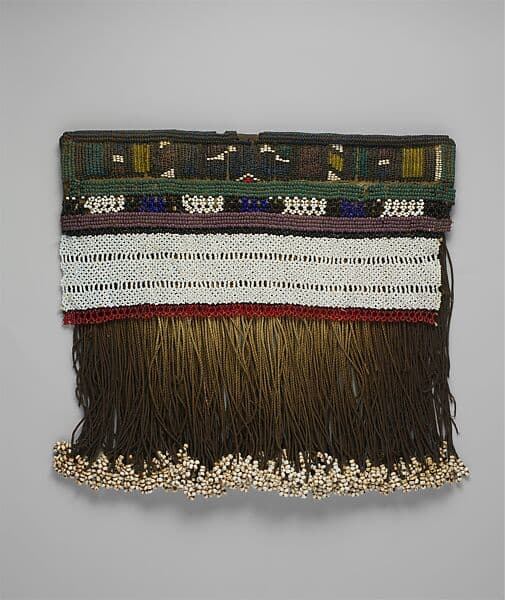
The Metropolitan Museum of Art’s Beadwork in the Arts of Africa and Beyond makes that logic plain. Beads do not simply decorate an object; they build it, one unit at a time, until repetition becomes surface and surface becomes structure. The museum’s detail view of a girl’s apron, a lighabi made by the Ndebele peoples of South Africa, shows how thousands of small elements can create a dense, layered field of color and rhythm rather than a single isolated ornament.
That same principle appears in the Met’s Throne of Njouteu, which is described with wood, glass beads, cloth, and cowrie shells. The object is not interesting because one material dominates. It is compelling because the materials work together, with beads acting as both pattern and glue in a larger assemblage. In that sense, beadwork already understands what modern layering often tries to imitate: texture, repetition, and contrast held in a deliberate composition.
Layering has always carried meaning
In many African and adjacent traditions, beadwork has never been just ornamental. The University of Maine’s Hudson Museum says African jewelry differentiates between the sexes, emphasizes the anatomy, indicates social status and wealth, and can even serve as a form of currency. That makes layered jewelry legible in a social sense as well as a visual one. A stack of strands can mark age, affiliation, ritual role, or prestige just as clearly as it signals taste.
This is where the idea of “more” becomes too thin. A layered piece can communicate lineage or ceremony through its order, color, and density. A fringe can soften a collar; a collar can frame the neck and shoulders; a strand can repeat a bead family until the arrangement reads like a sentence. The aesthetic pleasure of layering sits inside a larger system of meaning, and beadwork is one of the clearest places to see that system at work.
Trade routes are written into beads
The history of bead layering is also a history of movement. Google Arts & Culture says beads were first made in Africa from organic materials like bone, shells, and seeds many thousands of years ago. The same source notes that imported glass beads dating back to the mid-11th century have been found in present-day South Africa and Zimbabwe, a reminder that the materials in a beadwork piece often carry a route map with them.
Archaeology pushes the timeline even further back. Shell beads from Blombos Cave in South Africa date to about 75,000 years ago, making ornament and repetition part of the deep human record. Later scholarship, including a 2016 Nature article on bead sequences from Magoro Hill in South Africa and a 2019 MDPI review on glass beads as markers of ancient trade in sub-Saharan Africa, shows how bead histories continue to anchor scholarship on exchange, chronology, and contact. Glass beads did not just arrive as pretty imports; they became evidence of trade, circulation, and changing power.
The Victoria and Albert Museum extends that story across the Atlantic. It notes that beads with similar, if not identical, forms and designs have been found across the Atlantic Ocean, in the Caribbean, North America, West Africa, and Europe, describing them as “Atlantic objects” tied to early modern maritime trade routes loosely dated 1450 to 1750. That language matters. It shows that the bead strand is also a trade route in miniature, carrying design, labor, and history from one shore to another.
Google Arts & Culture’s southern Africa beadwork story adds another layer: beadwork grew and flourished through contact with people from outside Africa, and vast quantities of glass beads were imported from Europe. That is not a simple tale of influence. It is a record of contact, exchange, and unequal movement, with glass beads becoming part of local visual systems that were already sophisticated and symbolic.
How beadwork changes the way a modern stack reads
Seen through this history, layering becomes less about accumulation and more about composition. A good stack works when the pieces speak to one another the way beads do: by repeating a shape, interrupting it with contrast, or creating a visible hierarchy of scale. Small beads can act like punctuation. Larger beads can set the beat. Mixed materials can give the eye a place to rest.
- Repeat one material or color family so the eye sees intention, not clutter.
That is why beadwork remains such a useful guide for modern jewelry. If you are building a layered look, think the way a beadworker thinks:
- Mix scale with purpose, using small elements to support one bolder strand or collar.
- Combine finishes, such as matte shell, glossy glass, or carved organic material, so each layer has a distinct job.
- Treat provenance as part of the design, because a strand made from wood, glass beads, cloth, or cowrie shells carries different histories than one made only of polished metal.
The most satisfying layered jewelry often has the clarity of the Met’s examples and the material intelligence of the Throne of Njouteu. It is built from specific things, not vague style language. That makes it easier to buy, easier to wear, and harder to fake.
Why this tradition still matters now
Beadwork has lasted because it does several jobs at once. It decorates, identifies, protects, and records exchange. It can feel intimate, even personal, while still speaking to a community, a trade network, or a ceremonial role. That is a more durable idea than trend.
When you choose layered jewelry today, the most thoughtful stacks are the ones that can explain themselves: a strand of glass beads beside shell, a collar that owes more to structure than sparkle, a mix that respects material origin instead of hiding it. Beadwork shows that layering is strongest when it is readable, and the best layers are still the ones that turn repetition into meaning.
This article was produced by Prism’s automated news system from verified source data, official records, and press releases, then run through automated quality and moderation checks before publishing. The system is built and supervised by the people who set the standards it runs under. Read our full AI policy.
Did this article answer your question?