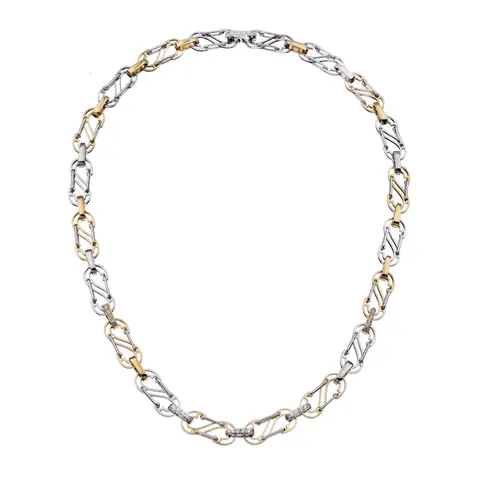
How to care for layered necklaces and keep them tangle-free
Layered necklaces stay crisp when you treat them like a small system: clean by material, store each chain separately, and keep oils, sweat, and tangles from softening the silhouette.

Once one strand starts to kink into another, a layered necklace stack loses the drape, separation, and metal contrast that made it compelling in the first place.
Zoe Vanderweide’s updated Wirecutter jewelry care guide treats jewelry as something to preserve, not just to polish. Layered necklaces demand that mindset. You are not maintaining one chain, but a small cluster of surfaces, closures, and finishes that wear against one another every time you move.
Why layered necklaces fail first
A single pendant chain can survive a lot of casual handling. A stack is more fragile because each strand introduces friction, and friction is what blurs a layered look fastest. Links brush against links, clasps snag, and the light-catching separation that makes layering feel intentional starts to collapse into a knot.
The other failure point is residue. Sweat, lotion, perfume, sunscreen, chlorine, and saltwater all leave traces that cling to metal and stones, dulling shine and muting contrast. Clean according to the material and construction, because a stack often combines pieces that do not tolerate the same treatment.
Clean for the materials in the stack, not for the easiest shortcut
The fastest way to flatten a layered necklace look is to use one aggressive cleaner on everything. Precious metals usually tolerate gentler cleaning, but pearls, plated finishes, delicate settings, and mixed-material pieces need far more caution. One harsh approach can cloud a polished gold chain, strip brightness from a plated layer, or compromise a setting that was meant to stay visually discreet.
A better routine keeps the stack bright without overworking it:
- Wipe each piece after wearing it, before oils and lotion dry into the links.
- Clean by material, not by assumption, so a pearl strand is not treated like a gold curb chain.
- Keep perfumes, body lotion, and sunscreen off the neckline until after you’ve dressed.
- If a piece has stones or a delicate setting, use the mildest method that protects the construction.
Wirecutter’s Instagram guidance for summer is direct: heat, sweat, salt, and chlorine are hard on jewelry, and sunscreen should go on before jewelry so the stack is not the last surface it touches. Multiple chains collect residue faster than one piece worn alone.
Store each chain so it keeps its shape
Storage is where a layered look is either preserved or quietly ruined. Toss several necklaces into one drawer and you invite knots, scratches, and chain stress, all of which change the way the stack falls on the body. Separate storage keeps each chain ready to wear and protects the spacing that makes layering look deliberate rather than accidental.
Individual pouches, hooks, and compartmented trays all help prevent tangling and abrasion. Hanging necklaces or keeping them apart protects both the finish and the shape of the piece, and compartmented jewelry boxes and organizers do the same.
Unclasp necklaces before storing them so they do not pull against their own chains, and do not drop a layered set into a catchall dish where fine links can grind against one another. If you wear mixed metals, this separation is even more important, because the contrast between yellow gold, silver, and rose gold reads best when each surface stays clean and distinct.
Keep the stack visually crisp
Layering has a long visual history. A 2024 jewelry blog post traced necklace layering back to ancient civilizations, where layered necklaces could signal status and spirituality, and linked it to the 1960s bohemian style cycle. Recent fashion coverage continues to frame layered necklaces as a recurring style that returns in fresh combinations of chains, charms, and sentimental pieces.
A stack depends on motion, and motion is what reveals whether a necklace is well cared for. When chains are clean, separated, and stored properly, they fall in clean tiers, reflect light at different heights, and keep their metal contrast sharp. When they are not, the whole look turns dull and compressed.
This article was produced by Prism’s automated news system from verified source data, official records, and press releases, then run through automated quality and moderation checks before publishing. The system is built and supervised by the people who set the standards it runs under. Read our full AI policy.
Did this article answer your question?