How Celebrity Stylists Say to Layer Jewelry for Every Formal Dress Code
Celebrity stylists say formal jewelry in 2026 should feel curated, not accidental — and the dress code determines everything.

There is a particular kind of confidence that comes from wearing the right jewelry to a formal event: not too much, not too little, every piece chosen as if it could not possibly have been otherwise. That calibration is harder than it looks, and it is precisely what separates a dressed woman from a styled one. Celebrity stylists who work the full spectrum of formal occasions — from charity galas to state dinners — are emphatic on this point: in 2026, intentionality is the entire game.
The guidance is worth taking seriously. These are professionals who dress clients under the most scrutinizing conditions imaginable, where a wrong necklace can shift a photograph and a poorly layered stack can undercut an otherwise immaculate look. Their core principle, and it bears repeating, is that layered jewelry for formal events should feel curated rather than accidental. The distinction matters enormously. Accidental layering is what happens when you reach into a jewelry box ten minutes before leaving; curated layering is what happens when you understand the relationship between your neckline, your stone choices, and the specific social weight of the occasion you are attending.
Understanding the Dress Code Before You Open the Jewelry Box
Formal dress codes are not interchangeable, and neither are the jewelry strategies that serve them. The most rigorous of these codes, white-tie, carries expectations that go beyond simply wearing something elegant. White-tie is the highest echelon of Western formal dress, and historically it has demanded jewelry that reads as significant from across a room: stones with genuine presence, metals that catch candlelight, pieces with architectural weight. Layering at this level is not about stacking delicate chains. It is about composing a look in which each element, whether a rivière necklace, a cuff, or a pair of drop earrings, occupies a deliberate and non-competing position.
This compositional thinking is what stylists mean when they talk about jewelry feeling intentional. At white-tie, every piece should appear as though it was considered in relation to every other piece, and in relation to the gown itself. A column gown in ivory silk calls for something entirely different than a strapless ballgown in navy velvet, even if both are technically appropriate for the same event.
The Logic of Layering Across Formal Registers
The discipline required at white-tie does not disappear at lower dress codes; it simply shifts register. Black-tie events offer more flexibility, but more flexibility is also more opportunity for misjudgment. The stylist's approach here tends to involve identifying one dominant piece, the one that carries the visual weight of the look, and building the remaining layers in genuine subordination to it. A statement ear cuff, for example, might anchor the look, which then means the neckline stays clean or carries only the thinnest, most refined chain. Competing focal points do not read as abundance; they read as noise.
Cocktail attire introduces the possibility of mixing metals and textures in ways that white-tie simply does not permit, and stylists often use this latitude to introduce more personal, less conventional pieces into the composition. A sculptural gold cuff worn against a shorter hemline, a delicate layered necklace situation that plays with negative space and proportion: these moves work because the register is lower and the room allows for more individual expression. The key, still, is that each decision appears made rather than stumbled upon.
Necklines as the Starting Point
Experienced stylists consistently identify the neckline as the primary variable in any layering decision. It is the architectural fact of the outfit, the element you cannot change on the way out the door, and it determines what is even possible in terms of necklace placement and layering depth. A deep V-neck creates a natural channel for a pendant or a single elongated chain; a bateau or boat neck, with its horizontal emphasis, typically calls for nothing at all at the throat, pushing attention instead toward the ears or wrists. A strapless gown presents the collarbone as an open canvas, which is where a truly beautiful choker or a short multi-strand piece can do its most compelling work.
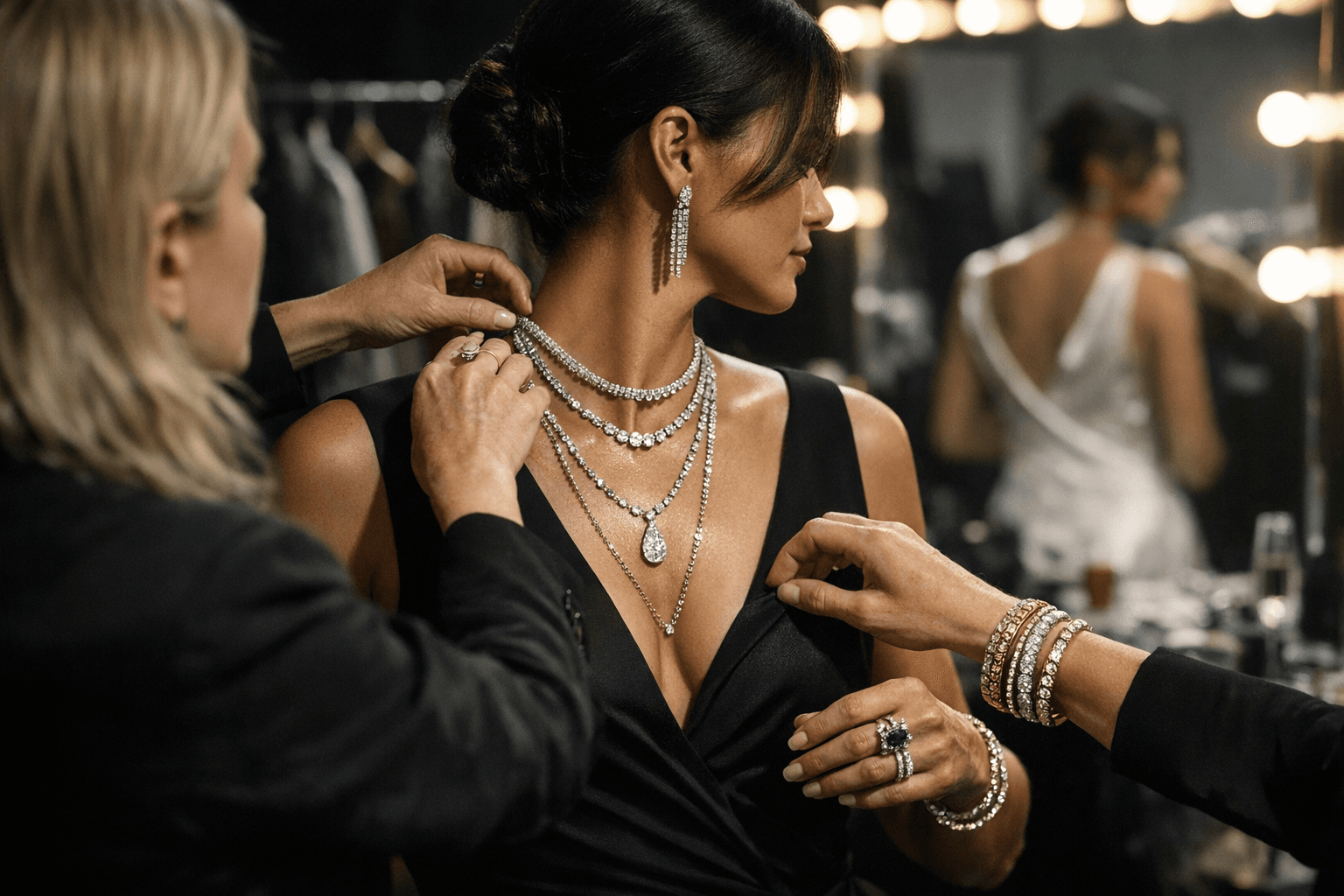
The error most people make is choosing jewelry they love without asking whether the neckline actually creates space for it. A gorgeous layered necklace disappears into a high-neck gown. A choker on a deep V reads as truncated rather than refined. Stylists work neckline-first, always.
Metals, Stones, and the Question of Occasion Weight
Not all jewelry is appropriate at all formal levels, and this has less to do with price than with visual register. Diamonds and colorless stones carry the most formal weight; they were designed, historically, for precisely these occasions. But that does not mean they are the only option at white-tie or black-tie events. Deeply saturated colored stones, particularly emeralds, sapphires, and rubies set in gold or platinum, read as equally serious when the scale and setting are right. What stylists caution against is the delicate everyday piece pressed into formal service without adjustment: the thin gold bar necklace that reads beautifully at a business dinner but disappears entirely under the lights of a ballroom.
Layering at formal events also demands attention to metal consistency. Mixing metals is a viable aesthetic choice at cocktail level and below; at white-tie and black-tie, the convention leans strongly toward a single metal family throughout the look. This is not a rule to be broken casually. When stylists do mix metals at the highest formal registers, it is with specific intention and usually in service of a very particular, architecturally considered look.
The Ear-to-Necklace Relationship
One of the most useful frameworks stylists apply is thinking about the ear and the necklace as a system rather than as separate decisions. Long, dramatic drop earrings almost always require a clean neck; the drama of the ear is the drama of the look, and a necklace competes rather than complements. Studs and small hoops, conversely, create space for necklace layering, though even here, stylists will note that the scale of the stud should echo something in the necklace chain or pendant weight. These are not arbitrary rules; they are observations about how the eye moves across a face and a décolletage, and how much information it can absorb before the overall effect becomes crowded.
At formal events, where the rest of the look is already working hard, crowded jewelry is one of the most common and most visible missteps. The stylist's job is to make it look as though no jewelry decision was ever in doubt, which is, of course, the product of a great many decisions made very carefully.
The principle that animates all of this is as simple to state as it is difficult to execute: wear jewelry that belongs to the occasion as completely as the gown does. When every piece has been chosen in relation to the neckline, the dress code, and the other pieces on the body, the result is not just elegance. It is the particular eloquence of a look that could not have been assembled any other way.
This article was produced by Prism’s automated news system from verified source data, official records, and press releases, then run through automated quality and moderation checks before publishing. The system is built and supervised by the people who set the standards it runs under. Read our full AI policy.
Did this article answer your question?