How Jewellers Are Shaping Runway Stories Through Bold Layered Designs
Anabela Chan and Robert Wun layered 8,892 lab-grown gemstones across a three-act couture narrative, proving jewellery has become the runway's most potent storytelling tool.

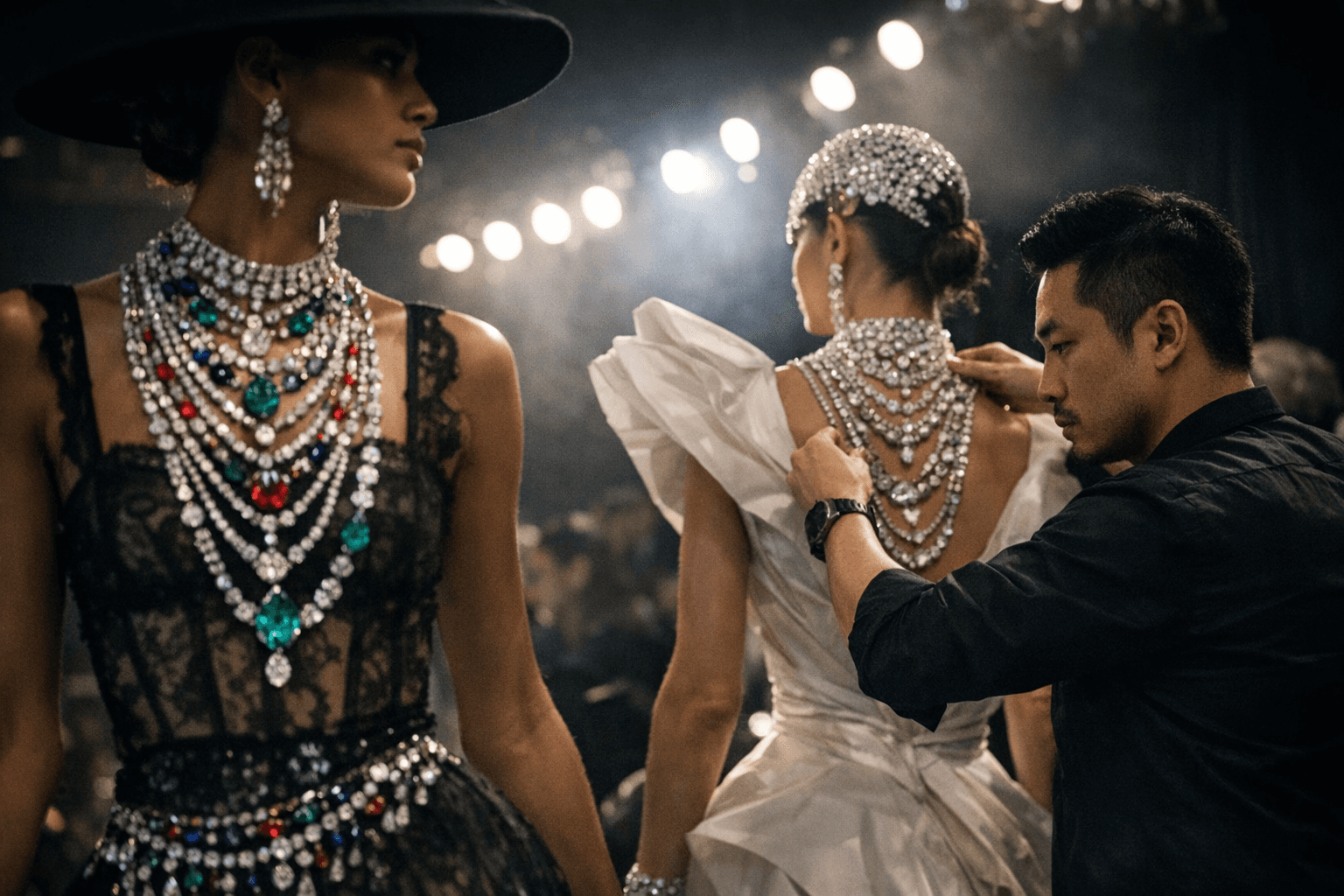
For spring/summer 2026, Robert Wun's Valour was as much constructed from gemstones as from fabric. London-based jeweller Anabela Chan produced more than 30 bespoke pieces to be layered onto models across the collection's three acts, each piece calibrated not merely to complement a garment but to advance a story. This is what jewellery-as-narrative-architecture looks like in practice: deliberate, emotionally loaded, and technically staggering.
The shift underway on the runway is significant. Jewellery is no longer styled as an afterthought, a last-minute addition from a brand partnership rack. The most compelling runway presentations of this season have been built around layered jewellery conceived alongside the clothes, not after them. Two collaborations, in particular, illustrate how differently this philosophy can be expressed: one rooted in haute couture spectacle and gemological ambition, the other grounded in minimalist craft and deeply personal storytelling.
A Full-Circle Moment: Anabela Chan and Robert Wun
Chan's biography reads like a deliberate accumulation of creative languages. She trained first as an architect under Lord Richard Rogers, then studied fashion with Alexander McQueen, before retraining in jewellery at the Royal College of Art. That layered education, spanning structural thinking, dramatic fashion instinct, and gemological precision, is precisely what makes her work for Wun's Valour so coherent. "To be able to work on haute couture shows in Paris again feels like a full-circle moment," she says.
Wun's Valour unfolded in three acts, titled Library, Luxury and Valour, charting what the Hong Kong-born, London-based couturier framed as the emotional journey of the creator. Chan's response to that brief was extraordinary in its specificity. She created Morse code earrings spelling secret messages, feather-light butterfly forms, and jewelled body armours recalling maharajas and royalty. These are not decorative flourishes; each category of piece maps onto a distinct phase of the narrative. The body armours, in particular, carry an almost totemic weight, evoking the ceremonial regalia of Mughal courts while sitting within the context of a contemporary couture show.
The material commitment behind the collection is worth pausing on. Together, Chan and Wun incorporated 8,892 calibrated laboratory-grown gemstones, totalling more than 6,600 carats across the collection. The word "calibrated" here is precise and meaningful: it signals that each stone was cut to an exact, consistent dimension, the kind of gemological control required when constructing body armours and layered jewellery that must sit correctly on a moving figure under runway lighting. Laboratory-grown stones allow that level of specification at scale, providing consistent colour, clarity, and cut across thousands of individual gems in a way that sourcing from natural rough would make near-impossible within a single collection's timeline.
Chan is clear-eyed about the dual nature of such collaborations. "Of course, collaborations can drive sales and extend client base," she acknowledges, "but haute couture for me is about the joy of creation where creative freedom triumphs over commerciality. As a designer, it is almost self-indulgent, and I love that." That candour is refreshing and rings true: the scale and specificity of what she built for Valour could not have been driven by commercial logic alone.
Craftsmanship at a Different Register: Pandora and Tove
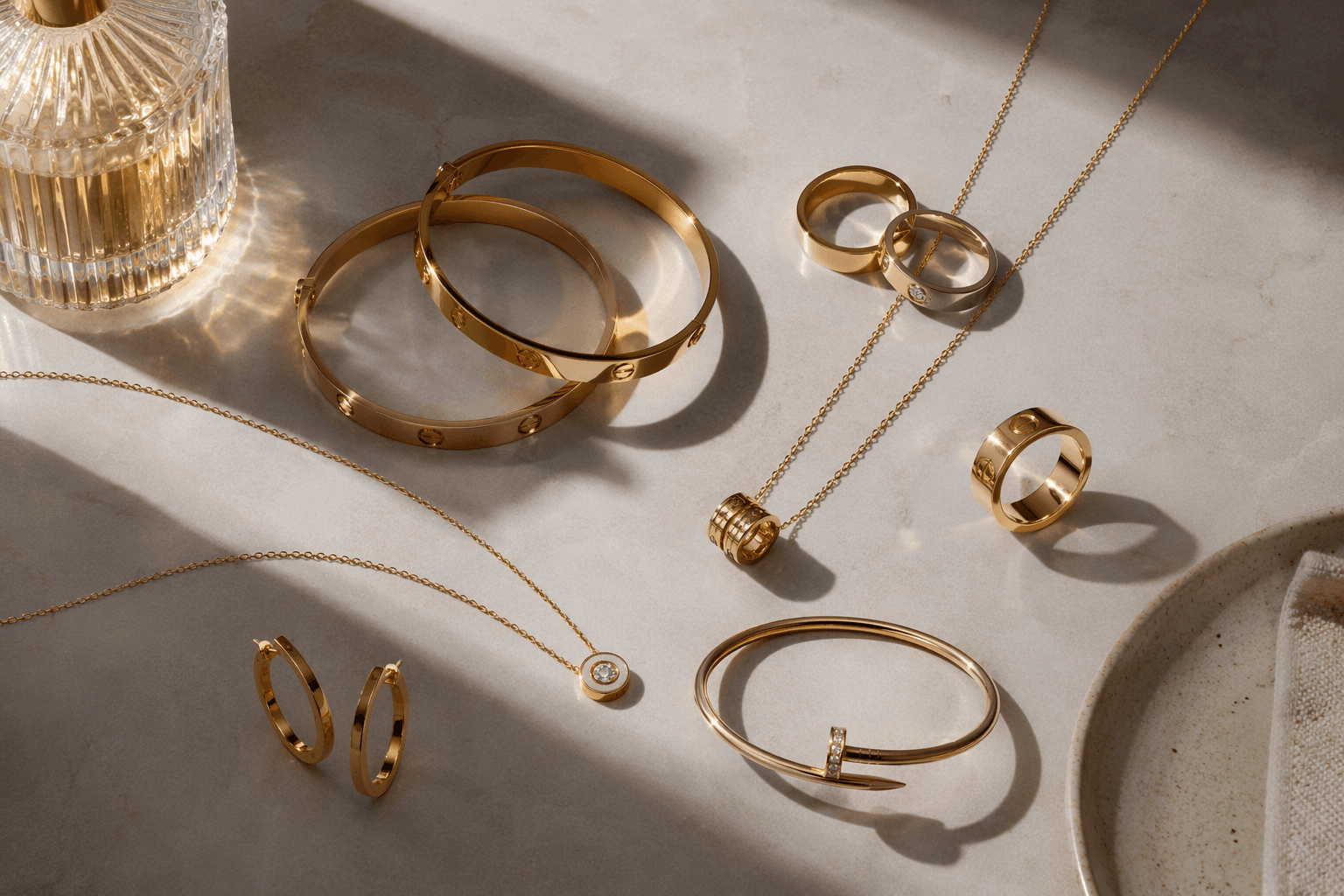
Where Chan and Wun operated at the register of spectacle, the collaboration between Danish jewellery house Pandora and London label Tove pursued a quieter kind of ambition. Holly Wright of Tove created engraving designs for Pandora charms, embedding them within Pandora's established minimalist language through layered necklaces and stacked, personalised pieces. The result is jewellery that layers in a literal sense but also in a conceptual one: each charm accumulates meaning, building a portrait of the wearer through accumulated detail rather than singular statement.
The collaboration is grounded in something more personal than most brand partnerships acknowledge publicly. Both teams share experience as parents of neurodiverse children, and that experience shaped the collection's core proposition: that jewellery can and should be a vehicle for expressing individuality. For a brand like Pandora, whose charm architecture already invites personalisation, this framing aligns naturally with the product. But Wright's contribution pushes beyond the transactional. Her engravings introduce a handcrafted visual vocabulary into Pandora's precision-engineered minimalism, creating a productive tension between the two brands' aesthetics.
The emphasis on longevity and considered design runs through both the creative and the ethical dimensions of this partnership. Sustainability, in this context, is not a marketing claim but a structural commitment: pieces designed to be worn, added to, and kept, rather than cycled through seasons.
What Layering Actually Demands
The technical dimension of runway jewellery layering deserves more attention than it typically receives. When Chan places feather-light butterfly forms alongside jewelled body armours on a single model, she is solving a problem that is simultaneously aesthetic and physical. Weight distribution across a layered look must account for movement, garment structure, and the cumulative load a model carries down a runway. "Feather-light" is a design specification as much as a poetic description: pieces that read as substantial under camera and runway lighting must not compromise a garment's drape or a model's posture.
Calibrated stones contribute directly to this. When every gem in a body armour is cut to the same precise dimensions, the setter can control weight and volume with accuracy. The difference between a 5mm and a 5.2mm stone, multiplied across hundreds of settings in a single piece, has real structural consequences. Chan's background in architecture, where material load and structural integrity are primary concerns, is not incidental to her jewellery practice. It is foundational.
Layering on the runway also demands a coherent visual logic. Pandora and Tove resolve this through the stacked necklace format: pieces that build vertically on the body, each layer readable independently but cohesive as a composition. Chan and Wun approach it through thematic escalation, moving from intimate (the Morse code earring, readable only at close range) through the natural world (butterfly forms) to the ceremonial and protective (body armour). Both strategies use jewellery to direct the viewer's eye and emotional response, which is what separates narrative architecture from decoration.
Creative Freedom as the Driving Logic
What connects these two very different collaborations is an insistence that jewellery, when conceived with genuine creative ambition, can do something clothes alone cannot: it can encode meaning at the level of material. A Morse code message is invisible to most viewers but present in the object; an engraving on a charm carries the hand of its maker into an otherwise standardised product. These are acts of authorship that survive the runway and persist in the piece itself.
The current fashion calendar suggests that more designers are recognising this. When the brief to a jeweller begins not with "accessorise the look" but with "help tell the story," the resulting pieces are built differently, with a different kind of intention in every setting choice and stone selection. What Chan and Wun achieved across 8,892 gemstones and more than 30 bespoke pieces, and what Wright and Pandora achieved through considered engraving within a minimalist framework, represents a maturation in how the industry understands jewellery's role. The runway, it turns out, is only where the conversation begins.
This article was produced by Prism’s automated news system from verified source data, official records, and press releases, then run through automated quality and moderation checks before publishing. The system is built and supervised by the people who set the standards it runs under. Read our full AI policy.
Did this article answer your question?