Michelle Yeoh Champions MIKIMOTO's Layered Pearl Vision Across 130 Years
In MIKIMOTO's new campaign, Michelle Yeoh layers 59, 79, and 118 inches of pearls simultaneously, providing the definitive blueprint for modern pearl stacking.
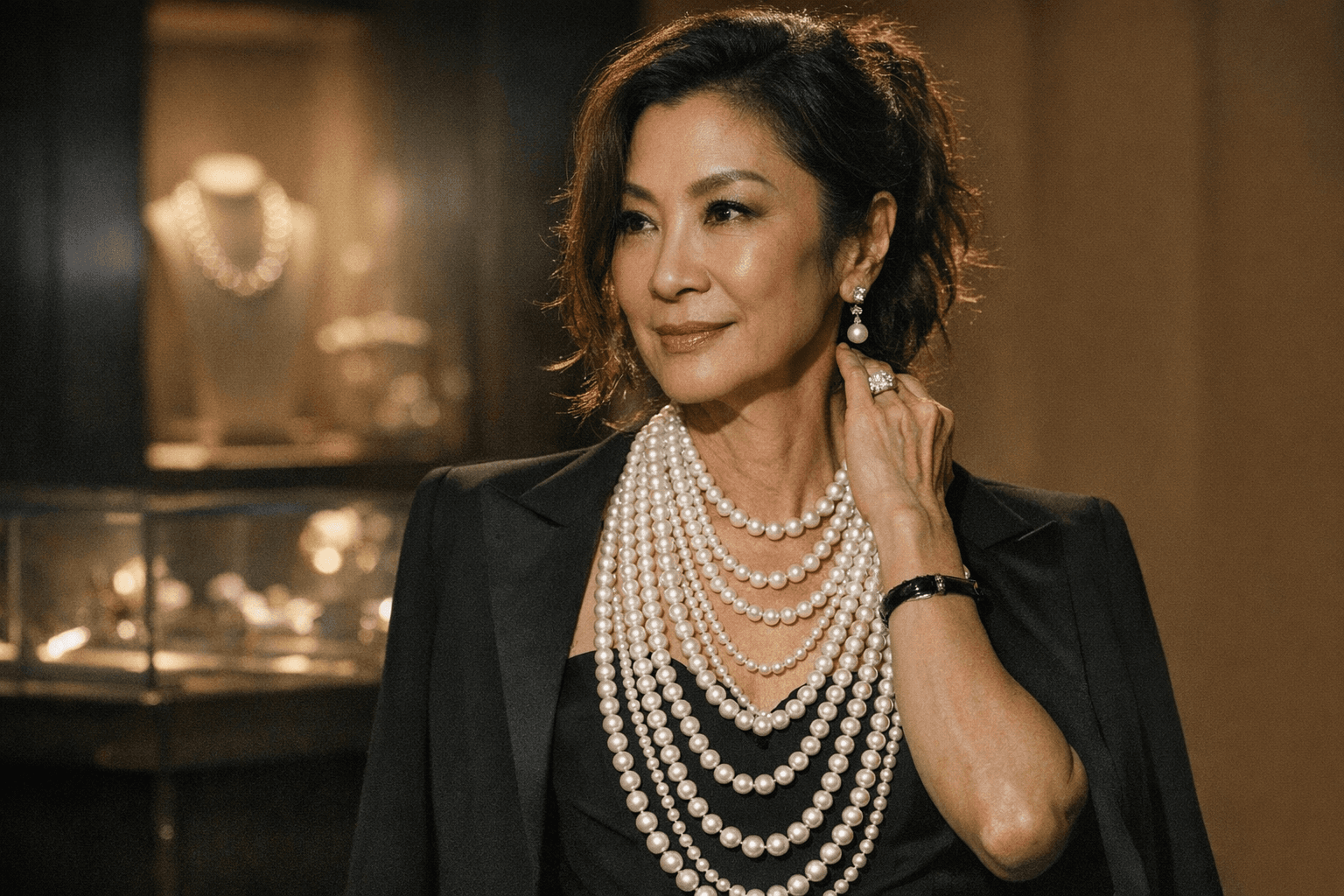
There is a longstanding anxiety around pearl necklaces: that more than one strand reads as costume, that layering them signals effort rather than ease. Michelle Yeoh, photographed for MIKIMOTO's new global campaign wearing 59, 79, and 118 inches of pearls simultaneously, dismantles that idea in a single frame.
The campaign, titled "1893 MIKIMOTO – Time on a String," launched in March 2026 and paid homage to the year Kokichi Mikimoto created the world's first cultured pearl. Mikimoto President and CEO Yasuhiko Hashimoto conceived the concept, which features Yeoh in three different looks. Hashimoto described Yeoh's appeal in precise terms: "At Mikimoto, we seek partners who embody both timeless elegance and modern strength. Michelle Yeoh is admired by audiences of all ages and across continents, making her a powerful reflection of the global spirit of our brand." That dual authority, classic and contemporary at once, is the visual argument running through every image.
The phrase "Time on a String" is meant to call to mind the idea of weaving through time as if stringing pearls on a necklace, expressing a legacy that connects past, present, and future through each strand. In 1893, Kokichi Mikimoto successfully created the world's first cultured pearls, an event that dramatically changed the history of gemstones by proving that humans and nature could work together in harmony to nurture pearls. More than 130 years later, the brand is using that founding moment not as a museum piece but as the premise for an entirely contemporary argument: the pearl necklace is the most layerable item in a jewelry wardrobe, provided you understand its proportional logic.
Understanding that logic begins with the language MIKIMOTO invented. A pearl choker, about 40 cm long, is appropriate with everything from casual to formal eveningwear and remains one of the most popular lengths. The matinée, at about 60 cm, is suited to daytime and long enough to sway subtly with movement. MIKIMOTO named both lengths, with matinée drawn from the French word for a daytime performance. The opera length, at about 80 cm, was also named by Mikimoto. Yeoh's three campaign strands at 59, 79, and 118 inches sit well beyond that scale, functioning as ropes and ultra-long ropes, but the layering architecture behind them follows the same core rule: each strand must claim its own visual territory, with enough separation between lengths that no two compete for the same neckline.
To build the look, start at the collarbone. A choker, snug against the base of the neck, functions as the foundation layer and the visual anchor for everything below. The second strand, an opera-length piece worn long or a matinée doubled for a stacked effect, should fall to the sternum and create the middle register. The third and longest strand, reaching to mid-chest or below depending on your frame, is what tips the look from elegant into editorial. The secret to a well-layered pearl look is mixing lengths: a pearl choker, a mid-length strand, and a longer matinée or opera-length necklace create depth and movement, drawing the eye downward and complementing most necklines. A practical minimum of four inches between each strand at the chest prevents tangling and keeps the separate lengths legible.
Neckline determines which combination of lengths works. A V-neck or plunging décolleté provides the open canvas for the full three-strand approach: bare skin gives each layer room to register cleanly. Low necklines invite multiple strands layered over bare skin or fabric, while high necklines, turtlenecks and structured tops, are best navigated by letting longer pearl strands flow over them. A crew or boat neck compresses the available space, making two strands, a choker and a single long rope, the more considered choice. Against a crewneck, abandon the choker and let a doubled opera-length strand carry the look on its own. Layering a pearl choker with a longer pendant necklace creates visual interest while allowing customization; keeping the rest of the outfit simple lets the layered necklaces remain the focal point.
Mixing pearls with metal is what prevents the look from reading as a period piece. A slim yellow gold chain threaded between pearl strands breaks the visual uniformity and signals intention rather than inheritance. MIKIMOTO's own Akoya pieces are characteristically finished with 18-karat gold clasps; at any price point, inserting even one gold chain between pearl strands achieves the same editorial interruption. Metal choice also functions as the day-to-night dial. Yellow gold reads warmer and more relaxed, appropriate for an afternoon event or a dinner with some formality. White gold or platinum pushes the register toward evening. For a daytime office look, one or two strands with a tailored blazer is sufficient. The full three-strand arrangement earns its effect in the evening, when the layered silhouette has space to land.
The day-to-night transition is generally a single swap: replace a choker with pearl drop earrings for the evening and the opera-length strand below it becomes the hero rather than one voice in a chord. The layering increases in weight and drama; the ear becomes the counterpoint.
At the splurge tier, MIKIMOTO's cultured Akoya pearl strands represent the benchmark. Individually knotted on silk thread and graded against the brand's exacting standards for luster, nacre thickness, and surface uniformity, an Akoya choker starts at several thousand dollars, with longer opera and rope-length strands climbing considerably higher. These are pieces designed to outlast fashion cycles, and the cost-per-wear calculus changes significantly when a necklace is expected to be worn, and handed down, for decades.
At the mid-range tier, brands including Honora, which specializes in freshwater cultured pearl jewelry widely available at department stores, and Pearl Paradise, an online retailer with notable transparency around pearl grading, both offer well-crafted strands in the $100 to $400 range. Building a three-strand look at this tier is achievable in stages, one length at a time.
Budget freshwater pearl strands have reached a quality level that would have surprised the market a decade ago. Chinese freshwater pearl cultivation has refined surface quality and round shape to the point where a matched 7mm to 8mm strand under $60 is now a realistic option. Layered with a gold chain and a longer strand, these pieces build the silhouette MIKIMOTO demonstrates with honest acknowledgment that the luster differential between freshwater and Akoya is real, visible in person, and proportionate to the price.
Kokichi Mikimoto's founding ambition, to adorn every woman with pearls, was never a statement about luxury. It was a statement about architecture: the pearl necklace as the organizing principle of dressed elegance at any scale. What the "Time on a String" campaign makes legible, through Yeoh's three-strand stacks and 118 inches of layered rope, is that the architecture has always been available. The technique simply needed demonstrating.
This article was produced by Prism’s automated news system from verified source data, official records, and press releases, then run through automated quality and moderation checks before publishing. The system is built and supervised by the people who set the standards it runs under. Read our full AI policy.
Did this article answer your question?