Mix Diamond Rings and Bands for a Perfectly Stacked Look
A ring stack is a composed visual rhythm, not a random pile — mastering the anchor-and-band logic transforms how every ring you own works together.

There is a particular satisfaction in looking down at your hand and seeing every ring working in concert: widths graduating, textures conversing, metal catching light in alternating registers. That effect is not accidental. A ring stack, at its most considered, functions as a composed visual rhythm with an anchor — the centre or engagement ring — and supporting bands built deliberately around it. Get that foundational logic right, and the rest follows naturally.
Start with your focal ring
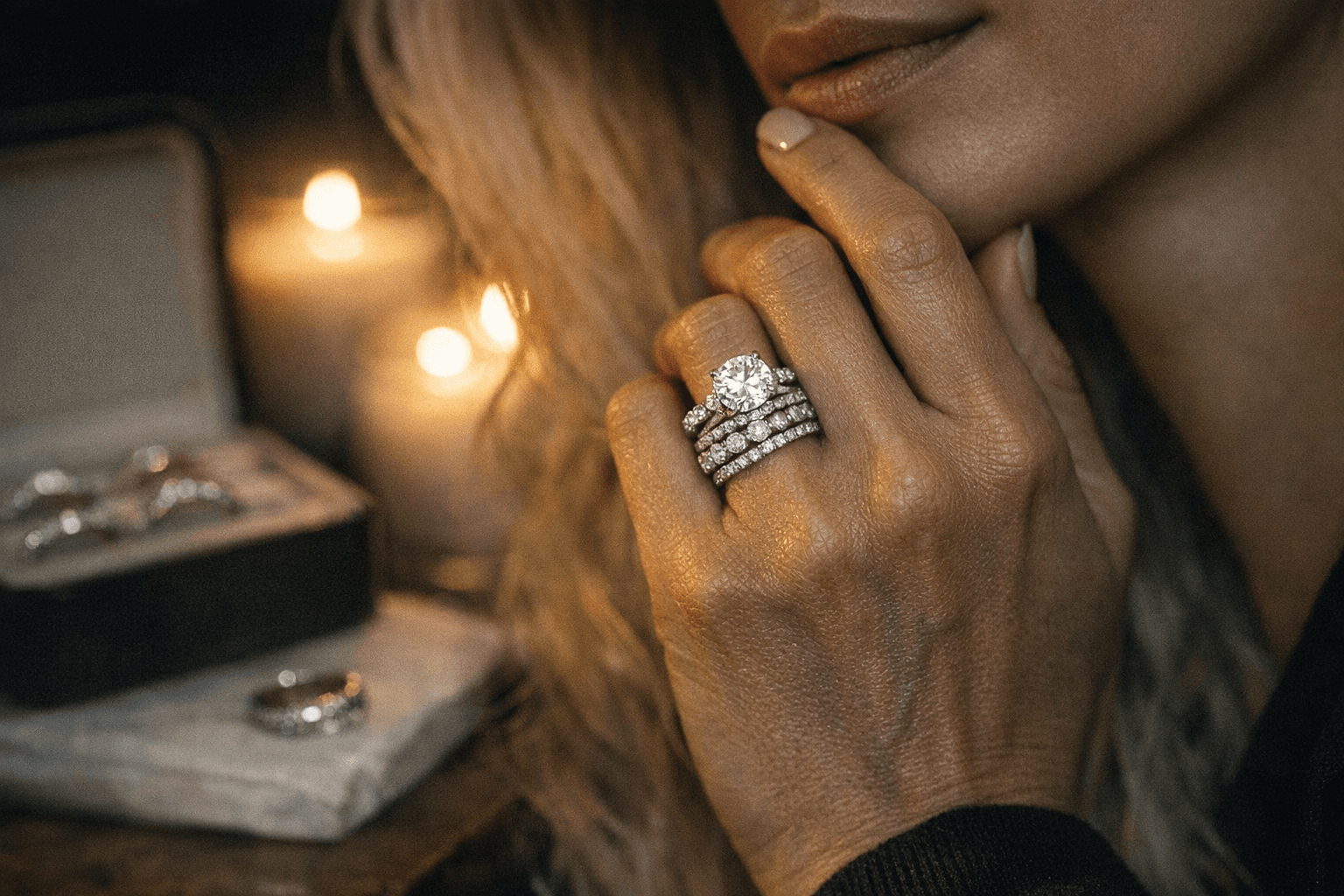
Every stack needs a starting point, and that starting point should be your most significant piece. It might be a cocktail ring, an engagement ring, or a diamond band with unique detailing — something with enough visual weight to organize the composition around it. Once you have established your centerpiece, the surrounding rings exist in service of it: slim stackable rings and simple bands that complement without overwhelming. This is not merely an aesthetic principle. It is the structural logic that keeps a stack from collapsing into visual noise.
If your engagement ring carries substantial presence, restraint in the surrounding bands is wise. But if your engagement ring is simpler, the calculus shifts entirely. A plainer solitaire, say the clean lines of an emerald cut like the Amelia from Sylvie Jewelry's collection, invites wider or more intricate bands alongside it. The B162, featuring a variety of diamond cuts, is exactly the kind of piece designed for this scenario: it adds texture and dimension to a simpler ring while its curved design ensures a comfortable and secure fit alongside other bands. The curve matters more than it might seem — bands that sit flush with their neighbors rather than gapping or pressing against them wear better over years of daily contact.
The taper principle and the spacer band
The single most reliable structural rule in ring stacking is the taper from wide to narrow. A bold band or signet ring belongs at the base, with slimmer rings layered above. This creates a natural visual graduation that reads as intentional rather than accumulated. Fighting that taper — placing a wide band on top of a narrow one, for instance — disrupts the rhythm without offering anything in return.
Between more intricate pieces, a spacer band earns its place. It gives breathing room and keeps the stack from feeling too heavy. Think of it as punctuation: without it, elaborately set bands crowd each other and the individual character of each ring gets lost. Many rings are designed with stacking in mind precisely to address this, making it straightforward to mix widths, finishes, and stone settings within a single composed look.
The approach also extends across the hand, not just a single finger. Balancing a bold index finger ring with finer bands elsewhere distributes visual weight intelligently and gives the entire hand a considered, rather than haphazard, appearance.
Profiles, textures, and what milgrain actually does
Surface character is where stacking becomes genuinely interesting from a gemological standpoint. Mixing flat, domed, and milgrain-accented bands adds variety without feeling mismatched — each profile catches light differently, which means the stack reads with more depth than a row of identical finishes ever could.
The contrast principle works at the texture level, too. Pavé diamonds set in polished gold create immediate visual dialogue: the scattered brilliance of the pavé against the mirror surface of the metal gives the eye movement and interest. A smooth, polished band placed next to the BS2503, which features round brilliant diamonds and milgrain details, creates exactly this kind of dynamic contrast — one that feels intentional and cohesive rather than accidental. The milgrain edge on the BS2503, that fine bead of metal rolled along the band's border, is a detail borrowed from Edwardian and Art Deco jewelry traditions, and it softens the transition between an ornate band and a plain one in a way that a sharply finished edge cannot.
Using ring sets is a reliable shortcut to symmetry when you are building a stack from scratch. Designers who create sets have already solved the proportional and tonal relationships between the pieces, which removes considerable guesswork. That said, the most personal stacks are rarely all-matching sets; they evolve over time, adding bands that mark different moments.
Wedding ring stacks: the personal archive
Wedding ring stacks occupy a specific emotional register that purely decorative stacking does not. They involve layering multiple rings on the same finger, combining wedding bands, engagement rings, and other meaningful pieces such as rings celebrating motherhood or life milestones. The finger becomes a kind of archive: a record of commitments, anniversaries, and significant passages rather than simply a place to display jewelry.
The practical challenge with wedding stacks is maintaining elegance as the stack grows. Pairing similarly bold rings produces a result that can feel too heavy or unbalanced. The solution is contrast: a chunky ring with a prominent gemstone or a thicker band works as the focal point, while delicate bands alongside it create harmony. The B0091, which combines baguette and round diamonds in a slim profile, is an example of a band designed to coexist gracefully next to a larger engagement ring — it adds interest through its mixed-cut design without competing for dominance.
Styling across occasions
The versatility of a well-built ring stack is that it adapts to context without requiring you to swap out every piece. For everyday wear, minimal ring stacking — a few slim bands anchored by your engagement ring — delivers effortless polish alongside gold chains and link bracelets. The stack should feel personal but not labored; the goal is something you put on without thinking too hard.
For evening, the same stack can be amplified. A striking cocktail ring added as an anchor to a wider composition, or diamond tennis bracelets that mirror the light-catching quality of your pavé bands, shifts the register toward something more deliberate and celebratory.
At milestone moments, the jewelry itself becomes part of the occasion's meaning. Stacking combinations built around rings that mark specific passages — a pusheen gift, a significant anniversary band, a stone tied to a particular memory — are where the form reaches its most resonant expression. A ring stack assembled over a decade tells a story that a single, perfectly chosen ring simply cannot.
The best stacks are never finished, which is precisely what makes them worth building carefully from the start.
This article was produced by Prism’s automated news system from verified source data, official records, and press releases, then run through automated quality and moderation checks before publishing. The system is built and supervised by the people who set the standards it runs under. Read our full AI policy.
Did this article answer your question?