Paris Street Style Elevates Jewelry Layering With Mixed Chains and Pendants
Paris Fashion Week's sidewalks proved more instructive than the runways, with layered chains and mixed pendants emerging as the street style's defining jewelry statement.
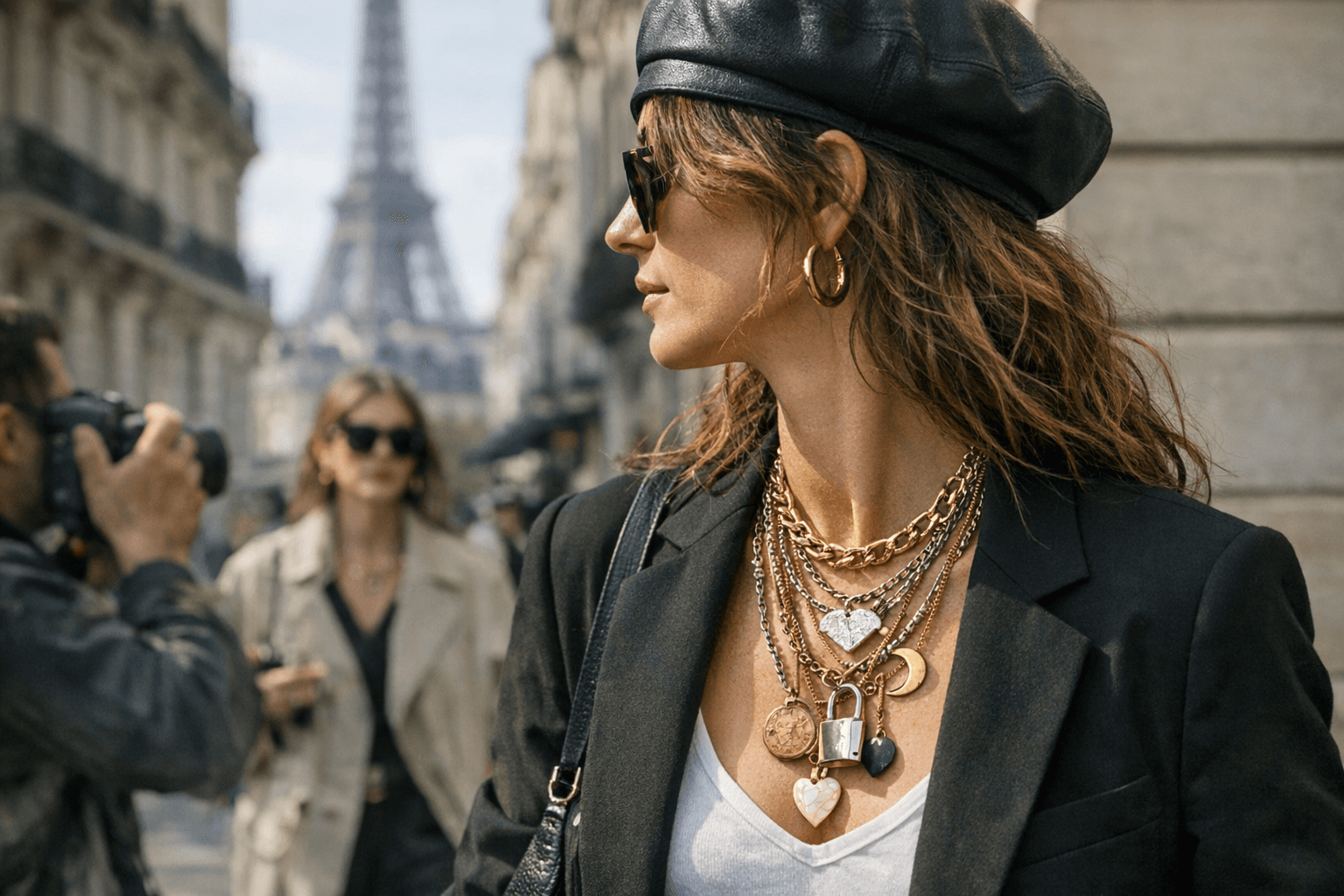
Outside the show venues during Paris Fashion Week, something quietly definitive was happening at the neckline. The street style photographs captured in The Cut's gallery from March 9, 2026 tell a consistent story: the most considered, most copied, most photographed jewelry move of the season is the layered necklace. Not a single statement piece, not a choker worn alone, but a deliberate composition of multiple chain weights, varying lengths, and pendants chosen to work in concert. It is a technique that looks effortless precisely because it is not.
Why Layering Reads as Sophisticated, Not Cluttered
The difference between a layered necklace stack that looks intentional and one that looks accidental comes down to architecture. The looks documented outside the Paris shows demonstrate this principle repeatedly: photographers and editors captioning The Cut's gallery called out multiple chain weights specifically, which suggests that variation in gauge and texture is the structural logic holding these compositions together. A fine cable chain at 16 inches, a slightly heavier link at 18, and a pendant-weighted piece at 20 or 22 inches creates visual rhythm through contrast. When all three chains share the same weight and finish, the eye has nowhere to travel. When they differ, each layer becomes legible on its own terms while contributing to a larger whole.
Material contrast works alongside length variation. A delicate gold vermeil chain reads differently against skin than a polished sterling or a matte oxidized link, and Paris street style has always understood that these distinctions matter. The most compelling looks in the gallery use that contrast purposefully, letting a high-shine chain anchor a pendant with more organic texture, or pairing a geometric link with a fine, almost invisible thread.
The Pendant Question
Pendants are where personal narrative enters the composition, and the Paris street style gallery makes clear that this season's approach favors specificity over scale. Rather than one oversized statement pendant worn alone, the looks captured outside the shows tend toward smaller, more particular charms and drops layered across multiple chains. A single pendant on a 20-inch chain carries more weight, visually and emotionally, when the chains surrounding it are intentionally minimal. Conversely, two or three pendants distributed across different lengths create a kind of conversation, each piece given enough breathing room to be read individually.
The choice of pendant shape matters here. Geometric drops, small medallions, and irregular organic forms all appear in the street style documentation, and they interact differently with chain weight. A flat disc pendant disappears on a chain that's too heavy; a three-dimensional form like a small stone-set drop can hold its own against a chunkier link. Understanding this relationship between pendant mass and chain gauge is the technical knowledge that separates an intentional layer from an accidental one.
Building a Layered Stack: Where to Begin
If the Paris street style looks function as a masterclass, the first lesson is to establish an anchor piece. This is typically the longest chain or the piece with the most visual weight, whether that weight comes from the pendant it carries or the gauge of the chain itself. Everything built above it should work upward in length increments of roughly two inches, which prevents chains from sitting on top of each other and obscures the individual layers that make the composition interesting.
A few practical principles drawn from what the strongest looks in the gallery demonstrate:
- Start with metals in the same family before mixing. Gold-on-gold or silver-on-silver allows texture and weight to do the visual work without the added variable of contrasting metals. Once you're comfortable with that composition, introducing a single piece in a different metal creates intentional contrast rather than confusion.
- Vary your chain types: a trace or cable chain paired with a rope or herringbone introduces texture contrast without requiring different metals.
- Consider the neckline of what you're wearing. The Paris street style context is instructive here: the photographs were taken on real people in real clothes, and the layered necklaces are working against everything from open collars to crewnecks. A V-neckline pulls the eye downward and benefits from a longer anchor chain; a high or crew neckline rewards shorter, more densely layered pieces that sit above the fabric.
- Clasp placement matters when stacking. Layered necklaces have a tendency to migrate, and pieces with lobster clasps sit differently against the skin than toggle or spring-ring closures. If chains are consistently tangling or stacking awkwardly, the issue is often clasp bulk at the back of the neck rather than the chains themselves.
What Paris Street Style Communicates About Investment
The broader significance of what The Cut documented outside the Paris shows is that jewelry layering, as a styling device, democratizes the idea of a "jewelry moment." It does not require a single significant piece purchased for a specific occasion. It asks instead for a collection built over time, where pieces accumulated at different price points, in different contexts, and from different makers can be worn together and recontextualized with each combination.
This is worth considering from a collector's perspective. A fine gold chain purchased years ago and worn solo has a second life as the foundational layer beneath something newer. A pendant with sentimental value that might feel too casual or too personal on its own becomes part of a more complex composition where its specificity is a strength rather than an awkwardness. The Paris street style approach to layering is, in this sense, an argument for buying fewer, better pieces rather than more: a well-made 18-karat gold cable chain at 16 inches will layer under everything and outlast every trend that surrounds it.
The quality markers worth prioritizing when building a layering collection are weight, finish consistency, and clasp durability. Chains that feel substantial in the hand, with even finishing across every link and clasps that close with a definitive click rather than a tentative catch, are the ones that will hold up to daily layering and the friction that comes with it.
The Longer View
What makes the jewelry story from Paris Fashion Week's sidewalks compelling beyond the season is that it reflects how people actually wear fine jewelry now: not saving it for occasions, but assembling it daily, treating each combination as a considered decision rather than a fixed result. The layered necklace looks documented by The Cut aren't prescriptive formulas to be replicated; they are demonstrations of a visual intelligence that can be learned and applied to whatever pieces you already own. The sidewalks outside the shows simply made visible what careful jewelry dressers have always known: the most interesting necklace is rarely a single chain worn alone.
Know something we missed? Have a correction or additional information?
Submit a Tip