Physical Retail Showrooms Are Reshaping How Shoppers Discover and Layer Jewelry
New jewelry showrooms are redesigning their floors around the layered stack, not just the display case: here's how to walk in prepared and leave wearing a cohesive look.
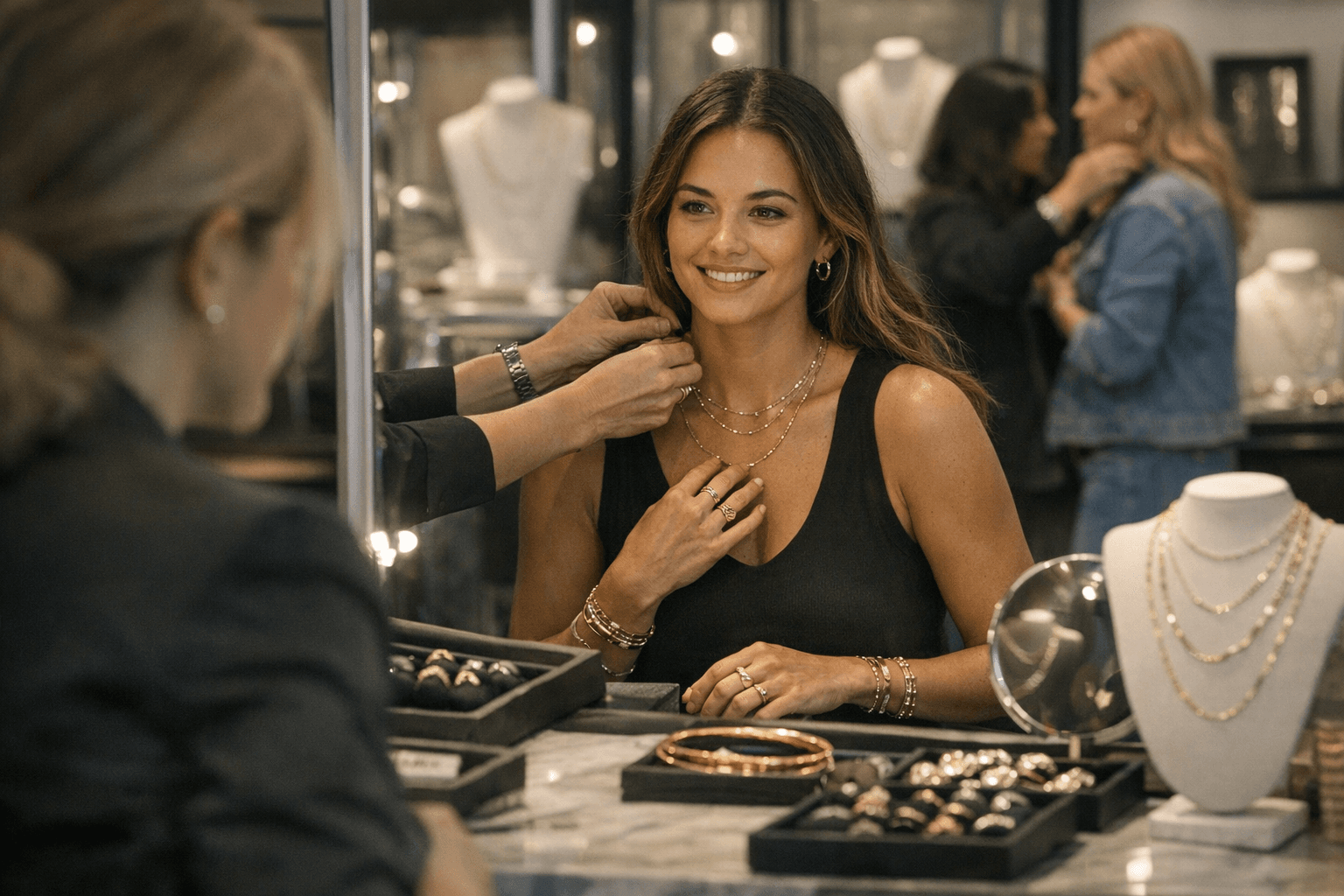
There is a particular confidence that comes from wearing jewelry well, not just wearing it, but composing it. A 16-inch chain resting at the collarbone, a 20-inch pendant dropping to the sternum, a 24-inch lariat falling past both. Each piece distinct in weight and texture, but reading together as one coherent thought. Getting there, in a single visit, without buying four necklaces and untangling them on your bathroom floor for a week, is exactly what a new generation of physical showrooms is now designed to help you do.
The architecture of fine jewelry retail is changing, and the implications for anyone who has struggled to build a stack that works go well beyond aesthetics. Retailers are redesigning floor plans around discovery and hands-on try-on, not locked display cases and one-sided glass. In Beverly Hills, Engelbert has opened a showroom as part of a broader push by fine jewelry brands to claim real-world space for experiential selling. Brilliant Earth, the responsibly sourced fine jewelry brand, unveiled what it calls its "Showroom of the Future" concept in Beverly Hills in January 2026, a model built on appointment-led consultations and hands-on exploration of its ethically sourced collection. In SoHo, Rocksbox, now part of the Signet Jewelers portfolio, opened a dedicated boutique at 239 Elizabeth Street, bringing its try-before-you-buy model off-screen and into a space where in-store styling appointments are a core part of the offer. These aren't isolated experiments. They represent a considered industry bet that shoppers who discover and compose jewelry in person buy more thoughtfully, return more often, and build longer relationships with the brands they collect.
Before You Walk In: The Checklist
The most productive showroom visits are prepared ones. Most people arrive with a vague sense of wanting "something to layer" and leave having bought one piece that may or may not work with what's already at home. Fifteen minutes of preparation changes that outcome substantially.
What to bring:
- Your existing chains, unclasped and tucked into a small pouch rather than worn around your neck. A stylist working with a neck form needs to see them loose to assess how their lengths and weights interact with new pieces.
- Phone photos of your most-worn necklines. A crewneck, a V-neck, and a wide scoop neckline are genuinely different canvases. A 16-inch chain that reads beautifully over a plunging V can disappear into a crewneck entirely. One photo takes thirty seconds and prevents a wrong purchase.
- Screenshots of layered looks that caught your eye, whether on a friend, in an editorial, or saved from social media. You don't need to articulate what you like about them. A good stylist reads the image and translates it into specific questions about length, chain weight, and metal finish.
What to ask for before you leave:
- A chain-length mapping session. Request that the stylist layer at least three lengths on you simultaneously, ideally including one piece you already own, so you see actual spacing rather than trying to visualize it mentally.
- Extender chains. Most showrooms carry them; few customers think to ask. A one-inch extender can be the difference between a 16-inch chain sitting deliberately at your collarbone and choking an inch too high.
- Permanent jewelry options. Welded bracelets and necklaces, fused in-store with a small jeweler's pulse welder rather than finished with a traditional clasp, have moved from novelty to standard service at a growing number of boutiques. One fewer clasp in a stack is not a small thing.
- On-site repair and extension fitting. Chains stretch, lobster clasps weaken, solder joints crack. If you're bringing a beloved piece, ask whether the store's jeweler can assess it while you're there.
- The sourcing story on anything you're seriously considering. More on why this question matters below.
What the New Showroom Format Actually Delivers
The styling appointment, once reserved almost exclusively for bridal consultations, is now offered as a general service at an expanding number of experiential jewelry boutiques. The format is direct: you book a time slot, a dedicated stylist meets you, and the goal is a finished, wearable look rather than an open-ended browse with no resolution. The most useful appointments run forty-five minutes to an hour, long enough to work through necklace lengths, consider ring stacking on both hands, and test how a new cuff or bangle behaves beside bracelets you already own.
Try-on bars, a concept adapted from eyewear retail and applied to fine and fashion jewelry, let you work independently or with light stylist guidance through a curated selection of pieces organized by metal type, chain weight, or price point. The chain-weight category is the most instructive. An ultra-fine 0.5mm cable chain and a 3mm rope chain can share a length but occupy completely different visual territory, and understanding that difference by feel, by actually wearing both simultaneously, is something no product page can replicate.
Permanent jewelry has genuinely earned its place as a layering tool. The appointment takes roughly fifteen minutes: you select a chain in gold-filled, sterling, or solid gold, the jeweler sizes and positions it, and a small pulse welder fuses the ends without any clasp hardware. For layerers, the benefit is structural. A permanent fine chain reads as part of your skin rather than something you put on, creating a visual anchor against which every piece you layer on top reads as deliberate. Prices vary with metal and gauge. Gold-filled permanent bracelets typically start around $50 to $75; solid gold options with charm additions can run $300 and above. The chain is snippable if you change your mind, but most people don't.
Building the Stack: The Method
The goal of a well-layered necklace arrangement is deliberate spacing, not maximum coverage. A gap of roughly two inches between each chain length gives the eye a place to rest and lets each piece register independently rather than blurring into visual noise. Blue Nile, tracking wearability trends for 2026, notes that the most resonant layered looks this year favor a relaxed, "thrown on" quality, mixing three necklaces of genuinely different lengths without forcing them to match in metal or pendant style. Introducing a lariat, which creates a different silhouette at the same length as a standard pendant chain, adds visual variation without requiring a fourth length in the stack.
The practical method runs bottom-up: anchor the longest piece first and layer shorter chains over it. If two pieces sit so close in length that they tangle within an hour, one of them needs to move. A stylist working with a neck form and good overhead light will identify these tangling risks in seconds; you'll miss the same problem entirely in a dressing-room mirror.
The Question You Should Always Ask
As showrooms grow more ambient and experience-led, the pleasure of the appointment can make it easy to skip the sourcing conversation. That would be a mistake. Fine jewelry carries a supply-chain story that begins long before the piece reaches the tray. Gold mining is energy- and water-intensive. Diamond supply chains have spent more than two decades building certification frameworks, and those frameworks don't yet reach every market. Ask directly: is this gold certified by the Responsible Jewellery Council or Fairmined? Is this stone lab-grown or mined, and can you show me the documentation? Brilliant Earth, whose entire retail model is built on responsibly sourced stones and traceable metal origins, designed its Beverly Hills showroom explicitly to make that conversation central rather than incidental. A brand with clean answers will give them without hesitation. Vague language about "ethical sourcing" with no named certifying body is a gap worth pressing.
The physical showroom is not a guarantee of ethical practice, but it is a better venue than a product page for asking hard questions and registering what the answers feel like in real time. That accountability, alongside the welding torch and the neck form, is the strongest argument for making the appointment in person.
This article was produced by Prism’s automated news system from verified source data, official records, and press releases, then run through automated quality and moderation checks before publishing. The system is built and supervised by the people who set the standards it runs under. Read our full AI policy.
Did this article answer your question?