Ring Stacking in 2026 Favors Intentional, Story-Driven Personal Curation
Storied stacks of slim bands, sculptural anchors, and chosen gemstones are displacing pre-made ring sets in 2026; personal curation is the new fine jewelry currency.
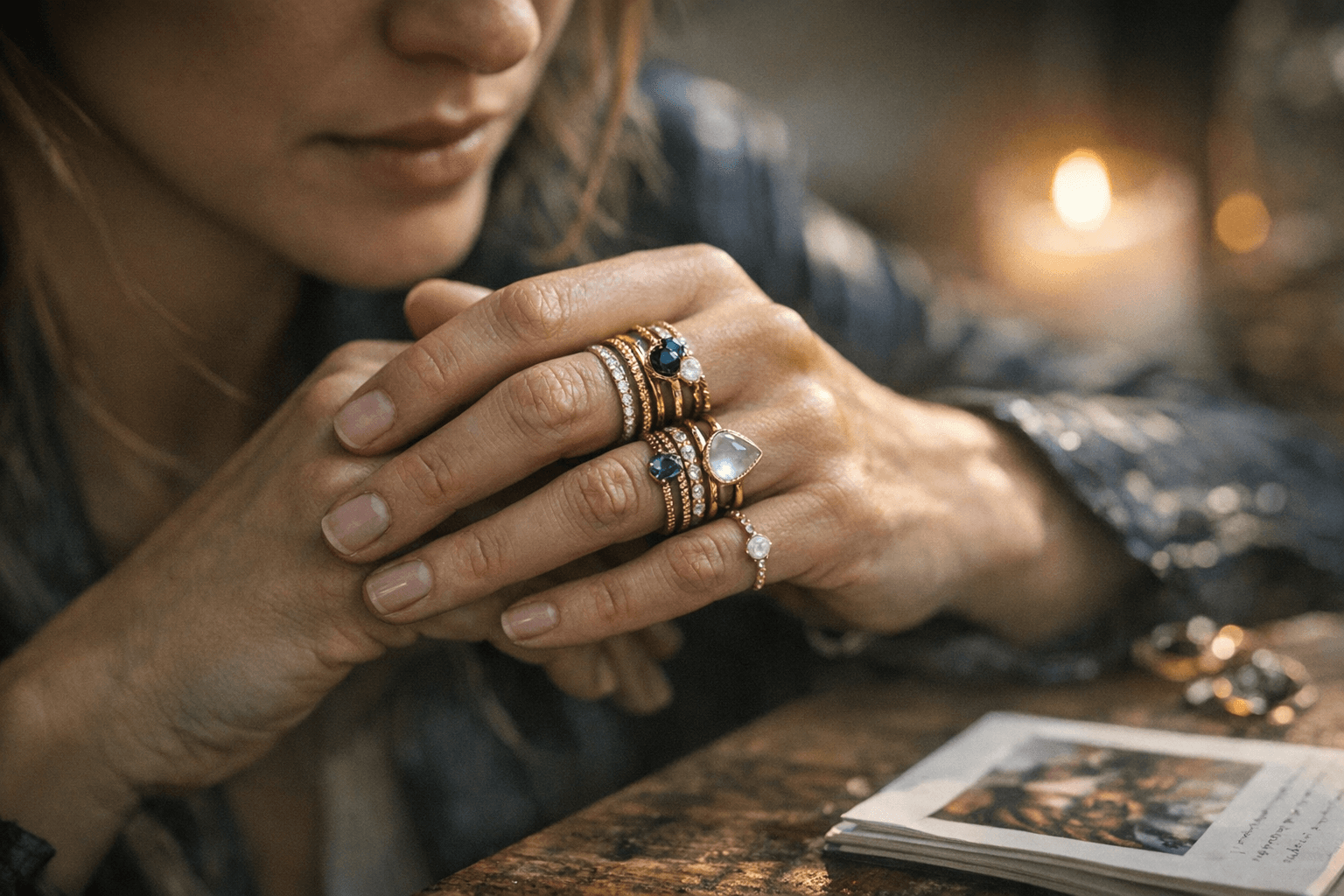
There is a particular grammar to the way rings are being worn right now. Not the visual shorthand of a matched bridal set or the restless accumulation of pieces without logic, but something more deliberate: a slim band chosen for its hammered surface, a sculptural form that anchors the arrangement, a colored stone that holds private significance. In 2026, the ring stack has become the most personal piece of jewelry you can build, and the rules governing how it is assembled have changed considerably.
The Philosophy Shift: From Sets to Stories
The defining impulse this year is a decisive move away from pre-curated retail sets toward stacks assembled ring by ring, each piece carrying specific weight. Where matching sets once offered convenience, they now feel too resolved, too complete to allow the wearer's own narrative to enter. Designers and founders across the fine and demi-fine spectrum have described the same shift: consumers are building rather than buying a look. Every ring must earn its place.
Stack recipe: A signet ring engraved with an initial or significant date; a slim pavé band in the same metal; a birthstone cabochon in a low bezel setting. Three rings, three references, one composition that reads as fully personal even when each component comes off the shelf.
Wear it for: desk-to-dinner dressing, when a single gold chain and a clean blazer need something on the hands that communicates a genuine point of view.
The Foundation Band: Where Every Stack Begins
The practical entry point to intentional stacking is the foundation band: the ring that establishes metal tone, surface finish, and width reference for everything that follows. A wider, textured option such as a hammered or engraved band creates visual weight that thinner rings can cluster around without competing. A slim plain band in polished yellow or white gold invites more variety and a lighter overall hand.
Stack recipe one: A 3mm hammered yellow gold band as anchor; two 1.5mm twisted wire bands in the same metal; one thin white gold pavé band for tonal contrast. The mixed texture keeps the combination from reading as a set, even when all four sit on the same finger.
Stack recipe two: A plain 2mm band in rose gold; a thin bezel-set turquoise or malachite ring; one fine engraved midi band worn above the knuckle. The color breaks the all-metal register and gives the stack a specific personality.
Wear it for: weekend dressing, with stacked linen or a simple T-shirt and white sneakers, where rings carry the full expressive load.
The Sculptural Anchor: One Ring That Commands the Stack
The sculptural anchor ring is the concept separating a considered stack from a mere accumulation. It is the single ring with real visual complexity: a bypass silhouette, an architectural open-form band, a piece with negative space cut into the shank, or an abstract shape that resists easy categorization. Its role is to provide one decisive focal point; the slim bands surrounding it then add rhythm and restraint.
Stack recipe: A sculptural bypass or open-form ring in 18k yellow gold on the middle finger; a plain thin band on either side; a slim diamond pavé band on the index finger as a quiet echo. The result reads as deliberately composed rather than casually accumulated.
Wear it for: evenings where the outfit is pared back to a column dress or a well-cut suit jacket, and the jewelry needs to carry structural authority on its own.
Mixing Metals and Textures: The Anti-Matchy Approach
The convention that a stack must be tonally unified has effectively dissolved. What designers are describing instead is a more layered interplay of metal tones and surface finishes: yellow gold, white gold, and sterling silver coexisting because the wearer chose each piece for a deliberate reason, not because they coordinate. Surface variation matters just as much as metal tone; polished against matte, engraved against smooth, braided against plain.
This direction was visible across the Paris Fashion Week F/W 2026 front rows, where stacked jewelry appeared alongside the season's broader emphasis on textural contrast and intentional eclecticism. At the Dior show, guests including Anya Taylor-Joy reinforced the cool-metal, multi-ring aesthetic that she then carried to the Vanity Fair Oscar Party, where she wore rings in platinum set with diamonds. That combination, varying band widths in a single cool metal family with different levels of sparkle, is among the cleanest stacking archetypes of this moment.
Stack recipe: A yellow gold signet ring on the ring finger; a rose gold pavé eternity band on the middle finger; a sterling silver twisted midi ring worn above the knuckle of the index finger. Three metals, three textures, one coherent hand.
Wear it for: gallery openings, creative industry events, any environment where a look rewards a second, slower look.
Midi Rings and the Multi-Finger Edit
Thin bands worn above the knuckle at the midi position are among the most flexible tools in the current stacking vocabulary. They extend visual interest across more than one finger without requiring a full committed stack on every hand position. The editorial approach favored right now is to anchor two or three fingers with foundation bands and use midi rings on one or two others to distribute the composition across the hand.
Stack recipe one: On the ring finger, two slim bands (one plain, one pavé); on the middle finger, a foundation band plus one midi ring at the knuckle; on the index finger, a single sculptural or gemstone ring. Leave the pinky and thumb bare, or add one very fine plain band to close the composition.
Stack recipe two: For a lighter, more graphic look: a single bold signet or gemstone ring on the index finger as sole anchor, with thin midi bands on the ring and middle fingers worn only above the knuckle. High contrast, low density, maximum intention.
Wear it for: occasions where the outfit carries strong structure, a strapless dress, clean tailoring, anything architectural, and the hands need jewelry complex enough to hold their own without adding visual chaos.
The Demi-Fine Entry Point: A Stack at Every Budget
The most significant structural change in ring stacking is the expansion of the demi-fine tier, which has placed sterling silver vermeil, gold-filled, and solid 9k gold pieces within reach of anyone building a first stack. Brands including Mejuri, Missoma, and Ana Luisa have made this category genuinely competitive, with the result that experimenting with stack compositions no longer requires fine jewelry pricing at every position.
Recreating the platinum-and-diamond architectural logic that Anya Taylor-Joy wore at the 2026 Vanity Fair Oscar Party is now possible across three price tiers:
- Entry tier: Sterling silver vermeil plain band plus a white topaz pavé band plus a slim plain stacking ring. All three available from demi-fine brands, typically under $200 for the complete set. The tonal logic is identical to the fine version; only the material changes.
- Mid-range tier: Solid 14k white gold plain band plus a diamond-chip pavé band plus a thin bezel-set white sapphire ring. The investment runs roughly $400 to $900 for the three pieces, each capable of standing alone and holding its value.
- Fine jewelry tier: Platinum or 18k white gold bands set with pavé brilliant diamonds, or a single fine diamond solitaire band as the anchor. Here the investment reflects permanence: pieces worn, inherited, and worn again.
The point is not replication but architectural understanding: cool metal tone, varying widths, deliberate restraint. That logic is transferable at any budget, and the best version of it is always the one built gradually, each ring arriving because it fits, because it meant something, because the combination felt more true than any pre-assembled set ever could.
Know something we missed? Have a correction or additional information?
Submit a Tip