Sculptural Metalwork and Beaded Designs Lead Jewelry Layering Trends for Retailers
Sculptural metalwork and beaded jewelry are rewriting the layering playbook for Spring-Summer 2026, as runway signals from Balenciaga to Chanel hand retailers a clear stocking strategy.
There is a particular confidence that comes from wearing jewelry well — not accumulated, but composed. For Spring-Summer 2026, that composition has shifted decisively: the runway conversation is no longer about delicate chains and quiet accents, but about pieces that carry architectural weight, speak in color, and earn their place as the outfit itself. Spring 2026 is the season where jewelry stops "finishing" an outfit and starts being the outfit. For retailers and stylists, understanding how to interpret these signals — specifically the twin forces of sculptural metalwork and elevated beaded design — is the difference between a case full of inventory and a floor that actually sells.
The Metal Movement: Architecture Over Ornament
The most obvious shift this season is that of sculptural movement, which treats precious metals more as fluid objets d'art than jewels. This is not bold jewelry in the traditional sense of a thick chain or a cocktail ring. It is something more considered: metal shaped by instinct, surface, and form. The sculptural movement reimagines metal as fluid art, shaped by instinct rather than precision — surfaces twist, curve, and fold in ways that feel organic and tactile.
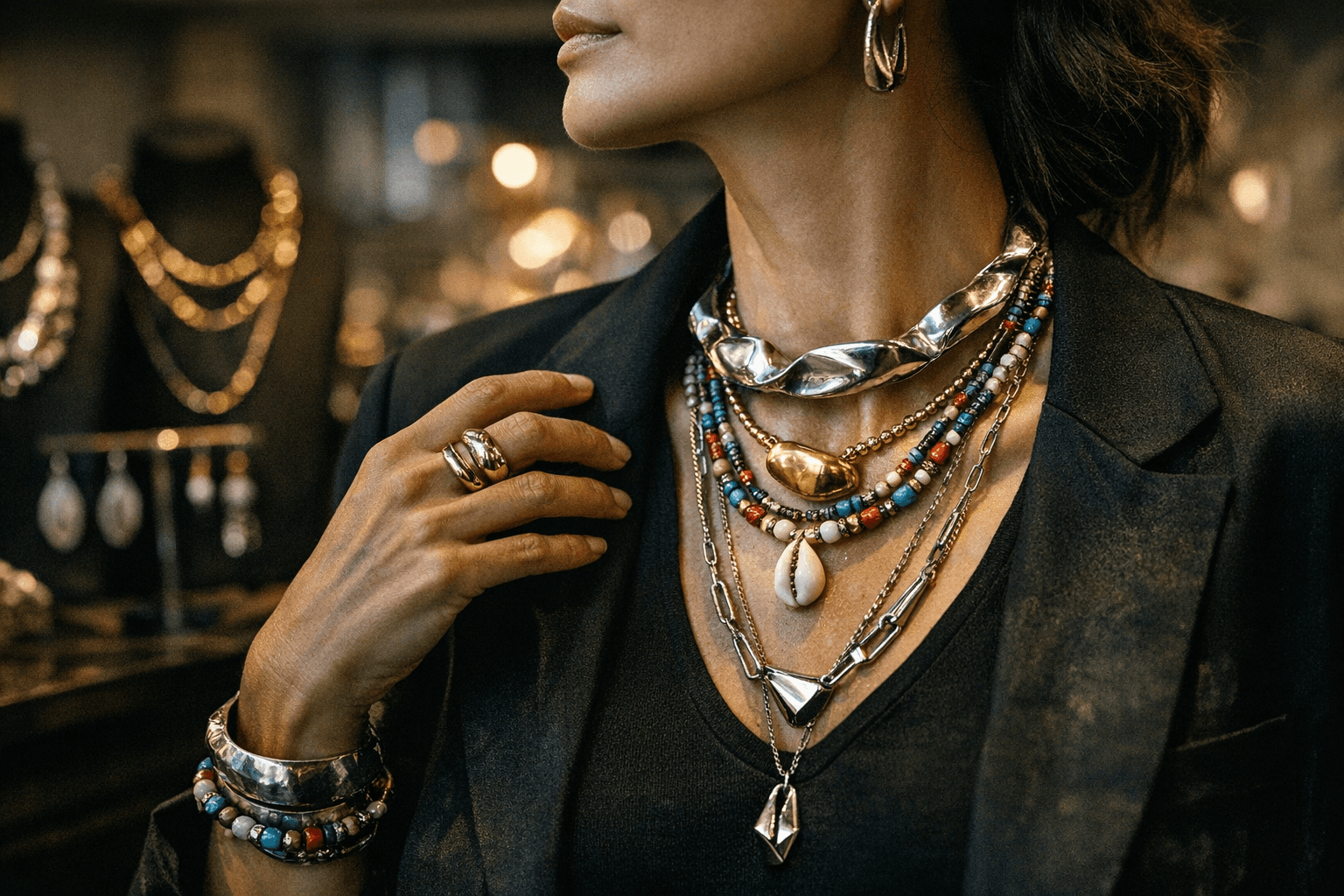
The runway evidence is specific. At Balenciaga, Pierpaolo Piccioli's debut collection reimagined the necklace as modern armor, sending models down the runway in metal collars and thick gold links that wrapped their bodies with architectural precision. This move toward soft geometry was mirrored at Michael Kors and Ralph Lauren, where hefty golden pebbles and faceted silver shapes served as the focal points of otherwise minimalist looks. What unites these disparate houses is an approach to metal as material rather than finish: the 2026 interpretation is not about delicate gold whispers — it is about weighted, architectural presence: thick hoops with hammered texture, asymmetrical drops that frame the face with genuine dramatic intent, and sculptural forms that read from across a room.
Big, bold metal is back. Elsa Peretti-esque sculptural silver was a standout trend on the Spring 2026 runways, but Nordstrom fashion director Linda Cui Zhang says not to overlook vintage-inspired gold. Zhang argues that "deco-inspired gold jewelry makes an impact and an elegant accent," noting that "from a brooch, chunky ring, or cuff, a bold gold piece adds warmth to looks." For retailers, this points to a clear stocking priority: pieces with physical presence, not just visual flash.
Beaded Jewelry Gets Its High-Fashion Upgrade
This year, a humble item has infiltrated some of the most high-end designer labels: beads. The shift is harder to overstate. Candy-colored strands and natural stone necklaces, once associated with coastal markets and summer camp crafts, have moved firmly into the fine jewelry and luxury conversation. Jewelry in candy-hued and mismatched beads is getting the grown-up, handcrafted treatment thanks to buzzy brands like Don't Let Disco and Eliou — and even heritage houses like Chanel and Saint Laurent are participating in the trend, with brightly-colored bead, stone necklaces, and chandelier earrings seen on their Spring 2026 runways.
The styling logic behind this elevation is rooted in color and expressiveness. One stylist puts it directly: "Beads and natural stones add depth and personality, making jewelry feel expressive and personal rather than overly precious." A candy-colored strand can brighten neutrals or dark winter layers, while a single stone pendant can add a creative flair to everyday pieces — and layering a few strands creates an artful stack.
For retailers, the beaded category also carries practical advantages. This trend is not about maximalism for its own sake; it offers accessible ways to introduce color into an otherwise minimal or metallic jewelry wardrobe, and styling experts recommend pairing a bead-accented piece with a plain metal accessory to maintain a contemporary and wearable look. Merchandising strategy should follow suit: stock carabiner necklaces, charms, beaded bracelets, and beaded necklaces that layer easily with existing metal inventory, and merchandise beads next to simple steel chains to encourage "add one pop of color" upsells.
Layering as the Central Skill
Both trend pillars converge on a single practice: layering. Stacking isn't new, but for 2026 it's bolder — the SS26 runways showed necklaces layered over necklaces, rings on multiple fingers, and bracelets worn with cuffs: less delicate, more deliberate.
The craft of layering sculptural and beaded pieces together requires some restraint. Mixing up the weight, material, and thickness of the pieces you're layering helps create a more visually appealing result while adding dimension and balance — and three is the magic number when it comes to layering. At the neckline specifically, a wilder, less choreographed approach has been seen on the runways of Blumarine, Celine, and Dsquared2 — layered over simple, neutral backdrops for maximum impact.
The statement pendant has also re-emerged as a layering anchor. The statement pendant has emerged as the lead note of 2026, specifically designed to be worn as a protective or sentimental totem — these long-line pieces were a staple on the runways of Michael Kors, Tory Burch, and Hermès, styled unexpectedly over everything from crisp white tops to sporty tees. Marissa Galante Frank, Bloomingdale's beauty and accessories fashion director, captures the shift well: "Leather cord pendants feel like the modern answer to statement jewelry."
Color, Gemstones, and the New Palette
The sculptural and beaded movements share a color story that retailers need to understand at the material level. Sapphires, emeralds, amethysts, and turquoise are appearing in sculptural yellow gold settings across the SS26 collections at Balmain, Michael Kors, and Etro — and enamel is following the same trajectory, with designers sweeping vivid greens and cobalt blues across curved metal in forms that feel painted rather than set.
Gemstones are being cut in unexpected forms, and mixed tones build layered depth — jewelers are blending soft pastels with polished silver, or pairing vivid greens and corals with warm metals, with the focus on harmony through contrast, using hue to define emotion and movement. For layering purposes, choosing shades that share undertones creates depth without visual noise.
Mixed Metals: Permission Granted
One of the most commercially significant shifts for retailers is the normalization of mixed-metal styling. Mixed-metal styling is one of the defining jewelry trends of 2026 — the runways and fine jewelry market are both showing it as the smart approach: gold earrings with a silver chain necklace, a warm-toned cuff beside a white-gold ring, two-tone pieces that layer both within a single construction.
Mixing yellow gold, silver, rose, and even blackened steel is highlighted as a major style direction, allowing for greater versatility and personalization — stainless steel's neutral tone makes it especially compatible, enabling wearers to effortlessly blend different metals for a balanced yet interesting look. On the floor, this translates to a clear merchandising instruction: merchandise by layered sets instead of single pieces, show two to three chains together, provide "mixed metal starter sets," and use signage like "Yes, you can mix metals" to remove customer hesitation.
What Retailers Should Stock and How to Show It
The Spring-Summer 2026 layering story is built on a few non-negotiable inventory pillars:
- Sculptural cuffs and collars in yellow gold and architectural silver, particularly forms with hammered, matte, or irregular surfaces
- Beaded necklaces in natural stones and candy-colored strands, designed to sit alongside existing metal inventory
- Long pendant necklaces on leather cord or chain, finished with a charm, stone, or medallion
- Statement earrings with genuine dramatic scale, from Saint Laurent's gilded sculptural cross-shaped drops to Valentino's geometric shapes
- Mixed-metal sets that give customers a curated starting point for layering at home
Runway reports point to a new mood: intentional maximalism — pieces that feel collectible, personal, and styled with purpose rather than piled on at random. That distinction matters enormously at the point of sale. Selling jewelry is no longer just about carat weight or metal quality — it is about listening, storytelling, and helping customers articulate what they want their jewelry to represent, with the most successful assortments balancing beauty with meaning.
The retailers who convert these runway signals into real sales will be the ones who display sculptural and beaded pieces together, who frame layering as a learnable skill rather than a lucky accident, and who understand that the customer walking through the door in spring 2026 is not looking for one perfect piece — she is building a composition.
This article was produced by Prism’s automated news system from verified source data, official records, and press releases, then run through automated quality and moderation checks before publishing. The system is built and supervised by the people who set the standards it runs under. Read our full AI policy.
Did this article answer your question?