Sia Taylor’s Blossom Tears collection layers mixed metals with a soft fade
Sia Taylor’s Blossom Tears turns mixed metals into a soft gradient, so yellow gold, platinum, and silver layer like fading petals.
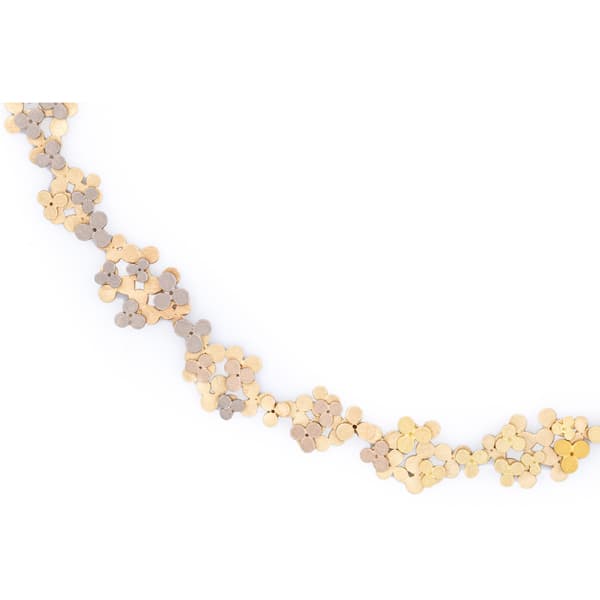
After a period she calls “creative hibernation,” Sia Taylor returns with Blossom Tears, a collection that makes mixed-metal styling feel tender rather than calculated. The pieces move through 14k to 24k yellow, white, and rose gold, then into platinum and silver, creating a fade that reads like light shifting across a flower rather than a stack assembled in a hurry.
A fade palette that does the styling work
Taylor has long treated jewelry as storytelling and escapism, and Blossom Tears carries that idea into the metal itself. The signature fade palette gives the eye a built-in path from warmer tones to cooler ones, so a necklace line, ring stack, or wrist combination can progress naturally instead of relying on abrupt contrast. In mixed-metal dressing, the most convincing combinations often look as if they were found in the same landscape rather than matched from the same tray.
The specific material range is what gives the collection its authority. Yellow gold shifts from 14k to 24k, white gold and rose gold add intermediate notes, and platinum and silver cool the finish at the edge. In practical styling terms, that means the collection already suggests how to layer it: start with gold, soften the transition with rose, and finish with platinum or silver so the stack feels graduated rather than accidental.
Blossoms, loss, and the new language of layering
Blossom Tears is built around the poetic notion of blossoms as the tears of a tree. Taylor’s own language around the collection centers on “tiny golden forms falling softly,” with tenderness and loss at the core of the idea. On the body, the jewels drift into view rather than shout for attention.
The blossom motif is useful because it gives mixed metals a narrative reason to coexist. Petals do not arrive in one flat color, and neither does this collection. The softer forms let yellow gold, white gold, rose gold, platinum, and silver read as variations on a theme, which is exactly why the combinations feel nuanced instead of disjointed.
From Somerset, with hand-worked detail
Taylor works from Somerset, England. A 2023 Forbes profile put her business at 15 years old, and her jewelry is made in England by a team of artisan jewelers who solder tiny components by hand. Those tiny hand-soldered components remain visible in the final effect.

Taylor is a British designer who graduated from the Royal College of Art sculpture school before launching her eponymous line after a final-year trip to Botswana. The silhouettes often echo insect eggs, seeds, grasses, and the internal structures of plants. The forms are organic, clustered, and slightly irregular, so the color variation feels like part of the natural structure.
What the price range tells you
At Liberty, Sia Taylor pieces are listed at roughly $1,500 to $6,750. That spread keeps the line firmly in fine-jewelry territory, where the value comes from precious-metal content, hand assembly, and the complexity of the design language. The collection moves from smaller pieces into more elaborate work without losing its core identity.
The pricing makes sense when set beside the materials. Pieces built from combinations of gold, platinum, and silver, and finished with hand-soldered detail, sit in a different category from plated fashion jewelry or mass-market layered sets. The range gives the fade palette room to operate across scales, from a single blossom accent to a more substantial composition that uses metal transitions as its main visual gesture.
How to wear the mix so it feels intentional
In 2026, with mixed metals, layering, and sculptural, nature-driven designs still shaping the conversation, the easiest way to read Blossom Tears is to follow its own internal gradient. Let yellow gold lead if you want warmth near the face or center of a stack, then introduce rose gold as a bridge and end with platinum or silver for a cooler finish. That sequence mirrors the collection’s own movement and keeps the eye traveling through the piece rather than stopping at a hard boundary.
The blossom motif helps here too, because it favors softness over symmetry. A stack built around Taylor’s language will usually look strongest when one metal dominates and the others appear as echoes, not rivals.
This article was produced by Prism’s automated news system from verified source data, official records, and press releases, then run through automated quality and moderation checks before publishing. The system is built and supervised by the people who set the standards it runs under. Read our full AI policy.
Did this article answer your question?