signet rings return as stackable anchors in jewelry layering
The signet ring is back, but now it works as the clean, personal anchor in a layered hand. Its new appeal lies in proportion, placement, and a taste for mixed metals.
The signet ring is no longer behaving like an heirloom reserved for a velvet box. In the current layering mood, it reads as a deliberate anchor, the kind of ring that can steady a stack of slimmer bands while still carrying the authority of a single, recognizable form. That shift makes sense in a market where jewelry keeps outperforming fashion and design, culture, and personal meaning are driving the conversation.
Why the signet feels current again
What looks new is often a fresh styling instinct applied to an old shape. A signet has always had a strong silhouette, but fashion now favors pieces that feel intentional rather than decorative for decoration’s sake, and that is where the signet lands beautifully. It gives a hand stack a focal point without needing a stone, a halo, or extra ornament to announce itself.
The broader jewelry mood helps explain the comeback. Personalization remains central, layering is everywhere, and statement pieces are being worn less as isolated trophies than as part of a considered composition. Yellow gold is especially persuasive here: it gives a signet warmth and visibility, then allows neighboring bands in white metal or textured finishes to create contrast rather than competition.
A form with deep roots and a new life
The signet ring’s modern return is striking precisely because the form is so old. The Metropolitan Museum of Art has a New Kingdom example from ancient Egypt dated to around 1353 to 1323 B.C., a reminder that the ring began life as a tool of identity as much as adornment. At the British Museum, one signet is identified as a personal seal used to stamp wax on letters, which captures the signet at its most practical and authoritative.
The British Museum’s Waddesdon Bequest extends that lineage across Europe, with engraved, intaglio, and enamelled signet rings made in the Netherlands, France, and Italy between 1400 and 1575. As wax sealing declined in the late nineteenth century, the signet shifted from functional instrument to symbolic accessory, and from the 1970s onward women broadened the category further, often replacing crests with initials and monograms. That evolution matters now: the ring’s meaning has moved from inherited authority to chosen identity, which is exactly what modern stacking favors.
How to wear a signet in a stacked-hand look
The most convincing signets today are not oversized for the sake of drama. They are proportioned so the face feels substantial, but not bulky, with enough metal weight to read clearly beside thinner bands. That balance is what keeps the ring from looking costume-like when it is worn with more delicate pieces.
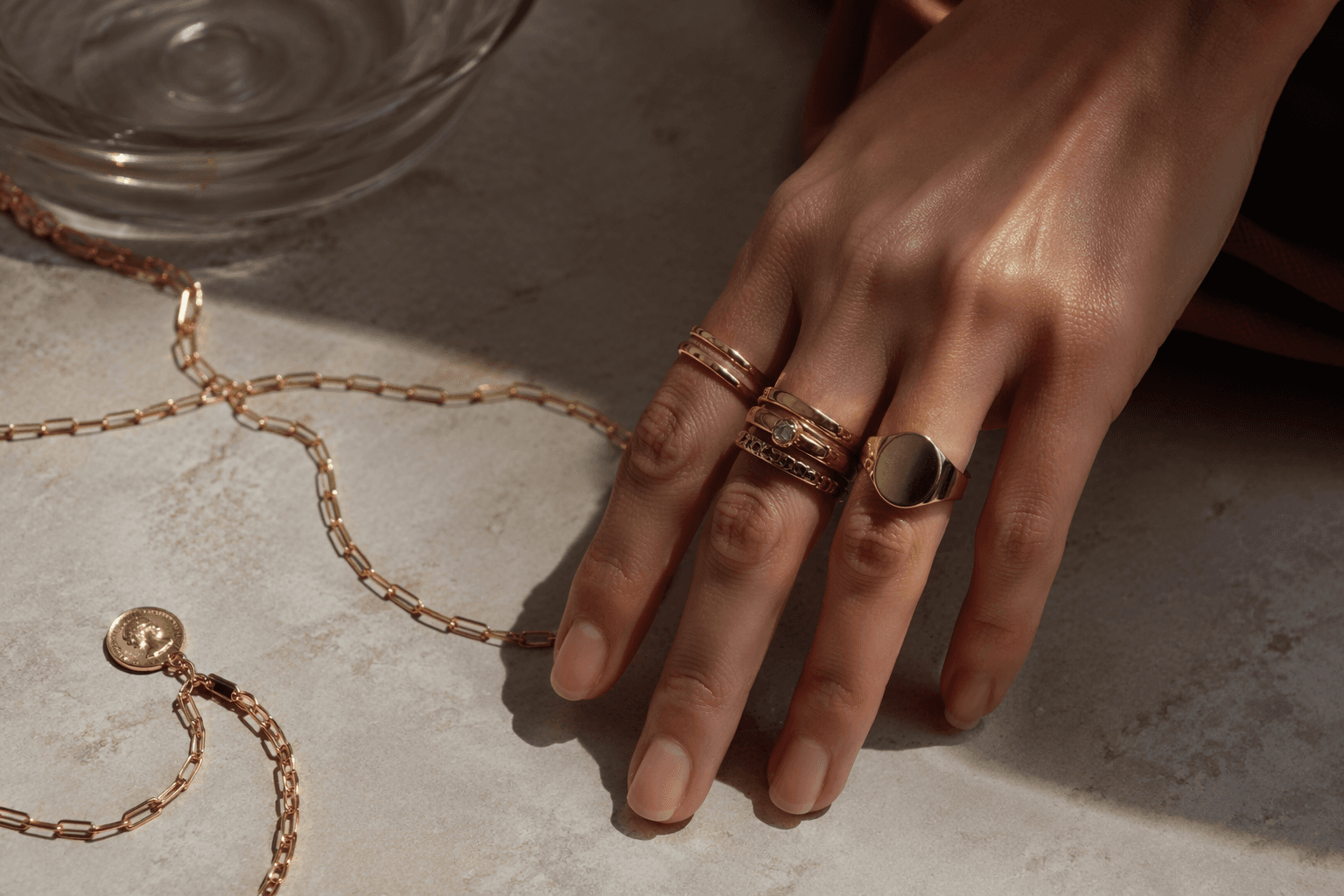
Placement changes the message immediately. On the pinky, a signet feels private and understated, almost coded. On the index finger, it turns architectural and assertive, which can be especially effective when the rest of the stack stays slim and restrained. On the ring or middle finger, it becomes the visual center of the hand, the piece that sets the rhythm for everything around it.
A good stack around a signet should feel edited, not crowded. The signet supplies presence, while one or two slimmer bands introduce texture, shine, or contrast. If the signet is yellow gold, a narrow white-gold or silver band nearby can sharpen the look; if the signet is silver or platinum, a slim gold ring can warm the composition without flattening it.
- Let the signet do the heavy visual lifting, then keep adjacent bands cleaner and slimmer.
- Repeat one metal somewhere in the stack so the hand feels connected, not mismatched.
- Use one mixed-metal accent if you want the look to feel current rather than formal.
- Choose a finger that changes the attitude of the ring, from intimate on the pinky to declarative on the index.
What to look for when buying one
The best signets still honor the logic of the original form. Look for a face that is crisp and purposeful, whether it carries initials, a monogram, or a plain polished surface that leaves room for engraving later. The shank should feel substantial enough to support the top, because a signet depends on proportion more than sparkle.
Craftsmanship matters because the ring’s appeal comes from silhouette and finish. A well-made signet should sit cleanly on the finger, with a face that is neither so tiny it disappears nor so large it overwhelms the hand. The point is not to mimic a crest from another century, but to translate the authority of that shape into something personal enough to wear every day.
For collectors, that dual identity is part of the value. The signet is one of the few ring forms that can move between symbolism and styling with no loss of character. It can sit beside fine pavé bands, a plain wedding band, or a second signet in another metal, and still read as the decisive piece in the mix.
The new signet is about authorship
What makes the signet ring feel fresh is not nostalgia, but control. It has returned in a moment that prizes jewelry with a point of view, and it answers that brief with clarity: a strong shape, a personal surface, and enough history to feel meaningful without becoming stiff. In a stacked-hand era, that is exactly the kind of anchor a collection needs.
This article was produced by Prism’s automated news system from verified source data, official records, and press releases, then run through automated quality and moderation checks before publishing. The system is built and supervised by the people who set the standards it runs under. Read our full AI policy.
Know something we missed? Have a correction or additional information?
Submit a Tip