TEFAF Maastricht 2026 Draws 50,000 Visitors, Reports Strong Sales
Over 50,000 visitors crowded TEFAF Maastricht this month, buying five-figure artist-made gold by Braque and Max Ernst; their collector logic is the clearest layering guide available right now.
There is a particular kind of confidence that comes from wearing a single, considered piece of jewelry — not just wearing it, but composing it. At TEFAF Maastricht this month, 50,000 visitors walked past that confidence under glass, and a significant number of them bought it. What they chose, and why, carries real information for anyone trying to build a personal jewelry wardrobe that reads as intentional rather than accumulated.
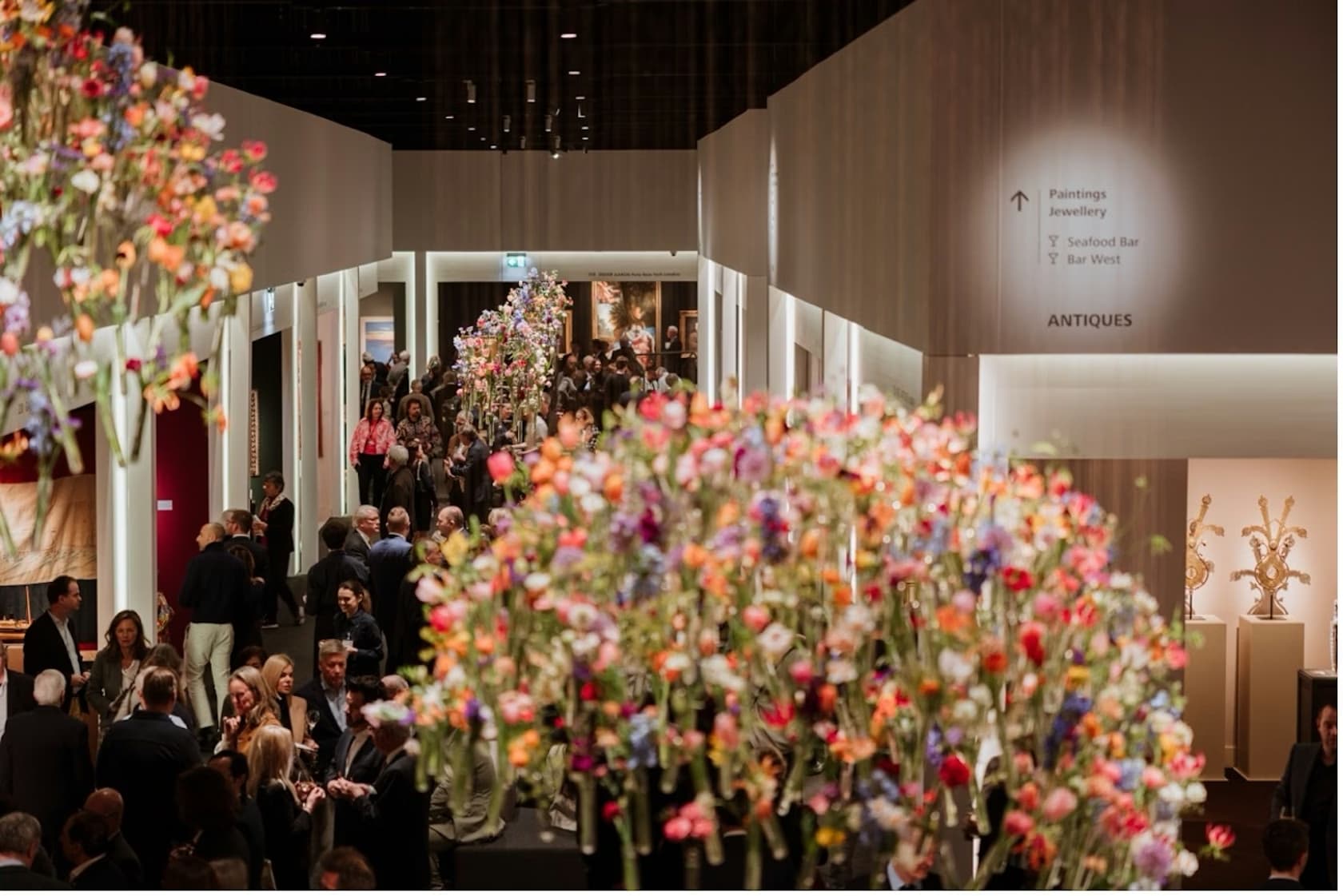
The 39th edition of the fair ran March 12–19 across Maastricht's exhibition halls, with 277 galleries presenting works spanning 7,000 years. More than 450 museums attended, including 67 patron groups; the Metropolitan Museum of Art, Rijksmuseum, Louvre, Musée d'Orsay, and Victoria and Albert Museum all sent representatives. Strong sales were reported across categories, but the jewelry and design booths carried a specific signal for the current moment.
Among the stands drawing the most sustained collector interest was one classified not under jewelry but under design: Didier Ltd., the UK gallery whose 2026 presentation was organized around the theme "Gold in the Hands of Artists." Roughly 150 works filled the booth, all gold pieces made by, or closely directed by, painters and sculptors active in the mid-twentieth century. Pablo Picasso, Max Ernst, André Derain, and Georges Braque were all represented; Braque's jewels were produced in close collaboration with Heger de Lowenfeld, who Braque reportedly described as "the extension of my hands." Some works were made in small editions by goldsmith François Hugo in Aix-en-Provence; others, from the Rome School — including Afro and Mirko Basaldella, Giuseppe Uncini, and Franco Cannilla — were unique pieces made in the workshop of Roman jeweler Mario Masenza. Reported sales included two pendants by Max Ernst and Jean Arp, a bracelet designed by Belgian kinetic sculptor Pol Bury that had belonged to his wife, and a fish-shaped brooch by Braque. All were from the 1960s and 1970s; all sold at five-figure sums.
Brazilian jeweler Fernando Jorge, making his TEFAF debut, brought 13 newly made pieces, each one unique. He described them as "very much centered around specific gemstones." In a fair that rewards objects with an identifiable mind behind them, both Didier and Jorge made the same argument: that one piece with genuine authorship carries more presence than a dozen decorative ones.
That argument is the foundation of how the most considered layering looks are built right now. The collectors at TEFAF were not assembling sets; they were acquiring one exceptional object and thinking about the environment it would inhabit. The question is never "what do I add?" but "what does this piece need around it to be read properly?" Five principles from the fair's most-discussed booths make that logic portable.
One sculptural pendant worn long changes everything. Braque's fish-shaped brooch would function, converted to a pendant on a long, fine chain at sternum height, as a complete statement for a look. The rule is scale and singularity: when the anchor is genuinely sculptural — worked metal, irregular surface, a readable silhouette — it needs only one chain above it, ideally a thin trace or round-link chain sitting at the base of the throat. The two chains establish a vertical rhythm. The space between them is part of the composition, not an accident.
The collar-and-pendant pairing is the most underused structure in personal layering. A narrow polished collar or snake chain sitting just above the clavicle creates the equivalent of a gallery wall: a clean horizontal line against which a pendant falling at 18 to 20 inches reads as a deliberate, framed object. Fernando Jorge's gemstone-anchored pieces make this case naturally. When a single exceptional stone is doing the work, give it that gallery-wall structure above and resist adding a third chain.
Mixed-era pieces do not fight each other if the metalwork finishes are related. Didier's booth placed abstract and figurative forms, cast and repoussé surfaces, all in close proximity — and the combinations cohered because the gold had consistent temperature across the stand, whether warm and matte or bright and worked. The practical rule: layering a 1960s artist-made pendant alongside a contemporary fine chain does not require matching aesthetic traditions. It requires matching surface quality. A brushed mid-century pendant and a high-polish contemporary chain will always read as a mismatch; a brushed pendant and a hand-drawn oxidized chain will not.
A brooch worn as a pendant is the most gallery-adjacent move in layering and the most widely misapplied. Braque's fish piece was designed as a brooch; several collectors at the fair discussed wearing it long. Converting a brooch to a pendant with a discreet bail shifts scale in a way an equivalent necklace rarely achieves — the piece stays dimensional and does not collapse flat against the sternum. The rule is weight: anything heavier than roughly 15 grams needs a sturdy curb or box chain, not a trace. The chain has to read as structural support, not as something the pendant might overwhelm.
Negative space is the discipline that separates a considered stack from a crowded one. The most instructive visual at Didier's stand was not any individual piece but the gaps between them: the eye needed those resting points to register the quality in each object. In a layered necklace arrangement, the same principle applies. Three chains of different lengths require at least one unadorned element among them — a plain cable link or simple gold ring at an intermediate length, carrying no pendant and drawing no specific attention. It is the silence in the composition that lets the louder elements land.
TEFAF Maastricht's sales record this year was built on specificity. Buyers knew precisely what they wanted, and they could articulate why one object over another. That clarity — piece chosen, not category browsed — is the closest thing the art market has to a rule about wearing jewelry well.
SUMMARY: Over 50,000 visitors crowded TEFAF Maastricht this month, buying five-figure artist-made gold by Braque and Max Ernst; their collector logic is the clearest layering guide available right now.

CONTENT:
There is a particular kind of confidence that comes from wearing a single, considered piece of jewelry — not just wearing it, but composing it. At TEFAF Maastricht this month, 50,000 visitors walked past that confidence under glass, and a significant number of them bought it. What they chose, and why, carries real information for anyone trying to build a personal jewelry wardrobe that reads as intentional rather than accumulated.
The 39th edition of the fair ran March 12–19 across Maastricht's exhibition halls, with 277 galleries presenting works spanning 7,000 years. More than 450 museums attended, including 67 patron groups; the Metropolitan Museum of Art, Rijksmuseum, Louvre, Musée d'Orsay, and Victoria and Albert Museum all sent representatives. Strong sales were reported across categories, but the jewelry and design booths carried a specific signal for the current moment.
Among the stands drawing the most sustained collector interest was one classified not under jewelry but under design: Didier Ltd., the UK gallery whose 2026 presentation was organized around the theme "Gold in the Hands of Artists." Roughly 150 works filled the booth, all gold pieces made by, or closely directed by, painters and sculptors active in the mid-twentieth century. Pablo Picasso, Max Ernst, André Derain, and Georges Braque were all represented; Braque's jewels were produced in close collaboration with Heger de Lowenfeld. Some works were made in small editions by goldsmith François Hugo in Aix-en-Provence; others, from the Rome School, including Afro and Mirko Basaldella, Giuseppe Uncini, and Franco Cannilla, were unique pieces made in the workshop of Roman jeweler Mario Masenza. Reported sales included two pendants by Max Ernst and Jean Arp, a bracelet designed by Belgian kinetic sculptor Pol Bury that had belonged to his wife, and a fish-shaped brooch by Braque. All were from the 1960s and 1970s; all sold at five-figure sums.
Brazilian jeweler Fernando Jorge, making his first TEFAF appearance, brought 13 newly made pieces, each one unique. He described them as "very much centered around specific gemstones." In a fair that rewards objects with an identifiable mind behind them, both presentations made the same argument: that one piece with genuine authorship carries more presence than a dozen decorative ones.
That argument is the foundation of how the most considered layering looks are built right now. The collectors at TEFAF were not assembling sets; they were acquiring one exceptional object and thinking about the environment it would inhabit. The question is not "what do I add?" but "what does this piece need around it to be read correctly?" Five principles from the fair's most-discussed stands make that logic portable.
One sculptural pendant worn long changes everything. Braque's fish-shaped brooch would function, converted to a pendant on a fine chain at sternum height, as a complete statement for a look. The rule is scale and singularity: when the anchor is genuinely sculptural, with worked metal, an irregular surface, and a readable silhouette, it needs only one chain above it, ideally a thin trace or round-link chain sitting at the base of the throat. The two chains establish a vertical rhythm. The space between them is part of the composition, not an accident.
The collar-and-pendant pairing is the most underused structure in personal layering. A narrow polished collar or snake chain sitting just above the clavicle creates the equivalent of a gallery wall: a clean horizontal line against which a pendant falling at 18 to 20 inches reads as a deliberate, framed object. Fernando Jorge's gemstone-anchored pieces make this case naturally. When a single exceptional stone is doing the work, give it that gallery-wall structure above and resist adding a third chain.
Mixed-era pieces do not fight each other if the metalwork finishes are related. Didier's stand placed abstract and figurative forms, cast and repoussé surfaces, all in close proximity, and the combinations cohered because the gold held a consistent temperature across the booth, whether warm and matte or bright and worked. The practical rule: layering a 1960s artist-made pendant alongside a contemporary fine chain does not require matching aesthetic traditions. It requires matching surface quality. A brushed mid-century pendant and a high-polish contemporary chain will always read as a mismatch; a brushed pendant and a hand-drawn oxidized chain will not.
A brooch worn as a pendant is the most gallery-adjacent move in layering and the most widely misunderstood. Braque's fish piece was designed as a brooch; collectors discussed wearing it long. Converting a brooch to a pendant with a discreet bail shifts scale in a way an equivalent necklace rarely achieves: the piece stays dimensional and does not collapse flat against the sternum. The rule is weight. Anything heavier than roughly 15 grams needs a sturdy curb or box chain, not a trace. The chain has to read as structural support, not as something the pendant might overwhelm.
Negative space is the discipline that separates a considered stack from a crowded one. The most instructive visual at Didier's stand was not any individual piece but the gaps between them: the eye needed those resting points to register the quality in each object. In a layered arrangement, the same principle applies. Three chains of different lengths require at least one unadorned element among them, a plain cable link or simple ring at an intermediate length, carrying no pendant and drawing no specific attention. It is the silence in the composition that lets the louder elements land.
TEFAF Maastricht's strong sales record this year was built on specificity. Buyers knew precisely what they wanted, and they could articulate why one object over another. That clarity, piece chosen rather than category browsed, is the closest thing the art market has to a rule about wearing jewelry well.
Know something we missed? Have a correction or additional information?
Submit a Tip