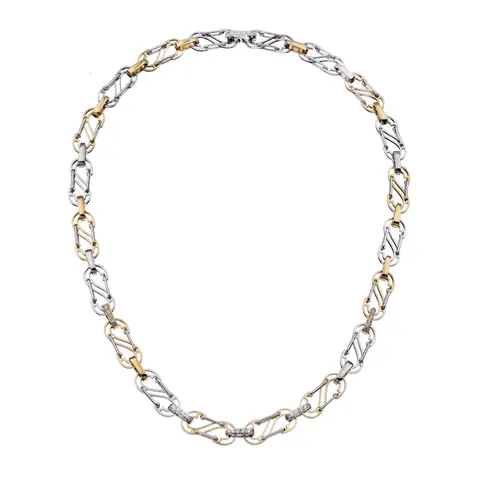
Why lariat necklaces anchor jewelry layering with a clean vertical line
A lariat’s vertical Y-shape gives a necklace stack a clear axis, separates crowded chains, and turns layered metal into a composition with movement and space.

A lariat necklace usually hangs low on the chest and often skips a traditional closure. That creates a vertical line where most chains run horizontal. The drop pulls the eye downward, gives shorter necklaces a place to land, and leaves the kind of negative space that keeps a stack from reading as one dense band of metal.
The shape that organizes the stack
The lariat’s vertical, Y-shaped silhouette gets to the heart of its usefulness. The Y-line draws the eye downward, often through and past the cleavage, which is why the style has such a distinct visual charge compared with a straight collar or a simple pendant. In practical terms, the lariat works as the longest visual line in a composition, so the rest of the necklace layers can sit above it without competing.
Layering is not only about accumulation, it is about proportion. Necklace stacking turns on balance, proportion, and avoiding tangles. It works best when the pieces stay separated and the arrangement feels curated rather than crowded. The lariat is the cleanest answer to that problem because its drop breaks the visual block and gives the stack a spine.
Lariats sit alongside chokers, rivières, and pendants in women’s necklace edits. The style belongs in the same wardrobe logic as the other foundational necklace shapes. A lariat is less about novelty than about how it changes the way everything else around it sits.
How to build a stack around a lariat
Think of the lariat as the extension piece in a necklace lineup. Short chains, especially chokers and 16-inch necklaces, frame the neck. Mid-length chains and pendants fill the center. The lariat is what keeps the composition from stopping too soon, because it extends the line downward and adds motion where a stack might otherwise flatten.
The most reliable length benchmarks are 16, 18, and 20 inches. Those measurements give you enough separation to keep each layer visible, especially when one of them is a lariat with a drop that hangs below the others. Many of Mason Madison’s 18K gold vermeil pieces include 2-inch extenders that can turn a 16-inch necklace into an 18-inch one, and that kind of adjustment is exactly what makes layering feel custom rather than forced.
A few formulas make the shape work fast:
- V-neck top: Start with a 16-inch chain near the throat, add an 18-inch pendant in the middle, then place the lariat as the longest line so its drop echoes the V of the neckline.
- Scoop neck: Use a 16-inch short chain and an 18-inch mid-layer, then let the lariat fall just below the widest part of the neckline so the curve feels balanced, not crowded.
- Button-down shirt worn partly open: A short 16-inch chain can sit at the collarbone, an 18-inch piece can rest in the open placket, and the lariat can trace the vertical opening so the whole stack feels integrated with the shirt.
- Simple knitwear: On a crewneck or plain sweater, an 18-inch base layer and a lariat create more structure than two short chains alone, because the drop gives the eye somewhere to travel.
If the middle layer feels too tight, use an extender before you add another necklace. Moving a 16-inch piece out to 18 inches can open enough room for the lariat to do its work, which is often better than piling on a third chain that only adds bulk.
What to look for in the piece itself
A good lariat should feel fluid but controlled. Because the style often has no traditional closure, the chain weight matters: too light, and the drop can twist or collapse; too heavy, and the line loses the ease that makes the silhouette appealing. The best versions hang with enough structure to read as a clean vertical line, not as a chain that has simply been tugged downward.
The focal point also matters. Some lariats create a centered drop, while others read more asymmetrically, and that difference changes the mood of the stack. A centered Y feels formal and architectural. An off-center drop feels more directional, especially over open shirts or soft knitwear. The design is at its best when it feels deliberate, not fussy.
Where the shape comes from
The term lariat began with ropes and lassos used for cattle in the American West before the form became ornamental.
This article was produced by Prism’s automated news system from verified source data, official records, and press releases, then run through automated quality and moderation checks before publishing. The system is built and supervised by the people who set the standards it runs under. Read our full AI policy.
Did this article answer your question?