Why the T-bar is back as jewelry's versatile layering staple
The T-bar has moved from pocket-watch hardware to the center of modern layering, where heritage gold, antique chains, and cleaner proportions make it feel newly relevant.
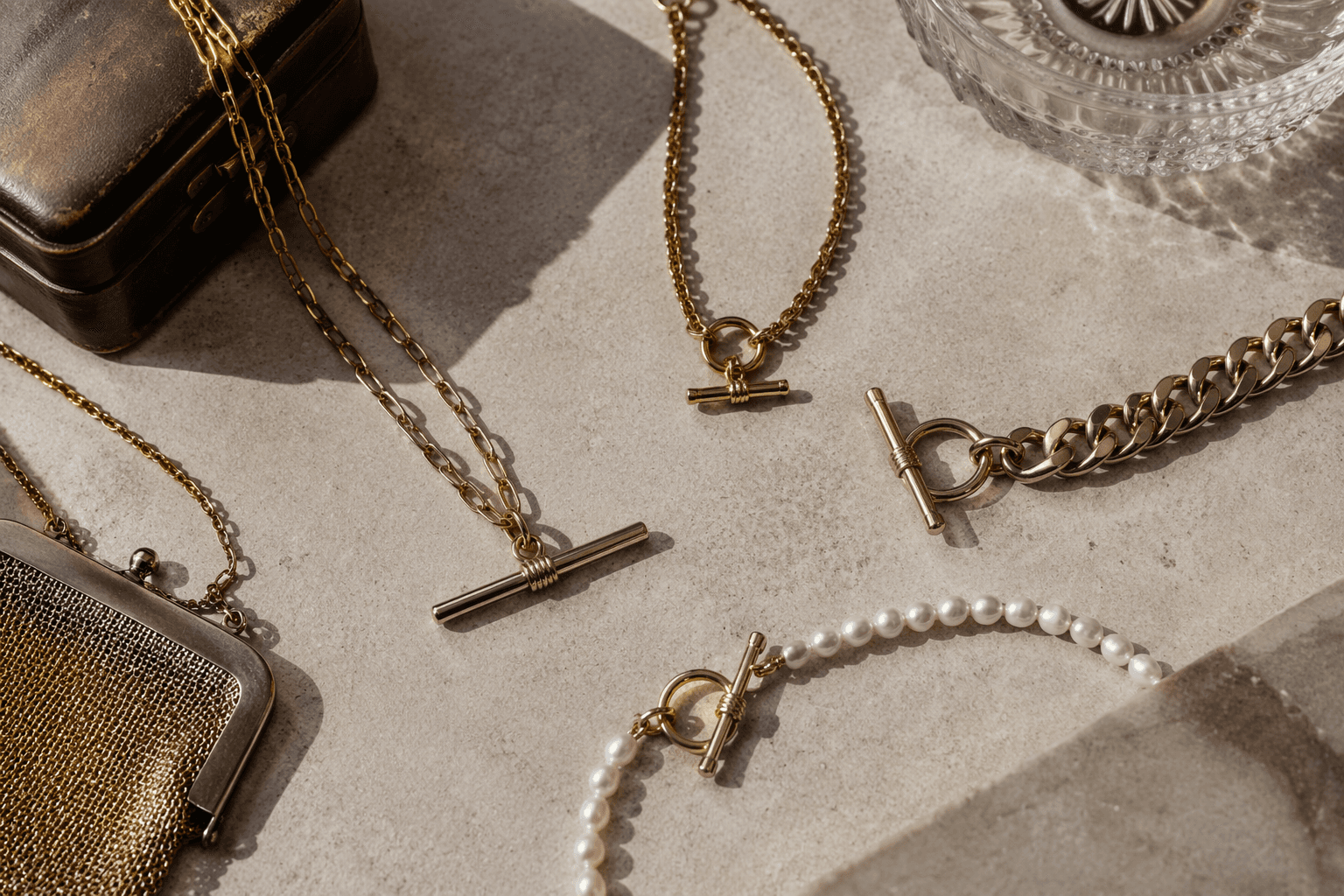
In the late 1800s, the T-bar served as the toggle on an Albert chain, anchoring a gentleman’s pocket watch to a waistcoat. That practical shape is exactly what makes it so useful now, whether it sits in a necklace stack, on a bracelet, or as the focal point of a longer chain.
From watch chain to wardrobe anchor
By the early 20th century, wristwatches had overtaken pocket watches, and many antique Albert chains were shortened into necklaces and bracelets, turning a fastening into a design element.
Portable watchmaking reaches far earlier. Peter Henlein of Nuremberg is credited with miniaturizing clock components into a portable format in the early 1500s, then developing a mainspring in the 1520s. The Jewellery Editor puts the pocket watch’s lifespan at roughly 500 years before it migrated to the wrist at the turn of the 20th century, a shift accelerated by wartime use and the return of soldiers from World War I battlefronts.
Why the silhouette feels current again
The renewed interest in T-bars tracks the broader return of heritage jewelry, antique conversions, and chunky gold chains, categories that reward pieces with visible history and a little weight. The shape also got an extra lift after a fashion-film appearance featuring Jemma Wynne’s Forme diamond toggle necklace, with Anne Hathaway bringing the look into wider view.
The T-bar is easy to read at a glance. It gives a necklace structure without making it feel rigid, and it gives a bracelet a clean center point without overwhelming smaller links. In a market that has swung back toward gold, the bar’s geometry works especially well in yellow metal, where it can catch light and still feel restrained.
How collectors and stylists are using it
The strongest modern versions treat the T-bar as a connector rather than a solo act. It can sit across a fine chain, hang from a longer antique strand, or punctuate a layered neck with a single clean horizontal line. Contemporary jewelers are also reworking the form with color and whimsy, which softens the old mechanical feel without losing the original clarity of the shape.
The T-bar sits naturally inside the larger return of layered jewelry. Modern stacks are not only about adding more pieces; they are about balance, texture, and spacing. A T-bar helps hold that composition together because it gives the eye a fixed point amid movement, especially when it is paired with mixed chain weights or a pendant that sits lower on the chest.
What to look for in antique chains
Antique gold chains have become especially desirable again because collectors are drawn to the refined elegance of Georgian through Art Nouveau styles. Lisa Stockhammer-Mial said, “The return of gold and the artful layering of both modern and antique pendants and chains have all contributed to this renewed popularity and interest among new collectors of period jewellery.”
Some Georgian guard chains stretched beyond 50 inches and could reach 64 inches; The Jewellery Editor lists examples in that range. Those long lines were made to drape, double, and move, and they create the kind of vertical rhythm that a T-bar can interrupt.
Period chains are often lighter and more delicate than reproductions, and that difference is not cosmetic. A true antique chain tends to feel finer in the hand, with a more restrained scale and a less heavy-built finish than a later copy, so a piece that looks too thick or too polished can be a warning sign.
- Look for proportion that feels airy rather than bulky, especially in Georgian and early Victorian chains.
- Expect real age to show in delicacy, not in overbuilt links.
- Let the T-bar provide structure, while the chain carries the softness.
- Favor gold tones that echo the current appetite for heritage pieces, especially if the chain will sit with other antique pendants.
A good eye for antique layering starts with a few details:
The role of the museum case and the collector’s eye
The V&A’s jewellery collection holds over 3,000 jewels, making it one of the most comprehensive collections in the world, and preserves the kind of chain work behind the T-bar.
This article was produced by Prism’s automated news system from verified source data, official records, and press releases, then run through automated quality and moderation checks before publishing. The system is built and supervised by the people who set the standards it runs under. Read our full AI policy.
Did this article answer your question?