GIA Essential Care Tips Keep Your Fine Jewelry Beautiful and Lasting
Fine jewelry rewards the care you give it; GIA's essential guidelines cover daily habits, safe cleaning by material, and routine inspections.
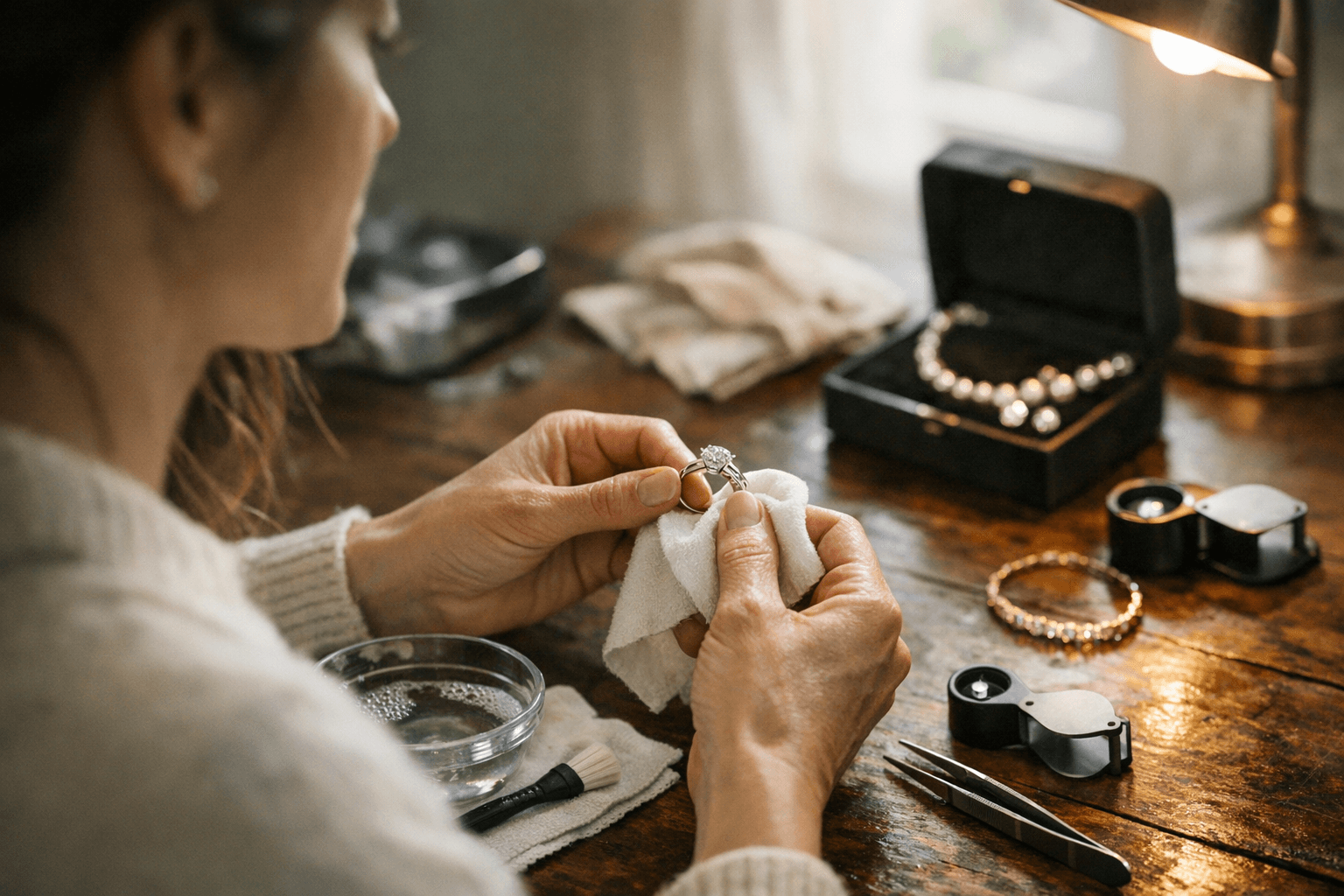
Fine jewelry is not passive. Every ring you slide on before washing dishes, every necklace you clasp before a workout, every bracelet you forget to remove before bed is a small decision that compounds over years into either a piece that glows with its original life or one that has quietly, incrementally diminished. The Gemological Institute of America, the world's foremost authority on gem science and the organization behind the universal grading standards used across the industry, has long published care recommendations that cut through the noise of well-meaning but inconsistent advice. What follows draws on GIA's guidance to give you a clear, material-specific framework for protecting what you own.
Understanding why fine jewelry is vulnerable
The instinct to treat fine jewelry as durable because it is precious is understandable, but it works against good stewardship. Precious metals scratch, prongs fatigue, and gemstones, despite their hardness ratings, can chip along cleavage planes or lose their surface polish from everyday abrasion. Even a diamond, the hardest natural material on earth at 10 on the Mohs scale, is not immune to damage: it can fracture if struck at the right angle, and its signature brilliance dulls noticeably under a film of lotion, soap residue, and skin oil. Softer stones face more immediate risks. Opals, at roughly 5.5 to 6.5 on the Mohs scale, are porous and sensitive to temperature swings. Emeralds, most of which are fracture-filled with resin or oil as a standard trade practice, can have those fillings compromised by heat and harsh chemicals. Pearls, which are essentially layers of aragonite bound by an organic protein, are among the most chemically vulnerable materials in your jewelry box. Knowing what your pieces are made of is the first step in caring for them properly.
Daily-wear precautions that make a real difference
GIA's daily-wear guidance centers on a straightforward principle: remove jewelry before activities that expose it to mechanical stress, chemicals, or extreme conditions. That means taking off rings before gardening, where grit and soil act as abrasives against both metal and stone. It means unclasping bracelets before a gym session, where a barbell can score a gold bangle or, worse, warp a delicate setting. It means leaving fine pieces on the dresser before swimming, because chlorinated pool water and saltwater both attack metal alloys over time, accelerating the tarnishing of silver and the corrosion of lower-karat gold alloys.
Household cleaning products deserve particular attention. Bleach, ammonia-based cleaners, and acetone are among the most damaging substances a piece of jewelry can encounter. Bleach causes irreversible pitting in gold. Ammonia, while sometimes used in diluted, controlled cleaning solutions for diamonds, is harmful at household concentrations and should never be used on pearls, opals, or any porous or organic material. The habit of removing rings before applying hand cream or perfume also pays dividends: fragrance alcohols and emollients build up in the recesses of settings and beneath stones, dulling brilliance and creating conditions for tarnish.
Safe cleaning methods by gem type and metal
The most reliable at-home cleaning method for the majority of fine jewelry, including diamonds, rubies, sapphires, and most hard stones set in gold or platinum, involves nothing more sophisticated than a bowl of warm water, a drop of mild dish soap, and a soft-bristled brush, the kind sold as a baby toothbrush or a dedicated jewelry brush. Soak the piece for a few minutes to loosen debris, gently work the brush into the setting to dislodge buildup around prongs and beneath the stone, then rinse thoroughly under running water. The rinse step is critical: soap residue left in a setting is itself a source of the dullness you were trying to eliminate.
For pearls, the approach is gentler still. Because nacre is sensitive to acids and detergents, the standard recommendation is to wipe strands with a soft, slightly damp cloth after each wearing. Never soak a pearl necklace: prolonged water exposure weakens the silk thread used in traditional knotted strands and can loosen the adhesive securing drilled pearls to posts. String replacement every few years is advisable for frequently worn strands.
Ultrasonic cleaners, sold widely for home use, are effective for certain pieces and dangerous for others. They work by passing high-frequency sound waves through a liquid solution, creating microscopic bubbles that vibrate debris loose. For a solid diamond solitaire in a sturdy four-prong setting, an ultrasonic cleaner is efficient and safe. For an emerald with fracture filling, an opal, a tanzanite, or any stone with visible inclusions that might act as fracture points under vibration, an ultrasonic cleaner can cause catastrophic damage. Steam cleaners carry similar caveats. When in doubt, the bowl-and-brush method is the conservative and correct choice.
Silver requires its own approach. Sterling silver tarnishes through a chemical reaction between the metal's copper content and sulfur compounds in the air and on skin. Anti-tarnish polishing cloths, which are impregnated with a mild abrasive and a tarnish inhibitor, are the most practical solution for light tarnish. For heavier buildup, a paste of baking soda and water applied with a soft cloth, then rinsed thoroughly, can restore brightness. Avoid abrasive paper towels or rough fabrics, which leave micro-scratches that actually accelerate future tarnishing by increasing the surface area available for oxidation.
The role of routine inspections
Home cleaning sessions are also an opportunity to inspect your pieces, but a professional inspection at a jeweler's bench is not replaceable. GIA's recommendations include routine professional inspections as a foundational element of jewelry care, and the reason is structural: a trained jeweler with a loupe can identify a prong that has thinned or bent, a loose stone that moves under gentle pressure, a worn clasp mechanism, or a hairline fracture in a shank before any of these conditions cause loss or irreversible damage.
For everyday pieces, an annual professional inspection is a reasonable baseline. For heirloom or high-value items worn regularly, twice a year is prudent. Prongs are the most common point of failure: they are by design the thinnest parts of a setting, holding a stone in place through their tension, and they wear down against clothing and surfaces with every wearing. A skilled bench jeweler can retip worn prongs, a relatively inexpensive service, for a fraction of the cost of replacing a lost stone.
Keep a simple record of your pieces: photographs, any grading reports, receipts, and insurance appraisals. GIA grading reports, issued for diamonds and certain colored stones, provide a permanent document of a stone's characteristics that is invaluable for insurance purposes and for verifying a piece's identity after repair. An up-to-date insurance appraisal, typically recommended every two to three years given fluctuations in precious metal and gemstone markets, ensures that replacement coverage reflects current market value.
Storage as protection
How you store jewelry between wearings matters as much as how you clean it. Tossing pieces into a shared drawer allows harder stones to scratch softer ones and creates the kind of tangled chains that stress delicate links to the point of breakage. Individual soft pouches, the fabric compartments of a lined jewelry box, or small zip-lock bags for travel storage prevent contact damage and, in the case of silver, slow tarnish by limiting air exposure.
Store pearls separately and flat, never hanging, to avoid stretching the strand. Keep opals away from extremely dry environments, as low humidity can cause them to crack. Avoid storing any jewelry in direct sunlight or near heat sources: thermal stress and UV exposure can fade certain colored stones and, over time, dry out organic materials including coral, ivory, and the organic binders used in some composite or assembled stones.
The investment you made in a fine piece is protected not by a single dramatic intervention but by accumulated small habits. GIA's framework for jewelry care is, at its core, a case for paying attention: to what your pieces are made of, to the environments you take them into, and to the quiet signs of wear that a jeweler's eye can catch before they become something you cannot undo.
This article was produced by Prism’s automated news system from verified source data, official records, and press releases, then run through automated quality and moderation checks before publishing. The system is built and supervised by the people who set the standards it runs under. Read our full AI policy.
Did this article answer your question?