NDC Launches World Diamond Day April 8 to Celebrate Cultural Significance
The NDC designates April 8 as inaugural World Diamond Day, framing it as a collective moment rather than a campaign. Here's what that distinction actually means for buyers.
Every engagement ring, inherited brooch, and custom pendant has a back story that no marketing department invented. The Natural Diamond Council is counting on exactly that premise, and April 8, the inaugural World Diamond Day, is the vehicle. The NDC frames the observance as a collective moment rather than a formal campaign, inviting jewelers, designers, manufacturers, and consumers worldwide to post photographs and short videos tagged #WorldDiamondDay and #NaturalDiamonds on social media. The organization is treating this first year as a soft launch, a groundswell play rather than a coordinated advertising push. Understanding what the NDC is actually doing here is the first step to using the occasion for something more useful than a well-lit post.
The day was conceived in 2025 by the World Diamond Heritage Board, which subsequently transferred oversight to the NDC. CEO Amber Pepper described it to JCK as "a rare and meaningful moment, one that no other category can so authentically galvanize." Under the motto "One day to celebrate natural diamonds, together," the council is asking participants to include the World Diamond Day logo in their posts and to spread content across Instagram, Facebook, LinkedIn, and TikTok simultaneously on April 8. A digital toolkit with optional assets and guidelines is available on the NDC's website.
The campaign's suggested themes are carefully chosen. The NDC encourages posts about engagements and anniversaries, heirloom transitions, the mine-to-market journey of a diamond, and the social and environmental impact of diamond mining on education, conservation, and communities. Designers are specifically invited to document craftsmanship and finished creations. Taken together, these categories form a coherent counter-narrative to the lab-grown diamond market, which has spent the better part of a decade challenging natural diamonds' emotional premium with arguments about sustainability and accessible pricing. "In a time of global uncertainty, the values that natural diamonds embody, authenticity, human connection, and enduring meaning, resonate more deeply than ever," Pepper told JCK. "Now more than ever, the power of the natural diamond industry lies in its ability to come together with a unified voice."
She is not wrong. But a buyer approaching April 8 with genuine curiosity rather than brand loyalty will find the occasion most valuable as a deadline for asking harder questions.
Start with origin. Natural diamonds form over billions of years in the Earth's mantle and travel to the surface through volcanic pipes. That geological narrative is real and irreducible: no laboratory can replicate the specific conditions, timeline, or mineral inclusions that make each natural diamond singular. But rarity does not automatically confer traceability. A GIA or IGI grading certificate documents a stone's color, clarity, cut, and carat weight with precision. It does not document which mine the rough came from or the labor conditions under which it was extracted. If a retailer cannot produce a certificate from a recognized grading laboratory, treat that absence as information.
Ask next about provenance. The Kimberley Process Certification Scheme, established in 2003, set minimum standards for rough diamond trade to exclude stones financing armed conflict. Its limitations are well documented: it covers only rough diamonds, not polished stones, and its definition of conflict is narrow enough to exclude mining operations that involve exploitative labor without technically funding rebel movements. The scheme's civil society coalition raised these concerns again at the 2024 plenary in Dubai. If you care about the community impact stories that World Diamond Day invites you to celebrate, ask whether the brand makes additional ethical sourcing commitments beyond Kimberley compliance. Companies like Brilliant Earth publish detailed chain-of-custody policies. Tiffany discloses diamond source information by country of origin. Many independent jewelers can trace stones to specific mines in Canada, Botswana, or Namibia, countries with stronger regulatory frameworks and documented community benefit programs. Botswana's Debswana partnership with De Beers has funded schools and hospitals for decades; that is a real and documentable story, and exactly the kind the NDC wants shared on April 8.
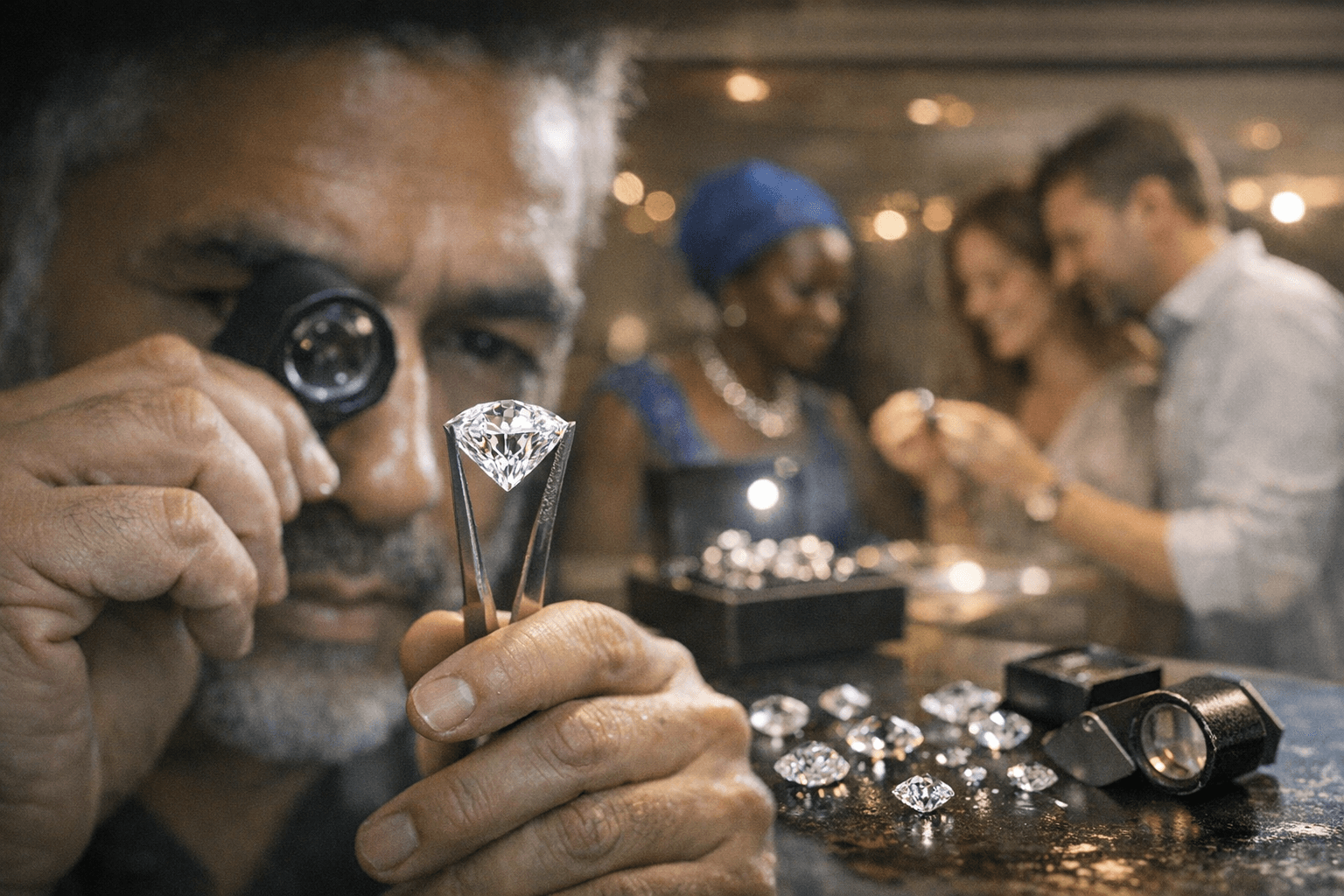
The natural versus lab question is now unavoidable in any serious diamond conversation. Laboratory-grown diamonds are chemically identical to natural stones; a loupe cannot distinguish them, and neither can most instruments short of a specialized detector. They carry GIA grades and can reach exceptional cut quality. Their price has dropped sharply: lab-grown diamonds now commonly trade at a fraction of what comparable natural stones command, because supply is no longer geologically constrained. If you value a diamond primarily as an optical object and want maximum carat weight for a given budget, a lab-grown stone is a legitimate choice. If you believe, as the NDC argues and as many gemologists concur, that the emotional and financial value of a natural diamond is inseparable from its geological rarity and irreproducibility, that position is also defensible. Neither is irrational. What is irrational is spending significant money without having decided which argument you actually find persuasive.
Once you know the stone you want, the setting becomes the place where personal narrative physically enters the object. A bezel setting encircles the girdle in a continuous band of metal, protects the diamond from impact, and reads as modern and architectural. A classic four-prong Tiffany-style setting elevates the stone above the band, maximizes light return through the pavilion, and remains among the most legible symbols of commitment in fine jewelry. A pavé band adds brilliance along the shank but requires periodic inspection, since small accent stones can loosen with daily wear. The setting is not a decorative afterthought; it is a structural decision that determines how the piece will look and function in four decades.
Heirloom redesign is the most underutilized conversation in fine jewelry, and World Diamond Day is a reasonable prompt for it. An old-European-cut diamond, with its high crown, small table, and visible culet, has a visual warmth that modern round brilliants trade away in pursuit of maximum light dispersion. Reset in a clean bezel or a tension-style mounting, that stone becomes wearable daily while preserving a literal piece of family history. If April 8 prompts you to open a jewelry box you have not touched in years, consider whether the stones inside might carry more meaning worn than stored.
The NDC's initiative is, at its core, a category marketing effort with a human face. That does not make it cynical. The diamonds behind the best World Diamond Day submissions will be real, the memories genuine, and the mine-to-market stories documentable. What it does mean is that April 8 is most valuable not as a day to post, but as a deadline for the conversation you should have been having with your jeweler already: where did this stone come from, how was it certified, what does this setting say about the person who will wear it, and will it still say the same thing in 30 years? Those questions are the conversation the NDC is gesturing at. Asking them of a specific jeweler about a specific stone is the only way to get an answer that actually belongs to you.
Know something we missed? Have a correction or additional information?
Submit a Tip