Kate Middleton's Pearl Earrings and Symbolic Coat Carry Hidden Royal Meaning
Kate wore the same $10,210 Cassandra Goad pearl earrings she has carried to christenings and royal milestones, making them the most quietly sentimental piece in her wardrobe.
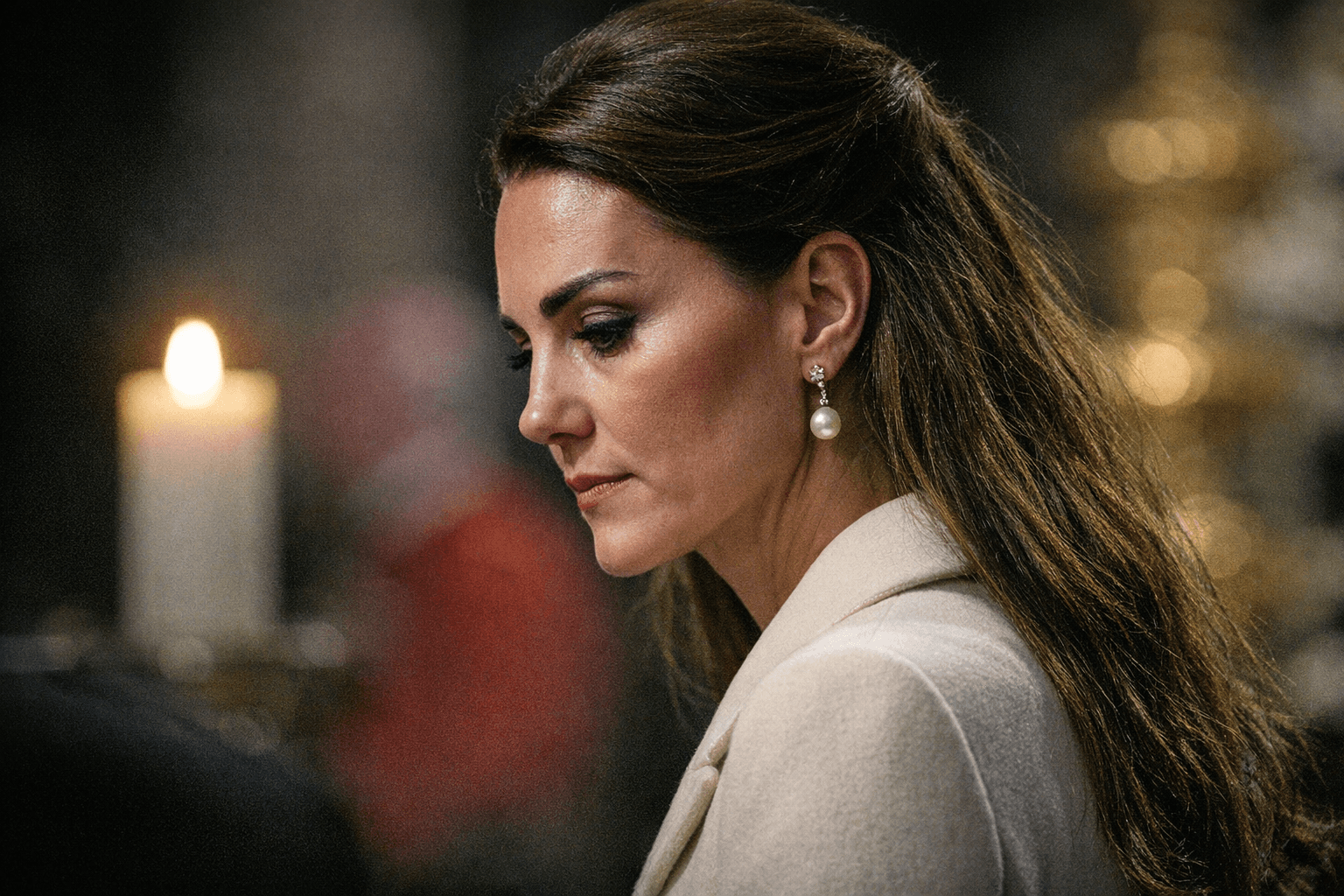
Pearls have always known when to show up. At christenings, at funerals, at the installation of the first woman to lead the Church of England in 1,400 years, they appear with a kind of compressed history: worn not to impress but to mark. The pearl is the only gem grown by a living creature, and it carries a grammar that other jewelry does not. It belongs to ceremony, to continuity, to the idea that some moments deserve to be linked to others.
Kate Middleton understood that grammar when she arrived at Canterbury Cathedral on March 25 for the installation of Dame Sarah Mullally as the 106th Archbishop of Canterbury. The occasion was historic by any measure. Mullally became the first woman to hold the role in the Church's 1,400-year history, and the more than 2,000 guests who filled the cathedral represented government, faith communities, and public service. Kate's ensemble read as studied restraint: a tailored patterned coat that fashion observers linked to royal lineage, a sculptural headpiece finished with a single ostrich quill that added height and drama without overwhelming the coat beneath, black pointed-toe pumps, a Chanel bag, and gloves carried in hand rather than worn, suggesting movement between ceremony and greeting.
But her jewelry carried the most personal resonance. She chose pearl cluster earrings by Cassandra Goad, the London jewelry house known for work that draws on classical motifs and natural forms, valued at $10,210. The earrings have appeared before: at a christening, and at other pivotal royal appearances, worn with what fashion analysis has called talismanic intention. The repeat wearing is not coincidence or wardrobe logistics. It is what jewelry does when it stops being ornament and becomes record.
That distinction is worth sitting with, because it is exactly what separates a meaningful piece from an expensive one.
No other gem communicates restraint with as much precision as a pearl. Diamonds demand attention; colored stones announce preference; pearls ask only for acknowledgment. At a ceremony as layered as an archiepiscopal installation, where the symbolism already runs several centuries deep, more visual noise would be the wrong move. What the Cassandra Goad cluster earrings did instead was locate Kate within a tradition of women who have marked significant public occasions with pearls, not because pearls are safe, but because they are specific. They are the color of ceremony and of milk, of inheritance and of new beginnings.
The cluster format matters, too. A single pearl stud reads as minimalist and modern. A drop pearl reads as formal, elongating the neck and signaling occasion. A cluster, with multiple pearls arranged in a starburst or pavé formation around a central stone, carries the weight of abundance without the aggression of it. It is the jeweler's version of a full stop: authoritative without being loud.
If the Cassandra Goad earrings have prompted you to invest in a pearl piece with staying power, the first quality indicator to understand is luster, the depth of light reflection from within the nacre. Hold a pearl in indirect light and look for a sharp, almost mirror-like reflection on its surface. A soft, diffuse glow indicates thin nacre, which also means a shorter lifespan: thin-nacred cultured pearls can chip, peel, or dull within a decade.
Nacre thickness varies by type and origin. Japanese Akoya pearls, the classic white saltwater pearl that anchored cultured production after Kokichi Mikimoto pioneered the culturing process in the early 20th century, typically range from 6 to 9 millimeters and are prized for exceptionally sharp luster. South Sea pearls, grown in Australian and Indonesian waters, run larger, commonly 10 to 16 millimeters, with a softer, satiny luster and a natural color range from white to deep gold. Tahitian pearls, cultured in French Polynesia's black-lipped oysters, produce naturally dark tones including peacock green, aubergine, and silver-grey, which sit beautifully in yellow or rose gold. Freshwater pearls from China have improved significantly in quality over the past two decades; at their best they now rival Akoya in luster at a lower price point, though the range is wide enough to require careful selection.
For a cluster earring, luster consistency across every pearl in the piece is the benchmark. Each stone needs to match not just in color but in the depth and sharpness of its reflection. A single flat-looking pearl in an otherwise brilliant cluster will always draw the eye to the wrong detail.
Pearl jewelry also separates itself from most of the fine jewelry category on the provenance question. Responsible pearl farming is less extractive than mining. Oysters and mollusks filter water as they grow, and a well-managed farm can improve the surrounding marine environment, a quality documented by researchers studying aquaculture's ecological footprint. Several farms now operate under third-party environmental certification, though the standards vary significantly by country and certifying body.
That does not mean all pearl sourcing is clean. Freshwater pearl production has faced scrutiny over water pollution and chemical use in some facilities, and claims of natural pearls, formed without human nucleation and genuinely rare, should always come with documentation. When a retailer cannot tell you a pearl's origin or farming method, that gap is worth pressing on. Reputable jewelers, including Assael, Mikimoto, and independent houses working with traceable suppliers, can speak to their supply chains with specificity.
The pair you will eventually reach for at a christening, a milestone anniversary, or a ceremony twenty years from now is almost certainly not the flashiest one. It is the one that fits the occasion with some room left over. For a cluster setting, look for individual cup-style prong mounts for each pearl rather than glue-set construction, which degrades over time. Yellow gold amplifies the warmth in cream or golden pearls; white gold and platinum suit cooler-toned white or grey pearls without competing with them. If you are choosing a piece with heirloom intent, go slightly larger than your instinct suggests. Smaller pearls read well now; they read better in thirty years as something clearly chosen with care rather than minimalism for its own sake.
An inherited pearl strand or a pair of studs from a grandmother's jewelry box is already carrying meaning. The question is whether the setting still serves it. A jeweler experienced with estate pieces can re-mount individual pearls from a broken strand into cluster earrings, a pendant drop, or a stacked ring. The pearls themselves are almost certainly in better condition than they appear; nacre does not deteriorate if the pieces are cleaned regularly with a soft cloth and kept away from perfume and hairspray, which erode the surface over time. If a strand is intact but feels too formal for modern wear, a bench jeweler can shorten it to a princess length of 17 to 19 inches and set the remaining pearls into a bracelet or a matching earring pair, creating a set that reads as intentional rather than inherited by default. The essential question to ask before handing over inherited pearls: will they be restrung on silk thread with individual knots between each pearl, which prevents friction damage and contains any loss if the thread breaks.
Dame Sarah Mullally's installation at Canterbury Cathedral was dense with historical weight: 1,400 years of precedent, reset in an afternoon, witnessed by more than 2,000 people. Kate's pearl cluster earrings, worn before at private milestones and returned to again at this public one, did not need to explain themselves. By the time a piece appears at the third ceremony, it is no longer just jewelry. It is evidence of a life in which certain moments have been considered worth marking.
This article was produced by Prism’s automated news system from verified source data, official records, and press releases, then run through automated quality and moderation checks before publishing. The system is built and supervised by the people who set the standards it runs under. Read our full AI policy.
Did this article answer your question?