Mejuri Adds Sterling Silver Options to Its Birthstone Puzzle Stacking Ring Line
Mejuri adds 14 sterling silver birthstone rings to its Puzzle stacking line, making two-tone stacks with 18k gold vermeil both achievable and more affordable.
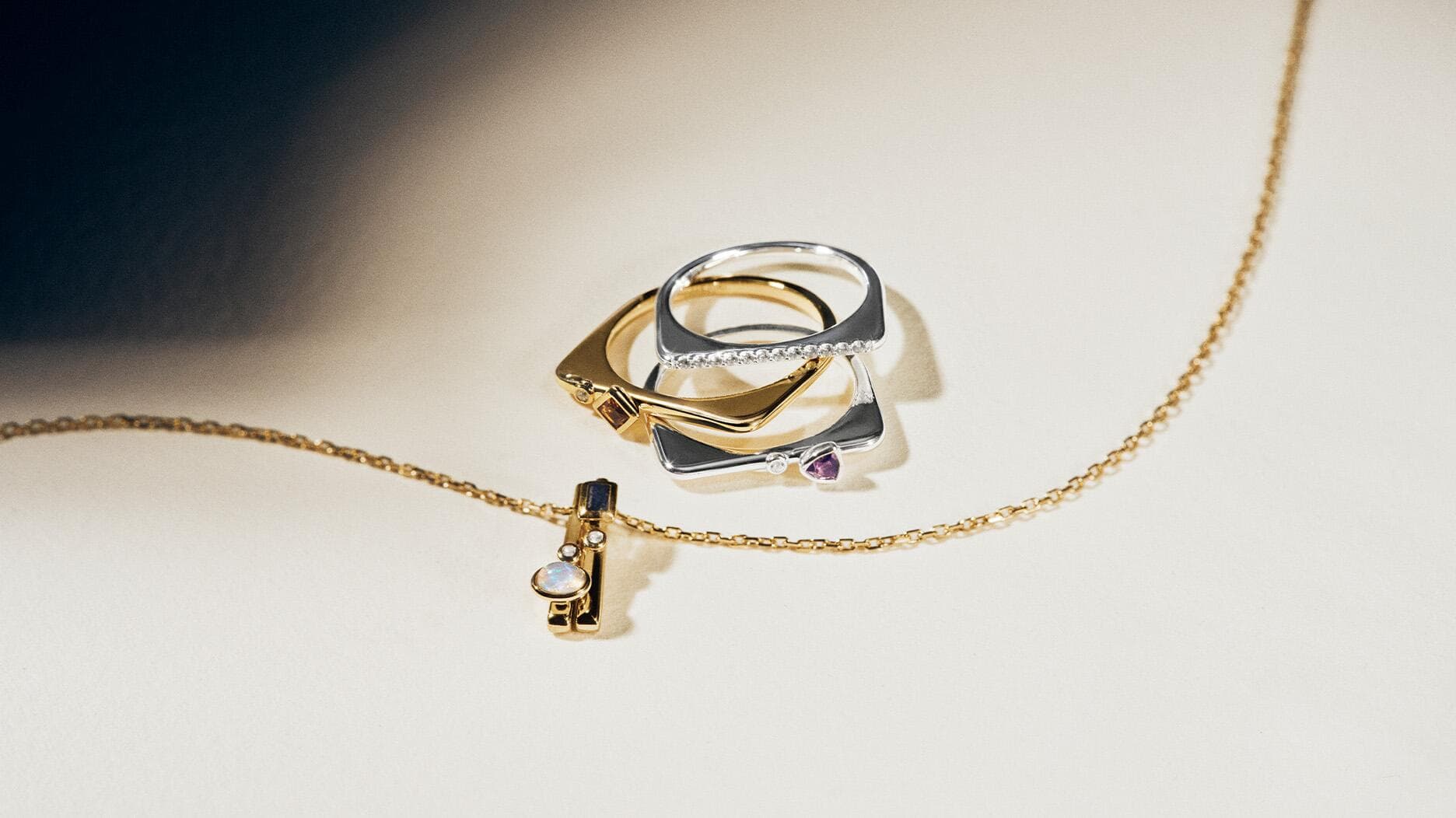
The ring assigned to your birth month is not a choice you made. A garnet for January, an amethyst for February, an aquamarine for March — the calendar settled that long before you had any say in the matter. What Mejuri's Puzzle collection has always understood is that the interesting decision comes after the calendar's: whose months you choose to carry on your hand, and how you arrange them. The line's new sterling silver expansion makes that decision significantly more accessible, and more visually layered, than it was before.
Mejuri added 14 sterling silver ring styles to the Puzzle line, each corresponding to a birth month, alongside an expanded set of Puzzle Sliding Charms now also available in sterling silver. The existing collection already covered all twelve months in 18k gold vermeil, with Puzzle Stacking Rings retailing at $128 per piece. The silver versions arrive at a lower price point, which is a meaningful difference the moment you start mapping out a stack that represents three or four people rather than just yourself.
What's worth pausing on first is how the Puzzle line was engineered. Mejuri's design team created all 14 ring styles simultaneously as a complete set, resolving how every band would sit against every other before a single piece went into production. The result is a collection in which an architectural baguette-cut garnet ring nests flush against a hand-reshaped trillion peridot, which in turn sits cleanly against a round aquamarine — not because buyers are expected to troubleshoot the fit themselves, but because the designers already did. That pre-engineered compatibility is not standard practice in the stackable ring category. Most brands design rings individually and leave the stacking geometry to chance. Here, any combination of Puzzle rings from any birth months, in any order, lies flat on the finger.
Each stone is paired with a brilliant lab-grown sapphire accent and set by hand. Every band carries a mirror finish and runs 1.5mm wide across the shank. The fancy cuts deserve specific attention: baguettes are rectangular and architectural, with step-cut facets that produce clean lines of light rather than sparkle; the trillion is a triangular form, here described as hand-reshaped, giving it a slightly softer geometry than its name suggests. Both cuts have a structural quality that makes each ring read as intentional rather than decorative, which matters when a piece is meant to carry biographical weight.
The sterling silver versions are dimensionally identical to the vermeil rings. The cuts are the same, the lab-grown sapphire accents are the same, the band dimensions are the same. What changes is the metal's character and what it demands over time.
Sterling silver tarnishes — a chemical reaction with sulfur compounds in the air, in lotions, and in perfume, not a quality defect. For Puzzle rings worn daily, tarnish is a question of when rather than if. A polishing cloth handles minor darkening in minutes; a brief soak in warm water with mild dish soap addresses heavier buildup. It's a recurring step, but not a complicated one. Mejuri's 18k gold vermeil, built on a base of 92% recycled sterling silver, carries a thick layer of 18k solid gold that delays the same reaction at the surface. The vermeil rings will eventually show wear at friction points after years of daily contact, but the silver versions need attention sooner. Perfume and lotion should be applied before the rings go on, not after. Removing them before swimming is good practice with either metal.
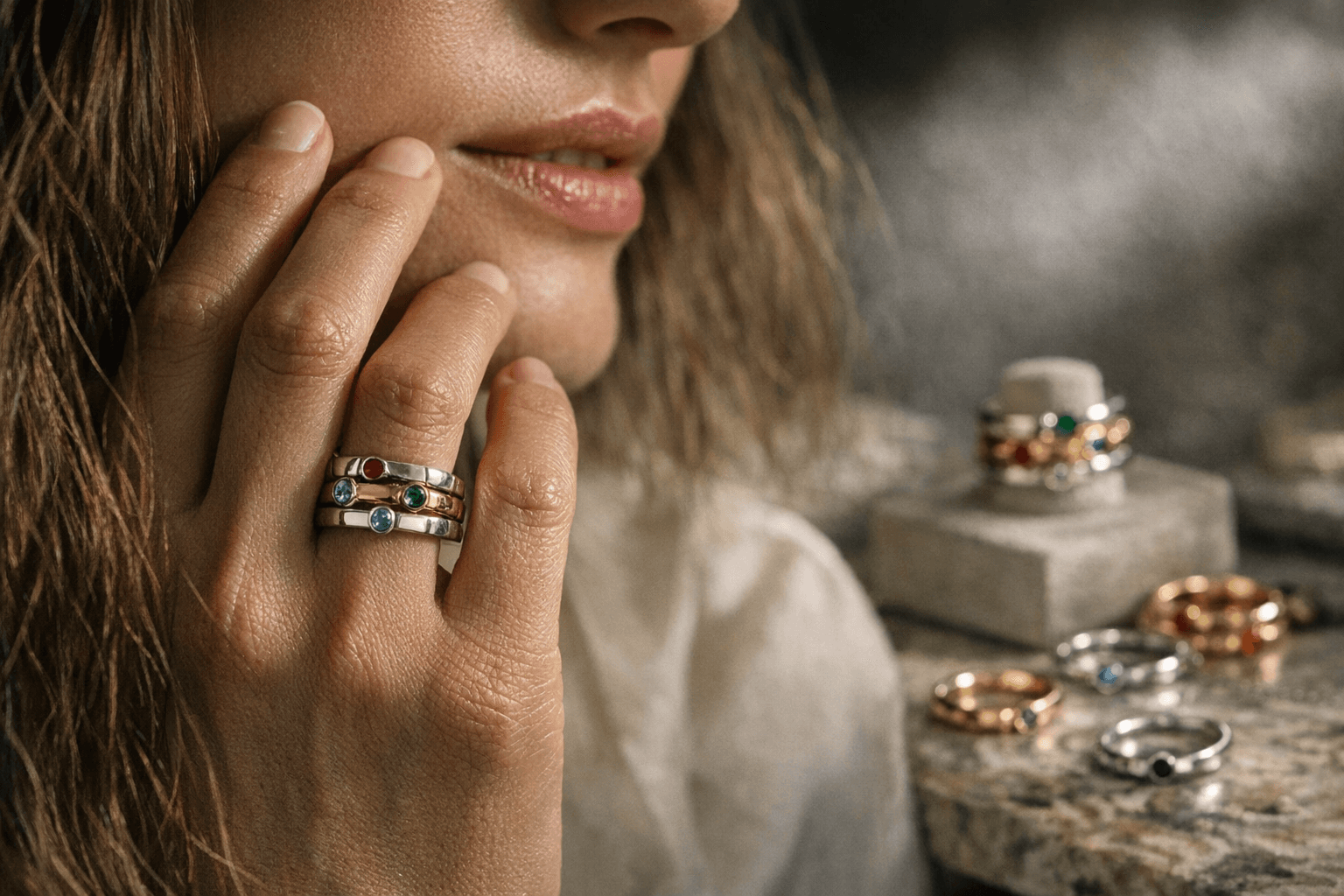
That maintenance reality is worth stating plainly rather than burying, because it shapes which metal makes sense where in a stack — and because it opens rather than forecloses the most interesting design possibility the expansion creates: deliberate two-tone stacking.
Silver and vermeil Puzzle rings share the same dimensions and nest against each other exactly as they nest within their own material. Mixing metals is the intended use. The visual logic of mixing them is worth thinking through before committing to a combination. Cooler-toned birthstones tend to read more naturally in silver settings: aquamarine (March), blue topaz (December), and alexandrite (June) all carry a clarity that silver amplifies. Warmer stones — garnet (January), citrine (November), and peridot (August) with its distinctive yellow-green — anchor well in gold vermeil. A two-tone stack that uses metal temperature as a secondary organizing principle often has the most visual coherence: silver rings toward the knuckle, a vermeil piece at center as a warm focal point, silver again closer to the base. The Puzzle Sliding Charms, which thread onto a base band rather than sitting as independent rings, add another layer of placement control; positioned between a silver ring and a vermeil ring, a sliding charm in either metal creates a deliberate transitional beat.
Mejuri frames the Puzzle line as milestone storytelling — the brand's own shorthand is "minorstones," a play on milestones and stones together. The framing is worth applying with some latitude. The most resonant stacks tend to be biographical rather than trend-driven: a partner's birth month in gold vermeil, a child's in silver, a parent's at the center of the knuckle. A stack built around the months of someone who has died carries a different kind of specificity than one built around a palette. Neither requires the stone colors to harmonize; the shared lab-grown sapphire accent that appears in every Puzzle ring provides enough visual continuity to hold disparate colors together across a full stack.
The practical starting point for anyone building from scratch is to anchor in one metal and introduce the second as punctuation. Two or three silver rings establish a base; a single vermeil anchor ring or sliding charm introduces warmth without competing. For hands that already wear gold, the reverse works equally well. The pre-engineered nesting means the order can be adjusted indefinitely, which is precisely what makes the system useful for a collection meant to grow over time.
The sterling silver expansion is, at its foundation, an argument that the cost of representing multiple people shouldn't price out the people who most want to do it. At $128 per vermeil ring, a four-month stack exceeds $500 before the charms. The silver entry point changes that arithmetic considerably. For a collection explicitly built around other people's months, the price point is the difference between wearing one person and wearing many.
This article was produced by Prism’s automated news system from verified source data, official records, and press releases, then run through automated quality and moderation checks before publishing. The system is built and supervised by the people who set the standards it runs under. Read our full AI policy.
Did this article answer your question?