The Secret Gaze of ‘Lover’s Eye’ Jewelry
A single painted eye, hidden in a Georgian gold locket, carried what no one could say aloud. Three centuries on, its secrecy has never felt more necessary.
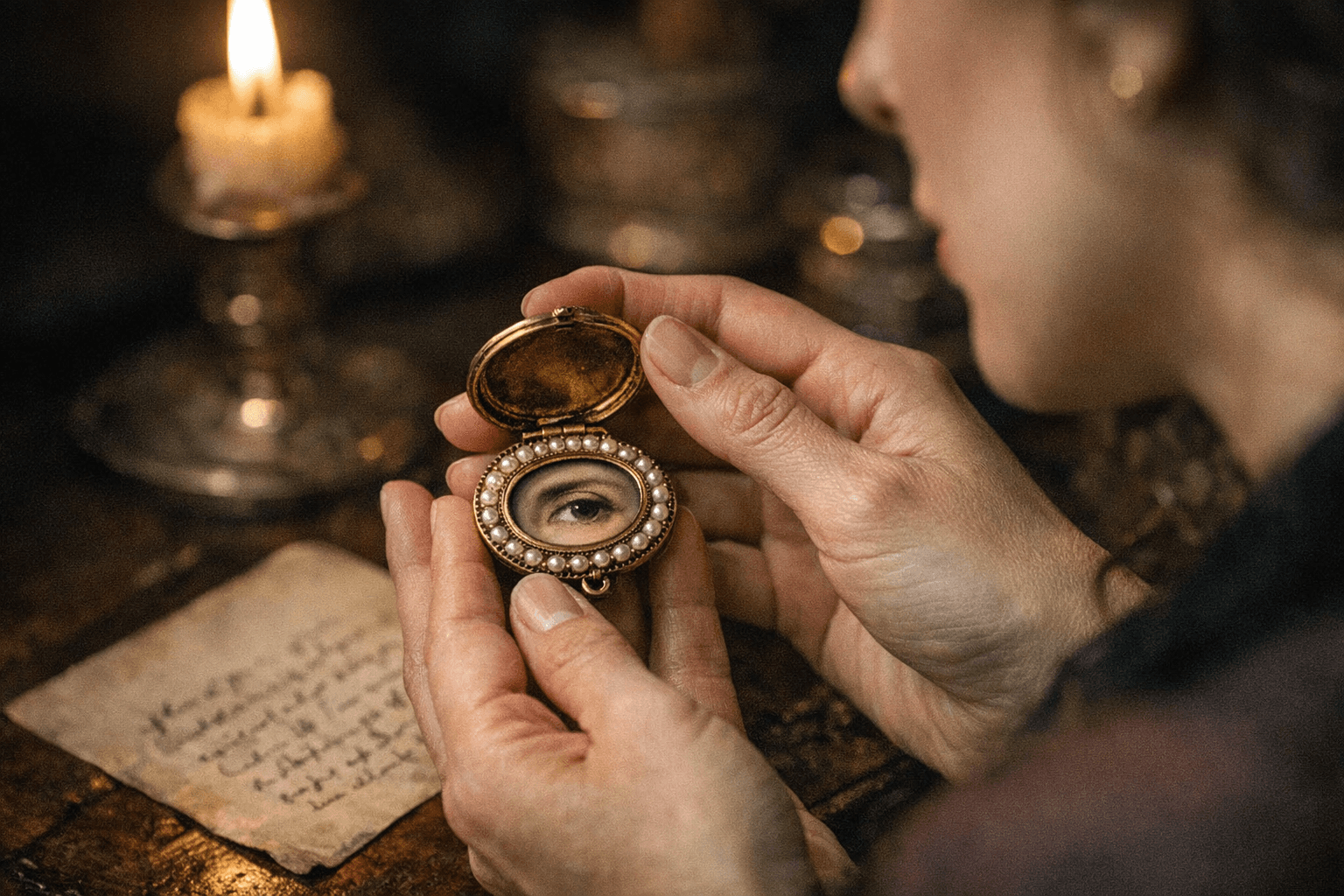
There is something quietly subversive about wearing a portrait that only you can read. Not a face, not a name — just an eye, rendered in watercolor on a sliver of ivory no larger than a thumbnail, pressed behind glass in a gold bezel. In the Georgian era, that was enough. Today, when every face is a public object and photographs circulate across continents before breakfast, the lover's eye has returned. The appeal is not nostalgia. It is the hunger for something genuinely private.
A Royal Letter That Changed Jewelry History
The motif's origin is one of the more cinematic moments in the archive of sentiment. The Prince of Wales, the future King George IV, had spent months pursuing the twice-widowed Maria Fitzherbert — a courtship made legally impossible by British law, which barred an Anglican royal from marrying a Catholic. Fitzherbert had fled to France. He had threatened to harm himself. And then, on November 3rd, 1785, he sent a letter with a postscript that would echo for centuries: "I send you a parcel… and I send you at the same time an Eye, if you have not totally forgot the whole countenance."
Eye miniatures, also known as lover's eyes, cropped up across Britain around 1785 in the wake of that royal gesture, and most were commissioned as gifts expressing devotion between loved ones. Because only the giver and recipient could identify the eye, the pieces carried a radical privacy: you could wear your beloved openly and anonymously at once. The vogue burned bright but brief, lasting barely half a century before photography displaced the miniaturist's art entirely.
Examples survive in museum collections on both sides of the Atlantic. The Victoria and Albert Museum in London holds a lover's eye brooch dated to 1800–1820. The Metropolitan Museum of Art and the Philadelphia Museum of Art both hold early 19th-century examples, each piece a small riddle: whose eye is this, and what did it cost to give away?
The Craft Behind the Secret
Eye portraits were always rendered in miniature, ranging in size from a few millimeters to a centimeter or two. A decorative border of burnished or engraved gold, gems, or pearls usually surrounded the portrait, and often a hair compartment was included on the reverse, with a cipher or braided motif of the beloved's hair. The anonymity was architectural: the lack of any depiction of further details of the face surrounding the eye miniature serves to envelop the portrait with a great degree of anonymity.
Art historian Grootenboer, who has made the lover's eye a focus of her scholarship on portraiture and the gaze, captured the deeper impulse precisely. Before the advent of lover's eyes, miniature portraits depicting a loved one's entire visage had become popular, often accompanied by a lock or braid of hair affixed behind the tiny canvas. But the eye alone was something different — more charged, more incomplete. People were "desperate to give each other not just images of themselves, but part of themselves," she has observed. The eye miniature was that part: the soul's window, mounted in gold, worn against the skin.
Why the Hidden Gaze Matters Now
It would be easy to read the contemporary revival as historicism. It is not. The jewelers working in this space understand that the motif's resonance has shifted, and that the shift is directly tied to the culture we are living in.
Every face is now a public object. Social media has made continuous self-display the default condition of modern life, and the idea of a portrait carries with it the assumption of broad, immediate circulation. Against that backdrop, a piece of jewelry that holds someone's likeness invisibly — knowable only to the wearer — is a quiet act of refusal. One contemporary jeweler noted that lover's eyes "are so relevant today because of the experiences of quarantine… The eye is a secretive way to have closeness on your person." That observation holds beyond any single historical moment; it names something structural about a culture in which privacy has become scarce.
A handful of contemporary jewelry designers are directly referencing lover's eyes in their own creations, but with contemporary updates. Erica Molinari's hand-painted lover's eyes in vitreous enamel and 18-karat gold are among the most carefully researched examples of this revival. Vitreous enamel, a glass-based medium fired at high temperature, demands the same painstaking control as historical watercolor on ivory; a single commission can require multiple firings to achieve the luminosity that makes an iris look alive. The 18-karat gold settings echo the Georgian originals while the interpretations have broadened considerably — from romantic cameos to memorial portraits to, most intriguingly, commissions that reproduce the wearer's own eye as a daily talisman.
Fracasso, a contemporary practitioner working in this space, articulated the change in register directly: "The motif is no longer tied to forbidden secrets or clandestine love, but to a broader sense of connection: memory, belonging, protection. For us, it has become a symbol of care — an eye that watches, that keeps."
That phrase — an eye that watches, that keeps — captures what has made the motif legible again. Worn as a memorial, it holds a person who is gone. Worn as a self-portrait, it holds a reminder of one's own witness. Both uses are extensions of the Georgian original, and both depend on the same essential quality: the piece means nothing to a stranger.
Commissioning a Lover's Eye: What to Know
If you want to commission a lover's eye today, the first decision is medium. Two approaches dominate the contemporary market, and they suit different intentions.
Hand-painted miniature is the traditional method, executed in watercolor on ivory or, increasingly, on vellum or sustainably sourced alternatives as international ivory trade restrictions have tightened significantly. A skilled miniaturist works from high-resolution reference photographs — ideally several images taken in different lights to capture the iris accurately. Lead times run from six weeks to several months. Artist Susannah Carson, for instance, creates contemporary eye miniatures which she sets in antique casings, combining period materials with living commissions. The result is irreducibly handmade, with the warmth and slight imprecision that characterizes all living craftsmanship.
Photo enamel transfers and fires a photographic image onto a porcelain or enamel substrate, then sets it in metal. The process achieves photographic precision and is typically faster and less expensive than hand painting. It suits wearers who want fidelity to a specific reference image above everything else; the tradeoff is that the piece reads more clinical than intimate when examined closely.
Both can be set in gold or silver, mounted as a brooch, locket, pendant, or ring. Period-correct settings with seed pearl borders remain popular; contemporary jewelers also offer clean bezel settings that let the eye sit like a photograph in a frameless mount.
- For hand-painted work, prepare high-resolution reference images, shot in natural light, from multiple angles.
- Discuss the setting before the portrait begins: the scale of the eye should determine the frame, not the other way around.
- If ordering a locket, specify whether you want a hair compartment on the reverse — this small detail connects the piece to its Georgian ancestry in a way that matters.
- Ask about firing count for enamel work: more firings generally mean greater depth and luminosity.
The Ethics of an Eye
Using someone's image in a wearable object raises questions the Georgian era did not need to ask. If you are commissioning a portrait of another person — a partner, a parent, a friend — the intimacy of the motif demands an explicit conversation rather than a unilateral gesture. The privacy that makes the lover's eye meaningful is also the privacy that makes commissioning it without consent uncomfortable. Consent is not bureaucratic in this context. It is the whole point.
For memorial commissions using the image of someone deceased, most practitioners will work from existing photographs with the family's blessing, producing something that occupies the same emotional register as Victorian mourning jewelry: grief made wearable, loss given a face, or at least a gaze.
Wearing It
The lover's eye functions best as a private talisman rather than a statement piece. Historically, it was worn close to the body — a brooch pinned at the breast, a locket on a long chain beneath a collar, a ring worn with the portrait facing inward. The contemporary instinct follows the same logic: layered in a necklace stack where it disappears among other pieces, kept in a pocket, or worn on the inside of the wrist.
That hiddenness is the whole argument for the form. The pieces that carry the most weight are the ones no one else can fully read — a gaze in gold, pressed against the skin, belonging entirely to the person who chose to wear it.
This article was produced by Prism’s automated news system from verified source data, official records, and press releases, then run through automated quality and moderation checks before publishing. The system is built and supervised by the people who set the standards it runs under. Read our full AI policy.
Did this article answer your question?