Anabela Chan Transforms Expired Food Waste Into Gem-Like Jewelry Stones
Anabela Chan's Fruit Gems are faceted from expired beetroot, spirulina, and spinach, then set in 18k gold vermeil alongside lab-grown stones. Three years of R&D yielded a material durable enough to cut and polish like a mined gem.
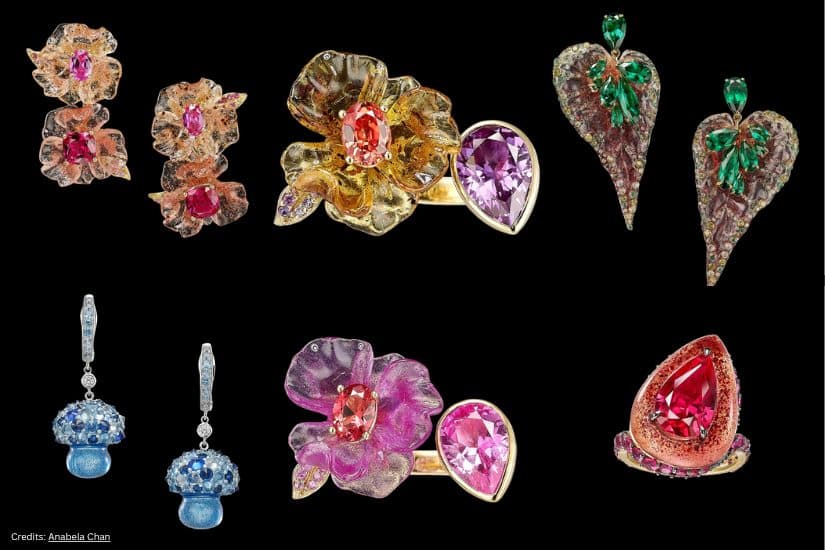
Hold the Elixir ring in good light and what you see reads, unmistakably, as a gemstone: deep, translucent, faceted to a saturated luster that a well-cut ruby produces. The stone is beetroot, reduced, pigment-extracted, and stabilized in a bio-resin foundation derived from avocado seeds, agave, and soybean.
That material is the center of Anabela Chan's Fruit Gems collection, three years of research and development out of her London studio that produced nearly 40 pieces built around eight distinct types of food-derived stones. The British-Chinese designer traced the idea back to volunteer work at Notting Hill Community Church, where she watched mountains of perfectly edible produce get discarded. "I saw how much food was coming through that was considered waste but was perfectly good," Chan said. She researched the scale of that problem and found that over a third of food produced in the West is thrown away annually: 9.5 million metric tons in the United Kingdom, 44 million in the United States. "It got me thinking that some of the most beautiful, vibrant colors come from nature," she said. "And humans have been extracting pigmentation from nature for thousands of years."
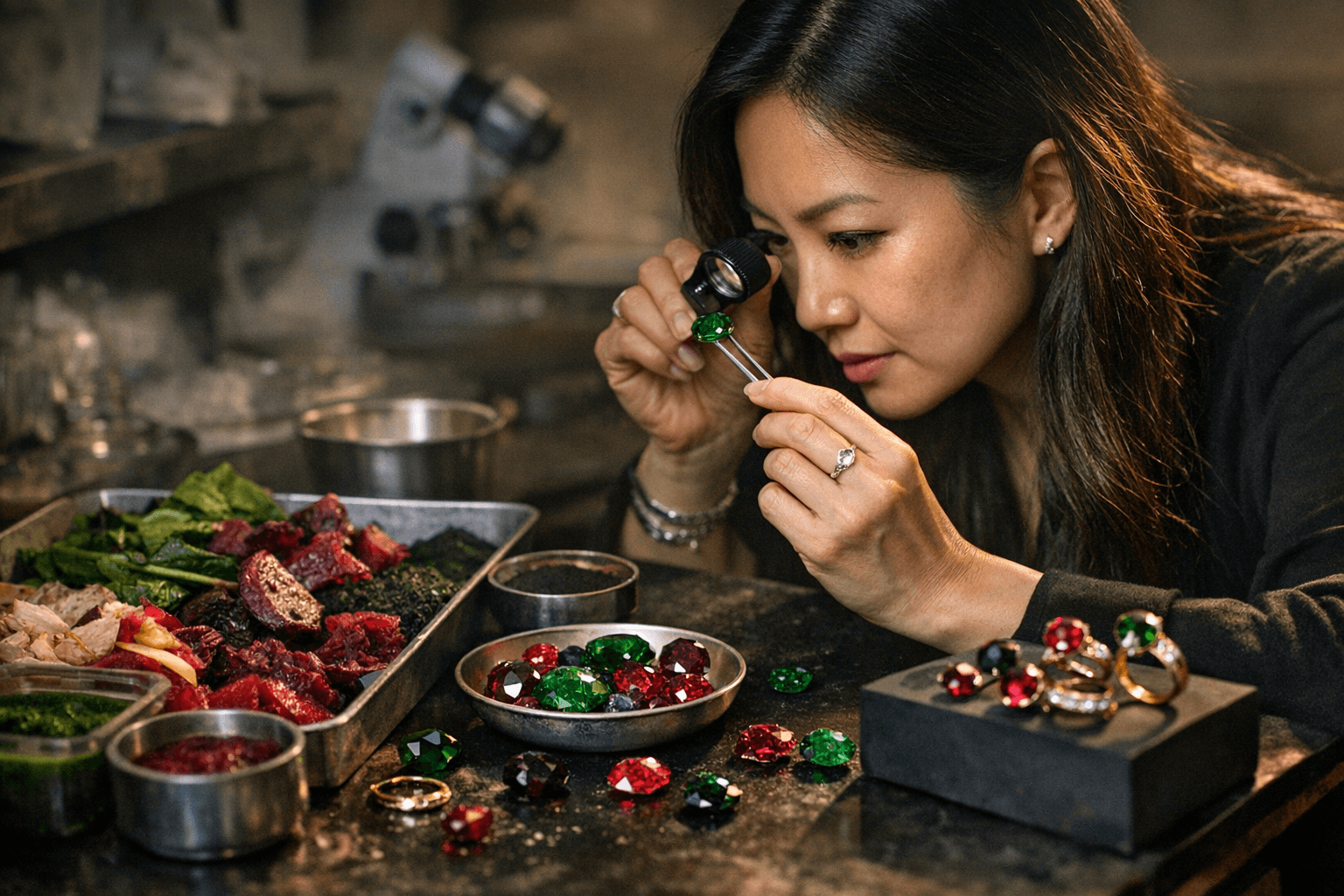
The process Chan developed in her London workshop pulls on exactly that tradition. Her team crushed, ground, simmered, air-dried, and freeze-dried fruits and vegetables to isolate and concentrate their pigments. The color logic is precise: carotenoids from dragon fruit and tomatoes yield red and orange; betalains from beetroot produce red and purple; anthocyanins from blueberries and spirulina render blue; chlorophyll from spinach and plankton gives green. Each pigment powder is then bonded into a plant-derived bio-resin base of corn, soybean, agave, and avocado seeds, producing a material with enough structural integrity to be cut, faceted, and polished using standard lapidary techniques, and stable enough to be cast like molten metal into fine jewelry settings. The process is also deliberately low-energy: Chan's initial reductions were done on a kitchen stove.
For a pared-back wardrobe, the collection offers a specific and practical entry point. Settings are clean bezel and prong work in 18-karat yellow gold vermeil, scaled for daily wear rather than occasion. The Garden ring pairs spirulina and spinach Fruit Gems with lab-grown orange sapphires, priced at $1,806. The beetroot Elixir ring, set with a lab-grown ruby with a black rhodium finish, is $1,666. The Virosa earrings, at $1,526, combine Regenerative Gemstone rose quartz with lab-grown pink sapphires and lab-grown diamonds. These are fine jewelry prices, and the silhouettes justify them: refined enough that the material reads as intention, not novelty.
Chan also developed what she calls Regenerative Gemstones alongside the Fruit Gems, using lapidary off-cuts of amethyst, lapis lazuli, malachite, and rose quartz, bound with bio-resin and infused with pigment from autumn leaves and twigs. The Chrysanthemum Citrine earrings reconstruct carved citrine from discarded fragments. Nothing in her studio, it appears, qualifies as waste.
The Fruit Gems collection follows her 2020 Blooms series, which used recycled and refined aluminum from soda cans, and her 2022 Mermaid's Tale line, built with ocean-waste metals. The through-line in all of it is a visit she made to the sapphire mines of Sri Lanka in 2012, where she watched workers extract some of the world's most valuable stones under conditions she found impossible to reconcile with the industry she had trained in at the Royal College of Art. "What excites me," she said, "is this idea of turning something really quite humble into something magical again by marrying science and art." A spinach stone, cut and polished and set in gold, makes that argument without saying a word.
Know something we missed? Have a correction or additional information?
Submit a Tip