Beaded Jewelry Is Back—But It’s Not as Sweet as You Remember
Beaded jewelry shed its camp nostalgia on the SS2026 runways at Celine and Chanel; worn in tonal micro-strands layered with fine gold, it reads sharp, not sweet.

Think about the last piece of jewelry you reached for this morning without deliberating. Probably a fine chain, sitting at the collarbone, doing that quiet thing where it catches light and then seems to vanish against your skin. Now imagine placing a single strand of small, polished onyx beads, about 4mm across, just above it. Nothing childhood about it. Nothing craft-table. Just graphic and grounded, the way a well-chosen signet ring grounds a hand.
That is precisely where beaded jewelry sits in Spring/Summer 2026: no longer pleading its case as a nostalgic accent or a beach souvenir, but renegotiating its place in the same wardrobe as your silk shirt and your sharpest tailoring. The transition is not accidental, and the runway evidence is specific enough to follow.
The Runway Reset
The story began to clarify itself during fashion month, when beads appeared at houses not typically associated with the craft-market register. At Chanel, under Matthieu Blazy, draped beaded necklaces were layered on top of looks in a way that felt architecturally considered rather than piled on. Etro and Chanel both sent gold and pavé-diamond beaded necklaces down the runway, pieces that share a vocabulary with beadwork but are built from the materials of fine jewelry. Super-long strands were wrapped multiple times at both houses, collapsing the distance between a sautoir and a beaded necklace into something new.
At Michael Rider's second collection for Celine, the bead moment read differently: stacks of colorful beaded necklaces worn alongside long beaded earrings, mixing shades and bead profiles with a confidence that belongs to someone who knows exactly what they are doing. Polo Ralph Lauren made a similar move, pairing beaded necklaces and earrings with piles of bracelets worn over crisp poplin shirts and cable-knit sweaters, which is perhaps the clearest proof of concept that beads can hold their own against intentionally restrained dressing.
And at Zankov, designer Presley Oldham, whose hand-strung strands have become coveted objects in their own right, showed jumbo-sized beaded chokers that reframed scale entirely. Oversized orbs are part of the story, but they are not the only part, and they are not the part that translates most cleanly into a minimalist wardrobe.
What Separates Polished Beads from Nostalgic Ones
The key variable is bead size. The pieces that photograph as "camp" and feel dated in the hand tend to cluster around 8mm and above, especially in opaque, saturated colors. The pieces generating the most interest for everyday, capsule-friendly wear are smaller: 3mm to 5mm polished gemstone beads that read more like a textured chain than a traditional bead strand. At that scale, the eye processes them as a sophisticated surface, not as individual units.
Tonal micro-bead chokers are particularly effective for this reason. When the beads match the stone color within a tight range, say cream pearls against a white or ivory ground, or matte black onyx beads worn close to the neck, the piece reads as a material statement rather than a pattern. It has the visual compactness of a delicate chain with the tactile warmth that metal cannot deliver.
The color logic matters, too. Marie Claire's Spring/Summer 2026 coverage made the case that "beads and natural stones add depth and personality, making jewelry feel expressive and personal rather than overly precious" — and that holds when the palette is controlled. Monochrome bead strands, particularly in black (onyx, obsidian, or black spinel), function almost as a neutral: graphic and high-contrast against skin or a white tee, but not competing with anything else in the look. Pearl strands operate the same way at the cool end of the spectrum.
The Metal Pairing Principle
The single most useful technique for integrating beaded pieces into a minimalist approach is the chain layer. A strand of small gemstone beads worn alongside an ultra-fine gold chain, at slightly different lengths, creates a relationship between the two pieces that makes both look more considered. The chain adds lightness; the bead strand adds body. Neither overwhelms the other. Marie Claire's Spring/Summer 2026 styling notes were explicit about this: mixing beaded elements with ultra-fine chains and delicate gold pieces allows beads to complement a minimalist capsule rather than disrupt it.
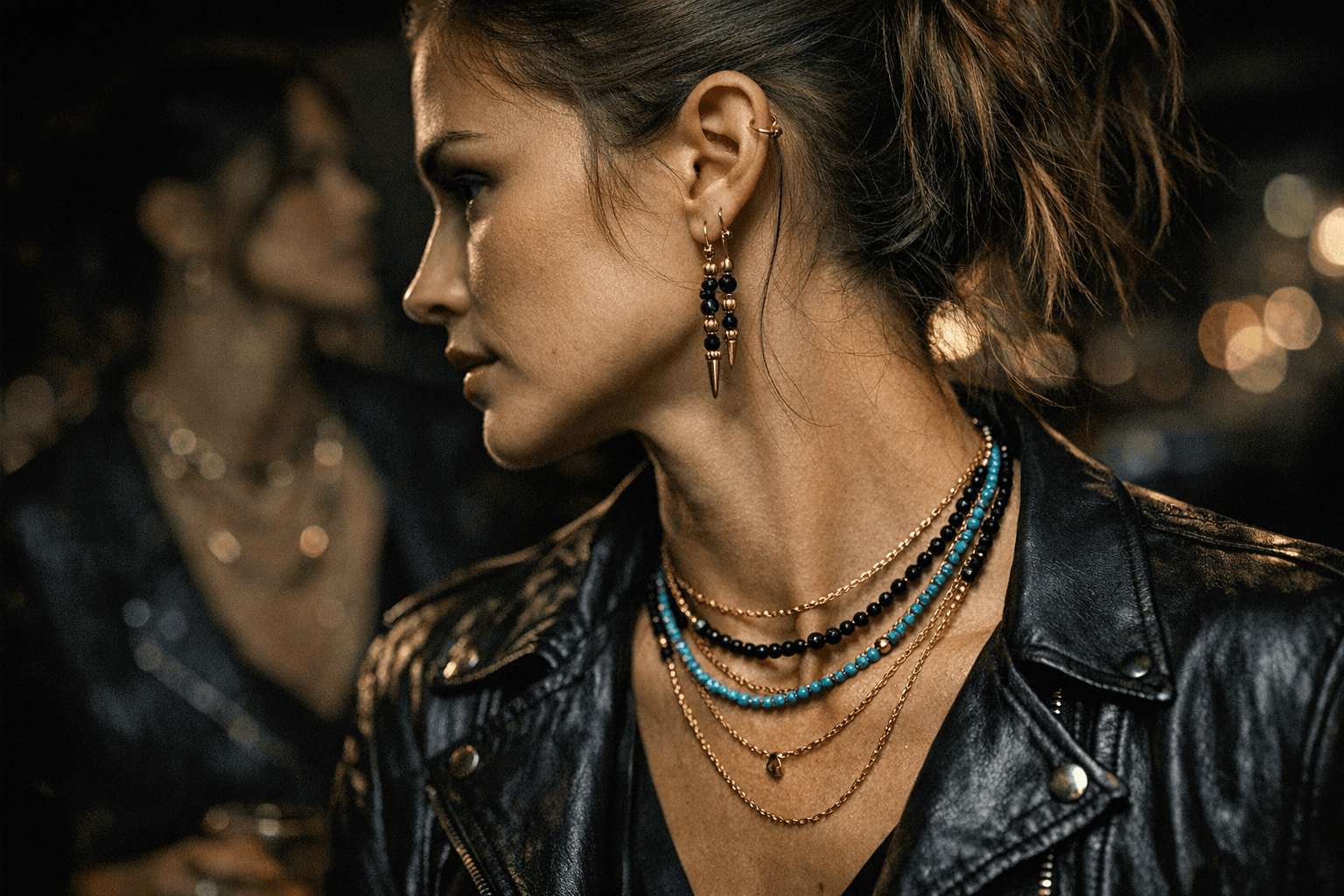
Yellow gold is the strongest pairing for warm-toned stones, including amber, citrine, and freshwater pearls. Sterling silver or white gold reads cleaner against black or gray bead strands, especially onyx. The metal does not need to match the beads; it needs to not compete with them.
Three Outfit Formulas Worth Screenshotting
The styling principles above converge into a handful of combinations that are specific enough to actually replicate:
- Tiny onyx beads + white fitted tee + structured blazer. A 3mm-4mm onyx strand, worn at collarbone length, sits directly on the collarbone and reads as a refined graphic element. The white tee provides contrast; the blazer provides structure. No additional necklace needed. This is the formula that makes beads look like a considered choice rather than a throwback.
- Single pearl bead strand layered with a fine gold chain. Wear the pearl strand slightly shorter, the gold chain falling a centimeter or two below it. The pearl bead strand should be graduated or uniform, not baroque or sculptural, so the silhouette stays quiet. This works over a silk slip dress, a linen shirt left open at the collar, or a ribbed tank. The two pieces together cost less visual attention than one statement piece.
- Tonal micro-bead choker + no other necklace + single fine hoop. The choker, at 3mm or under, sits high on the neck and finishes the neckline the way a band collar finishes a shirt. Keep the earring minimal, a 14k small hoop or a tiny stud, so the focus stays on the neck. This combination works for both a day meeting and an evening out without adjustment.
The Provenance Question
One thing the runway enthusiasm does not answer is where these beads are coming from. Polished gemstone beads, particularly onyx, spinel, and freshwater pearls, span an enormous range of sourcing practices. Onyx is primarily mined in Brazil, India, and parts of Africa, and supply chains are inconsistent in their transparency. Freshwater pearls from China dominate the accessible end of the market; conditions at pearl farms vary significantly and are not always independently audited.
If you are investing in a piece meant to last, it is worth asking whether the bead material is certified or traceable. Some independent jewelers working with gemstone beads now provide country-of-origin documentation; fewer can confirm labor practices at the cutting or polishing stage. This is not a reason to avoid the trend, but it is a reason to be selective and to ask directly before buying.
The best version of this moment is one where the polish in the jewelry extends all the way back through the supply chain, not just to the finished surface. At 3mm to 5mm, these pieces are small enough to seem inconsequential. The sourcing question is not.
*Sources: Marie Claire Spring/Summer 2026 trend coverage; Who What Wear runway reporting on Celine SS2026; Vogue runway coverage of Chanel Spring 2026; Porter jewelry trends SS26.*
This article was produced by Prism’s automated news system from verified source data, official records, and press releases, then run through automated quality and moderation checks before publishing. The system is built and supervised by the people who set the standards it runs under. Read our full AI policy.
Did this article answer your question?


