Boucheron reworks one silhouette into a study of human connection
One silhouette, five gemstone moods: Boucheron’s Human Being uses repetition and restraint to turn human difference into high jewelry’s main event.
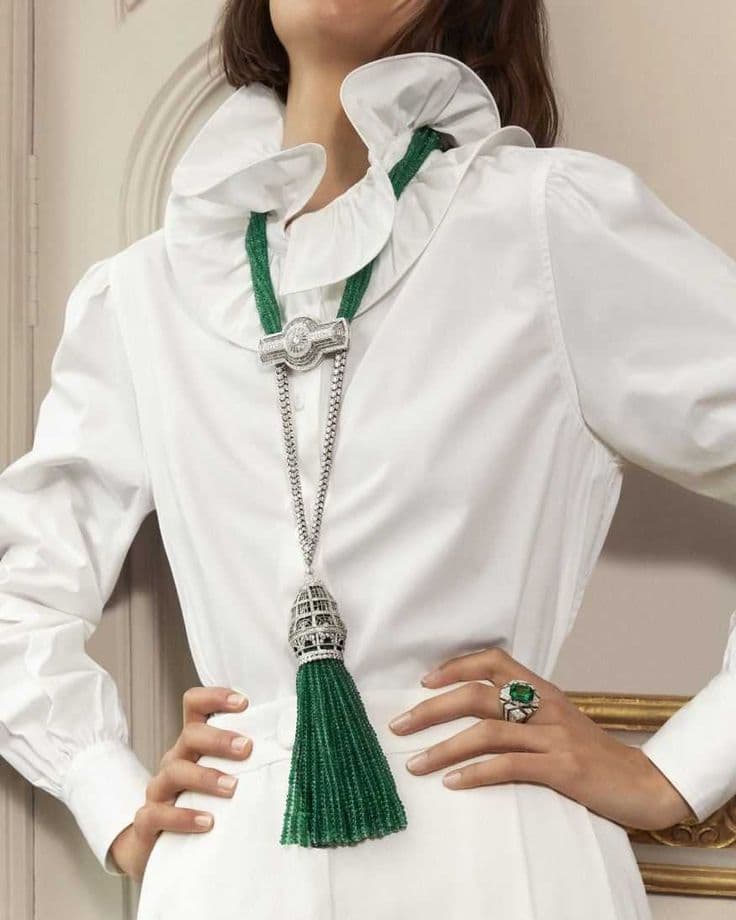
Boucheron builds Human Being on a simple idea that becomes richer the longer you look at it: one silhouette, repeated, adjusted, and re-seen across five jewelry sets. Claire Choisne lets shape do the heavy lifting, then shifts the mood through gemstones, volume, and light, so the collection reads less like a display of abundance than a study in connection. Unveiled during Paris Haute Couture Week on July 7, 2026, the 2026 Carte Blanche collection makes minimalism feel exacting rather than spare.
One silhouette, five vocabularies
The heart of the collection is repetition with discipline. Boucheron says “one and the same shape runs through every creation,” but each piece uses a different savoir-faire, which means the eye keeps returning to the same outline while the surface language changes from one set to the next. That is where the emotional charge comes from: consistency gives the collection its calm, while variation lets each jewel register as distinct.
The five sets are named Rain, Flower, Light, Tattoo, and Checkers. Those titles alone sketch a range from the organic to the graphic, and Boucheron uses them to organize the collection into distinct chapters without breaking the visual grammar. The result is a high jewelry suite that feels unified from afar and more intimate up close, where shifts in gemstone color, reflective quality, and structure become the real ornament.
Human connection as the subject
Boucheron dedicates Human Being to “what is most precious of all: the human being,” and the maison frames the collection around both the similarities that bring people together and the differences that make each person unique. That is a rare position for high jewelry, which often leans on rarity alone; here, the emphasis is on relation, not possession. The collection’s stated aim is to celebrate “being rather than seeming,” and that choice gives the work its quiet authority.
The restraint matters because it changes what luxury is asked to prove. Instead of piling on detail, the collection trusts one shape to carry meaning across five variations, with the differences expressed through materials and workmanship rather than overt display. In a category that can easily drift into excess, that is a minimalist principle at its most persuasive: consistency of form doing more of the work than decoration ever could.
Why the July unveiling matters
The timing sharpened the message. Boucheron unveiled Human Being in Paris during Haute Couture Week, a moment when the city’s jewelry and fashion houses compete on inventiveness, craftsmanship, and theater. Recent coverage has read the collection as a response to an increasingly artificial world, and that reading fits the way the jewels foreground the human hand through visible design decisions rather than spectacle for its own sake.
That emphasis on craftsmanship is especially telling for a house on Place Vendôme, where technical virtuosity often arrives wrapped in grandeur. Human Being feels more controlled than ostentatious, and the repetition of one silhouette across multiple gemstone treatments makes the craftsmanship easier to read, not harder. You are not looking for hidden complexity here; you are looking at how precision can create emotion.
Carte Blanche as Boucheron’s testing ground
Human Being also makes sense as part of Boucheron’s Carte Blanche program, the annual format the maison uses for creative freedom. Boucheron says Carte Blanche gives the studio complete freedom, and that loosened brief has become a way for the brand to push beyond conventional high jewelry narratives. The collection is not an isolated gesture, but the latest proof that Boucheron uses this platform to build conceptual pieces with a clear point of view.
That lineage matters when you compare it with the 2025 Carte Blanche collection, Impermanence. That project drew from Japanese ikebana and the philosophy of wabi-sabi, and it was organized through six botanical compositions, which shows how Boucheron has used Carte Blanche to move from one conceptual system to another without losing coherence. Impermanence looked to nature’s asymmetry; Human Being turns inward to shared form and individual difference.
How to read the collection
When you look at a collection built this way, the important question is not how much changes, but what stays fixed. Boucheron answers that by keeping the silhouette constant and letting the details shift through gemstones, light, and different modes of making. The eye learns to notice the smallest changes because the structure gives it something stable to hold.
- The repeated silhouette creates visual memory, so each variation feels related before it feels separate.
- The different gemstones change the emotional temperature of the same form without breaking its identity.
- The emphasis on savoir-faire keeps the collection grounded in craft, not concept alone.
- The five set names, Rain, Flower, Light, Tattoo, and Checkers, give the series range while preserving a single design language.
That is what makes Human Being such a precise exercise in minimalist high jewelry. Boucheron does not ask one shape to disappear into neutrality; it asks the shape to carry difference, and then proves that restraint can be as expressive as abundance.
This article was produced by Prism’s automated news system from verified source data, official records, and press releases, then run through automated quality and moderation checks before publishing. The system is built and supervised by the people who set the standards it runs under. Read our full AI policy.
Did this article answer your question?