How the Lavalier Necklace Became a Minimalist Jewelry Essential
Named for a French king's mistress and refined across three centuries, the lavalier earns its place in the minimalist rotation through proportion, drop, and studied restraint.
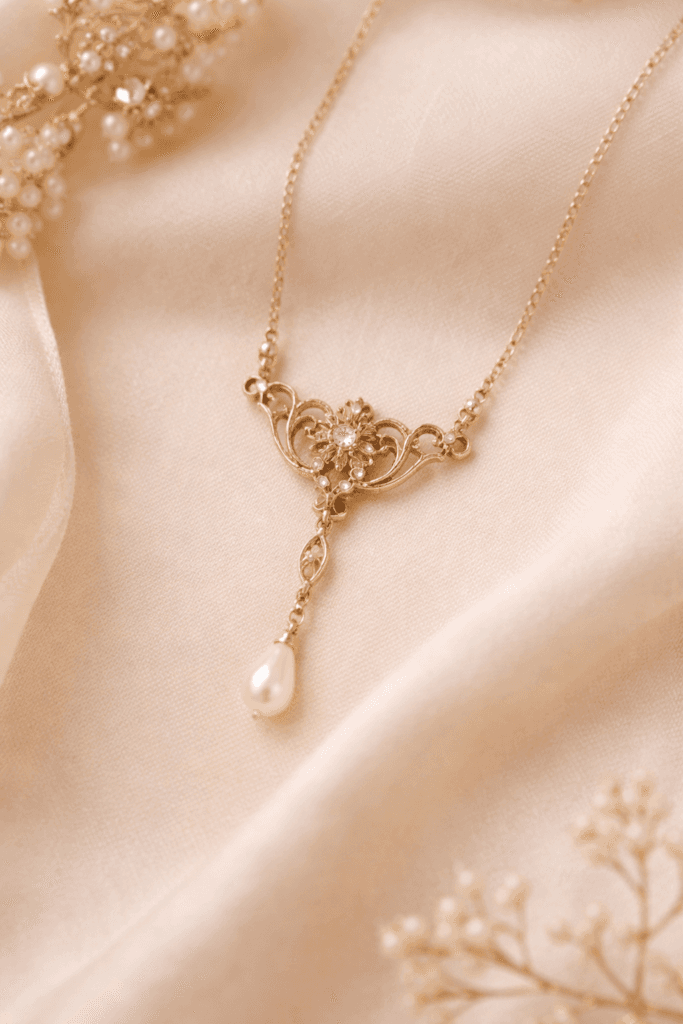
A thin pendant sitting just below the collarbone, its single drop catching light with every movement: that is the quiet power of the lavalier necklace. It does not shout. It does not stack or cluster or demand. What it offers, instead, is a precise vertical line and a self-contained elegance that has outlasted nearly every jewelry trend it predates. Understanding what a lavalier actually is, where it came from, and how it works in a modern wardrobe is the first step toward wearing one with intention rather than accident.
What Exactly Is a Lavalier
The lavalier (also spelled lavalliere or lavaliere) is a pendant necklace with a specific and non-negotiable structural logic: a fine chain suspending a small central ornament, finished at the bottom with a vertical drop. What separates it from an ordinary pendant is the attachment. A lavalier can be recognized most for its drop, usually consisting of a stone or a chandelier pendant, which is attached directly to the chain, not by a bail. That bail-free connection is the detail that matters. It keeps the pendant flat against the body, eliminates the visual interruption of a loop or jump ring, and gives the whole piece its characteristic fluidity. Lavaliers are more Y-shaped and usually feature fewer chain loops than festoon necklaces, and unlike ordinary pendant necklaces, they characteristically carry a dangling bottom element.
In terms of ornamentation, the lavalier's vocabulary is deliberately restrained. In pendant form, the lavalier often has delicate filigree work, sometimes with feminine and floral motifs. Antique lavalier pendants often feature seed pearls, old-cut diamonds, and soft-toned gemstones like aquamarine, amethyst, or garnet, all set in precious metals such as gold and platinum, with milgrain detailing on finer examples. This material restraint, small stones in open settings rather than bold clusters, is precisely what makes the lavalier compatible with minimalist dressing.
The Name and Its Origins
The etymology of the word lavalier is itself a piece of history. Lavaliers are believed to have been named after the Duchess Louise de La Vallière, the mistress of French King Louis XIV in the mid-17th century. Some have erroneously attributed the name to the French actress Ève Lavallière, whose career spanned the end of the 1800s; in fact, Lavallière received that stage name because she often wore that style of necklace. The actress effectively reversed the etymology, becoming so identified with the piece that later generations assumed she invented it.
According to Hans Nadelhoffer's 1984 book "Cartier: Jewelers Extraordinary," a special form of necklace produced around 1900 was the lavallière, described as an imaginative allusion to a fashion named for the actress Ève Lavallière, suspending two overlapping pendants of generally different lengths. The necklace itself often consisted of a simple silk cord with diamond sliding motifs, with imaginative end motifs that were often intertwined. Cartier made lavallières for royalty: Princess George of Greece received a lavallière with two diamond fir cones, and the Tsarina of Russia received one with amethyst acorns.
A Century of Evolution
The lavalier's arc across jewelry history is worth tracing, because each era left its fingerprints on the silhouette without fundamentally altering it.
In the last vestiges of the Victorian era, lavalier pendants were sweet and detailed, with floral motifs and delicate seed pearls. The Edwardian period that followed favored platinum and white gold, open lattice-work, and a cooler, more architectural refinement. Then came the Art Nouveau era, roughly 1895 to 1915, which leaned into organic motifs: Art Nouveau lavaliers were crafted in yellow gold, often featuring soft gemstones like amethyst and seed pearls, with chain lengths of 16 to 18 inches.
Art Deco examples were generally bolder and longer, and often featured a tassel at the end instead of a single dangle. During the early 1900s, a popular variation called the negligee featured two dangling elements of unequal lengths. The negligee read as more dramatic and asymmetrical; the classical lavalier, with its single centered drop, remained the quieter, more wearable option. That distinction still holds today.
The Visual Logic of the Drop
What makes the lavalier work as a minimalist piece is structural, not just stylistic. The vertical drop draws the eye downward along a single clean line, creating length and emphasis without surface noise. A conventional pendant, even a small one, sits flat against the chest and reads as a horizontal interruption. The lavalier's pendant-plus-drop format turns that logic on its head: the eye follows the chain down, pauses at the central ornament, and travels down once more to the drop. It is a two-beat visual rhythm rather than a full stop.

This vertical emphasis also means the lavalier performs differently across necklines. A V-neck mirrors and amplifies the Y-shape, creating a seamless line from collarbone to décolletage. A crew neck or high round neck provides contrast, letting the pendant hang as a clear focal point against a closed silhouette. Boat necks and square cuts, which frame the collarbone without competing with it, allow the lavalier to read as the sole ornament, which is precisely how it tends to look best.
Buying Guide: Settings, Stones, and Chain Length
When choosing a lavalier for a modern minimalist wardrobe, a few specific decisions determine whether the piece holds its character or tips into something heavier.
*Chain weight and length.* The chain should be fine enough that it recedes visually, directing attention to the pendant rather than the links themselves. A cable or trace chain in 0.8mm to 1.2mm width is ideal. Chain length matters for placement: a 16-inch chain sits at the collarbone and suits open necklines; an 18-inch chain drops just below the collarbone and works across a wider range of tops. Longer chains shift the lavalier into different visual territory and begin to lose the delicate proportion that defines the style.
*Metal tone.* Yellow gold reads warm and has clear historical precedent given the Art Nouveau era's preference for 14-karat and 9-karat gold. White gold and platinum align with Edwardian sensibility and complement cooler stone tones, particularly diamonds and aquamarines. Rose gold is a more recent interpretation, softer and contemporary. Whatever the metal, keeping the chain and pendant in the same tone preserves the lavalier's coherent vertical line.
*Stone size and setting.* The central ornament and drop should remain small enough to read as delicate rather than substantial. A single rose-cut diamond, a 4mm to 5mm pearl, or a small faceted gemstone like an amethyst or garnet is proportionally correct. Bezel settings, which encase the stone in a thin wall of metal, protect delicate stones and give a clean, modern edge. Open prong settings show more of the stone and allow light through, which suits diamonds and transparent gems. Filigree settings, the most historically faithful option, add texture without adding visual weight, because the openwork metal reads as light rather than mass.
- Avoid stones larger than 6mm for the central ornament; they shift the piece out of lavalier proportion and into statement-pendant territory.
- A drop that dangles freely rather than sitting rigid will move with the wearer, which is part of the lavalier's particular appeal.
- Milgrain edging, tiny beaded metal borders on the setting, adds period character to antique-inspired versions without making them look costumed.
Layering Without Losing the Line
The lavalier layers best when treated as the focal piece rather than one element in a crowded stack. A single fine chain worn slightly shorter, at 14 or 15 inches, can sit above it without visual conflict; anything longer risks tangling with the pendant drop. The key is separation by at least two inches between layers and avoiding other pieces with vertical drops at the same length, which creates visual confusion rather than depth.
If the lavalier is worn alone, it does not need competition. Antique lavalier pendants are characterized by a central drop suspended from a decorative element, designed to move gently with the wearer, drawing the eye and capturing the light. That movement is the point. Adding too many surrounding pieces stills it.
Why It Belongs Now
The lavalier's modern appeal is not nostalgia. It is function and proportion aligned with current taste. The minimalist jewelry conversation of the past several years has largely defaulted to simple bar pendants, solitaire studs, and thin stacking rings, all of which are sound but lack the structural interest the lavalier quietly delivers. A single lavalier introduces movement, verticality, and historical depth without requiring any additional pieces. It is, in the most literal sense, enough. The fact that it has been enough since the court of Louis XIV suggests it will remain so.
This article was produced by Prism’s automated news system from verified source data, official records, and press releases, then run through automated quality and moderation checks before publishing. The system is built and supervised by the people who set the standards it runs under. Read our full AI policy.
Did this article answer your question?


