Thin Bands, Bold Statements, and Smart Stacking Define Ring Trends Now
Whisper-thin bands and deliberate stacks are rewriting hand jewelry in 2026; here's how each ring trend upgrades your three most-worn outfits without visual noise.
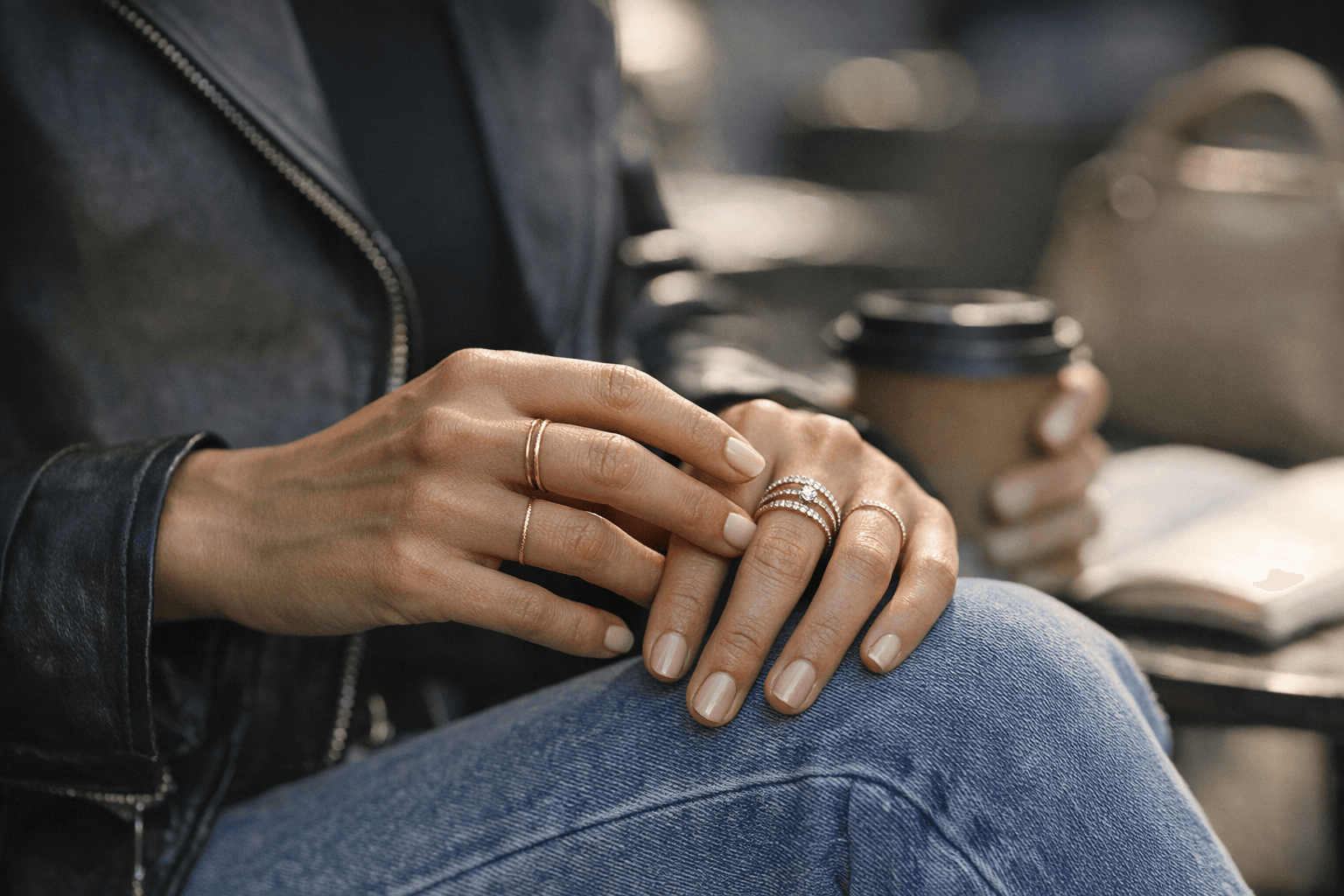
A single 1.5mm yellow gold band worn alone on the index finger has a way of stopping a conversation. Not because it's flashy, but because it's so precisely placed, so confident in its restraint, that it reads as a considered choice rather than an afterthought. That quality, the sense that every piece on your hand earned its spot, is exactly what makes the ring landscape worth paying attention to right now.
Four directions are shaping hand jewelry this season: the quiet authority of the thin band and slim signet; intentional, curated stacking; the rise of demi-fine pieces that perform like everyday fine jewelry; and the surprising coexistence of delicate bands with genuinely bold statement rings. None of these trends cancel each other out. The most interesting hands on the street are playing all four at once. Here is how to do it without noise.
The Thin Band and Slim Signet
Polished, unembellished gold bands have become a symbol of effortless luxury this cycle, and the slim signet, worn on the pinky or middle finger, is their natural companion. Think of both as sentence structures for hand jewelry: they set the tone for everything else. A whisper-thin pavé band, usually 1 to 1.5mm wide, catches light without demanding it. A signet, even at its most pared-back, brings architecture and just enough personal history.
The styling logic differs by outfit:
- White tee and jeans: One thin band on the middle finger is the only ring you need. Its simplicity reads as intention, not neglect, and the high contrast against the starkness of white cotton is where thin bands do their most persuasive work.
- Work blazer: The slim signet comes into its own here. Worn on the pinky of the hand not holding your phone or pen, it adds a flash of character without competing with the blazer's structure. Keep everything else bare on that hand.
- Slip dress: Two thin bands on different fingers of the same hand, spaced at least one knuckle apart, so each reads as a distinct choice rather than an accidental cluster.
One metal-matching shortcut that works across all three outfits: align your ring metal to the hardware on your bag or belt, then stop thinking about it. Yellow gold with gold-toned zippers. Silver with silver-buckled shoes. The coordination creates cohesion without effort.
*Short fingers:* Choose bands with oval or marquise stone profiles rather than perfectly round ones; the elongated geometry visually extends the finger. Keep band width at or under 1.5mm, since anything wider adds lateral bulk that shortens the digit further.
Intentional Stacking
Storied stacking, the practice of building a deliberate "ring wardrobe" on one or two fingers rather than scattering pieces at random, is the most versatile trend in this cycle. The key lies in balancing widths, silhouettes, and textures. A three-ring stack might include one flat band, one with a small bezel-set stone, and one with a subtle hammered or twisted surface. All thin. All in the same metal family. The variation in texture creates enough contrast to make the stack feel composed rather than uniform.
The non-negotiable spacing rule: leave visible skin between stacked rings. A gap of roughly 1 to 2mm between each band keeps every piece legible. Push them flush together and you lose the individual rings in compression, turning a considered stack into visual clutter.
- White tee and jeans: A three-ring index-finger stack is the only jewelry you need. The outfit's neutrality gives the stack room to be the whole story.
- Work blazer: Keep the stack to two rings on one hand only, leaving the other hand completely bare. A blazer already carries visual weight at the shoulder and lapel; adding rings to both hands competes with the structure you are already paying for.
- Slip dress: Four thin rings across the middle and ring fingers of one hand, worn as two pairs, creates a deliberate hand-jewelry moment that reads as dressed-up without the heaviness of a cocktail ring.
Personalization is driving much of the appeal in storied stacking. Birthstone accents, initial signet bands, and custom-engraved interiors turn a stack from a styling exercise into something closer to autobiography. The pinky finger remains an underused canvas: a small signet or single sculptural band there adds a finishing note to a fuller stack without interfering with traditional ring placements elsewhere.
*Long nails:* Manicured length already elongates the visual line of the finger, which means you can afford to stack slightly wider bands, up to 2mm each, without the hand looking crowded. The added length absorbs the proportion shift.
Demi-Fine That Behaves Like Fine
The category that used to sit awkwardly between costume and fine jewelry has matured. Demi-fine pieces, typically thick gold vermeil or sterling silver with genuine stones in solid settings, now perform with the durability and visual finish of everyday fine jewelry. The distinction that matters for a minimalist capsule is not price but construction: look for vermeil with at least 18k gold over sterling, secure prong or bezel settings, and stones described as genuine rather than "inspired by." These are pieces that transition seamlessly from a morning meeting to a late dinner without requiring a swap.
- White tee and jeans: A demi-fine bezel-set band in warm yellow gold is the outfit. No other ring needed. The neutrality of the look amplifies the ring's quality in a way that works only when the piece is genuinely well-made.
- Work blazer: A demi-fine half-eternity band adds consistent, low-level sparkle across the top of the finger. Because the stones are small and the band is thin, it registers as polish rather than decoration.
- Slip dress: The demi-fine category earns its value most here, giving access to a slim pavé eternity or a delicate twisted band at a price that doesn't require justification the morning after.
On provenance: as sustainability becomes more central to buying decisions, look for brands that disclose their metal sourcing, clarify whether stones are lab-grown or ethically mined, and confirm that vermeil meets a minimum thickness of at least 2.5 microns. Vague claims about "conscious jewelry" without those specifics are a signal to ask more direct questions before purchasing.
*Small hands:* Scale stone diameter to 2mm or under for demi-fine pieces. A bezel-set ring with a 3mm or larger stone can overwhelm a smaller hand; the ring reads as larger than intended, and the quiet precision that makes demi-fine appealing disappears entirely.
Mixing Scales: Thin Bands Beside Statement Rings
The most counterintuitive direction right now is the deliberate pairing of ultra-thin bands with a single genuinely bold statement ring, whether a sculptural dome, a chunky signet, or an oversized cocktail silhouette. Worn on the same hand but on different fingers, the contrast makes both pieces more interesting. The thin bands prevent the statement ring from reading as costume; the statement ring gives the thin bands context and weight.
One statement ring per hand is not a guideline here; it is the rule that makes the look function. Two statement rings on the same hand creates competition. One, surrounded by two or three thin companions, creates conversation.
- White tee and jeans: Let the statement ring be the sole bold note, nothing else on either hand. The outfit absorbs the ring's presence without resistance, and the effect is confident rather than overdressed.
- Work blazer: Position the statement ring on the hand opposite your watch, distributing visual interest across the body rather than concentrating it on one side.
- Slip dress: A sculptural statement ring plus two thin gold bands on an adjacent finger constitutes a fully realized hand-jewelry look. Nothing more is needed.
When mixing metals within the scale-contrast approach, anchor at least two of three rings in the same metal tone and let the contrasting metal appear in just one piece. The difference in visual weight between a bold ring and a thin band draws the eye first; metal contrast, when it appears, then reads as intentional layering rather than oversight.
*Short fingers:* Choose a statement ring with a vertical design element, an oval stone, a tall signet face, or an elongated sculptural shape, rather than a wide dome or flat square. Wide horizontal forms visibly shorten the finger. Keep companion thin bands at 1mm or below to avoid adding any further lateral weight.
Building the Capsule
A minimalist hand-jewelry capsule does not require many pieces. It requires the right proportions: one or two thin bands as the foundation, one slim signet for structure, one genuine statement ring for contrast, and the restraint to leave some fingers completely bare. The most common mistake in building a ring wardrobe is filling every finger; the second most common is buying only thin bands and wondering why nothing reads. Both problems resolve with the same solution: scale contrast, intentional spacing, and the understanding that negative space on the hand is not absence. It is part of the composition.
This article was produced by Prism’s automated news system from verified source data, official records, and press releases, then run through automated quality and moderation checks before publishing. The system is built and supervised by the people who set the standards it runs under. Read our full AI policy.
Did this article answer your question?


