How to Clean Gold Vermeil Jewelry Without Stripping Its Finish
Gold vermeil's finish survives daily wear — but only if you avoid three specific mistakes most wearers make without realizing it.

The thin gold chain sitting at your collarbone, the one that catches afternoon light like something much more expensive, is not solid gold. Almost certainly it is vermeil: sterling silver beneath a layer of real gold, pressed to a legally mandated minimum of 2.5 microns. That distinction matters enormously the moment you reach for the wrong cloth, the wrong cleaner, or the wrong habit. Gold vermeil requires a different approach than solid gold or standard gold-plated jewelry, and the gap between a piece that lasts years and one that exposes its silver base after a few months comes down almost entirely to what you do, and don't do, at home.
Why Vermeil Fades: The Real Culprit
Before the cleaning steps, it helps to understand the enemy. The primary cause of vermeil degradation is not time — it is the combination of abrasion and chemical exposure working simultaneously. Exposure to chemicals like perfumes, lotions, and deodorants can contribute to tarnishing over time. Those same chemicals, paired with the friction of fabric, skin, and stacking against other pieces, gradually thin and lift the gold layer from below. Dust, dirt, and traces of chemicals from lotions, perfumes, hair products, body oils, and pH levels can all cause your jewelry to tarnish. Sweat is particularly corrosive because its salt and acid content attacks both the gold surface and the bond between the gold and the silver base.
Solid gold survives this because it is gold all the way through. Vermeil cannot afford the same tolerance. At 2.5 microns — roughly 0.0025 millimeters — the gold layer has no reserves. Every abrasive contact, every harsh chemical rinse, takes a fraction of that budget permanently.
Never Do These Three Things
Before the care routine, the damage-prevention list. Three cleaning methods are commonly attempted on vermeil and all three accelerate the very degradation you are trying to reverse.
- Ultrasonic cleaners. Ultrasonic cleaners can erode the gold layer quickly. These machines use high-frequency vibrations to dislodge dirt, and they are excellent for solid gold and platinum. On vermeil, those vibrations attack the bond between the gold plating and the silver substrate. A single session can remove months' worth of finish.
- Toothpaste. This is perhaps the most persistent household myth in jewelry care. Toothpaste is mildly abrasive by design — that is what makes it effective on enamel. The chemicals in toothpaste can interact with the metals and damage the finish. Even "gentle" formulas contain micro-particles that scour a vermeil surface. Put the toothpaste down.
- Prolonged soaking. Water is not inherently dangerous to vermeil, but time changes that equation. For gold vermeil or gold-plated rings, keep soaking brief and avoid vigorous rubbing. Extended submersion allows water to work into micro-fractures in the plating and begin undermining the adhesion between gold and silver. Soaking should be kept to between one and three minutes.
The 8-Step Cleaning Routine
This sequence is optimized for speed and safety. It takes under ten minutes, requires no special equipment, and is the fastest method that will not cost you finish.
1. Gather your supplies first. You need a small bowl, lukewarm water, two or three drops of mild phosphate-free dish soap, an ultra-soft cloth or microfiber cloth, and optionally a very soft brush — a baby toothbrush works well.
Do not substitute: no jewelry-polishing cloths with embedded compounds, no silver cloths, no paper towels.
2. Mix a mild soapy solution. The water should be lukewarm, not hot.
Heat accelerates chemical reactions and can expand metal slightly, which stresses the plating bond over repeated exposure.
3. Submerge briefly. Submerge your jewelry for no more than five minutes.
Set a timer. This is enough to loosen surface oils, sweat residue, and product buildup without saturating the piece.
4. Brush gently if needed. For pieces with settings, chains with links, or pendants with texture, a soft brush lets you reach crevices without bearing down on flat surfaces.
Use the lightest pressure. Gently scrub your jewelry with a soft, bristle-free cloth or toothbrush, which is perfect for intricate pieces like rings or layered necklaces.
5. Rinse under lukewarm running water. Keep the temperature consistent.
A sudden shift from warm soapy water to cold tap water is a minor thermal shock, repeated enough times to matter over a piece's lifespan.
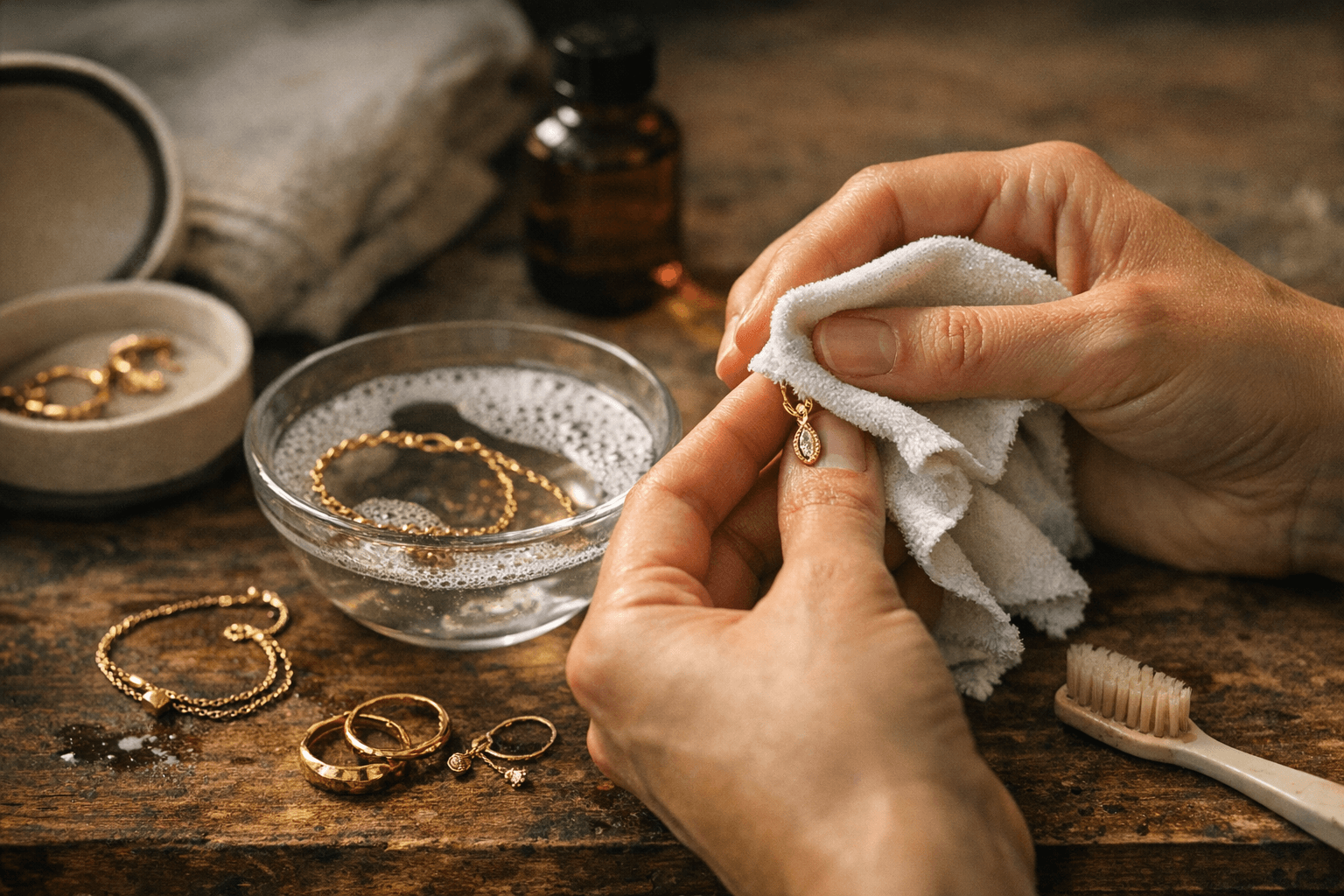
6. Pat dry immediately with a microfiber cloth. Do not rub.
The action of drying is the moment of highest abrasion risk in the entire process. Pat the surface, let the cloth absorb the moisture, and work your way across the piece section by section.
7. Air-dry completely before storing. Even after thorough patting, moisture can sit in chain links or beneath settings.
Lay the piece flat on a dry microfiber cloth for at least fifteen minutes before putting it away. Store dry, separately in a pouch or compartment to minimize friction.
8. Wipe after every wear, even when you haven't cleaned. After wear, wipe gently with a soft, dry microfiber cloth.
This single habit, done consistently, removes the sweat and product residue that compound into tarnish and plating damage if left overnight.
Is It Tarnish or Worn-Through Plating? How to Tell
This is the most important diagnostic question for any vermeil owner, because the answer determines whether home care can help or whether you need a jeweler.
Tarnish appears as a dull, hazy film over the gold surface. It may have a faintly yellowish or brownish cast, and critically, the piece still reads as gold-toned when you look at it straight on. Tarnish is a surface phenomenon — oxidation that sits on top of the metal. It is reversible with the soapy-water method above. If your gold vermeil is starting to look a little dull or scratched, it is time to give it some TLC.
Worn-through plating is a different problem entirely. Look for patches that appear distinctly silver or grey, especially at high-contact points: the backs of rings, the inside of bracelet curves, the areas where a necklace drapes against your neck. These areas receive the most friction and lose their gold layer first. Once the silver substrate is visible, no amount of home cleaning will restore the gold color in those spots.
What to Do When It's Already Turning Silver
If you are seeing silver-toned patches, home cleaning will not reverse the damage, but it can prevent it from spreading. Clean gently using the routine above to remove any surface tarnish from the remaining gold areas. Then store the piece carefully and consult a jeweler about replating.
Gold vermeil can be replated effectively because the sterling silver base bonds well with gold. The process involves stripping the remaining gold layer, polishing the silver base, and applying a fresh gold coat. Not every jeweler offers this service, but many do, and the cost is typically a fraction of replacing the piece. For pieces you love and wear constantly, replating every year or two is a reasonable part of ownership.
Daily Habits That Make the Difference
The most effective vermeil care happens before you put the piece on. Put jewelry on after skincare, SPF, and perfume. Applying products while wearing vermeil means those chemicals sit directly against the gold layer for hours. Putting jewelry on last, after everything else has absorbed or dried, dramatically reduces chemical exposure.
Avoid swimming or showering while wearing gold jewelry, as chlorine, salt water, and fresh water can damage precious metals. The chlorine in pools is particularly aggressive. Even brief contact is worth avoiding when a piece matters to you.
Storage deserves more thought than most people give it. Pieces knocked against each other in a jewelry dish are abrading each other constantly. Individual pouches — even the small organza bags that often come with jewelry purchases — keep surfaces separated and protected from dust and humidity.
Vermeil rewards attention disproportionately. The difference between a piece that looks new after two years and one that has gone dull and patchy after six months often comes down to a handful of daily minutes and three things you simply stop doing. The gold is thin, but it is real, and with the right routine, it holds.
This article was produced by Prism’s automated news system from verified source data, official records, and press releases, then run through automated quality and moderation checks before publishing. The system is built and supervised by the people who set the standards it runs under. Read our full AI policy.
Did this article answer your question?


