‘Kutchinsky’s Egg’ Outlines One Jeweler’s Obsession and His Downfall
When Paul Kutchinsky bet a century-old family business on the world's largest jeweled egg, 24,000 pink diamonds couldn't save him from ruin.
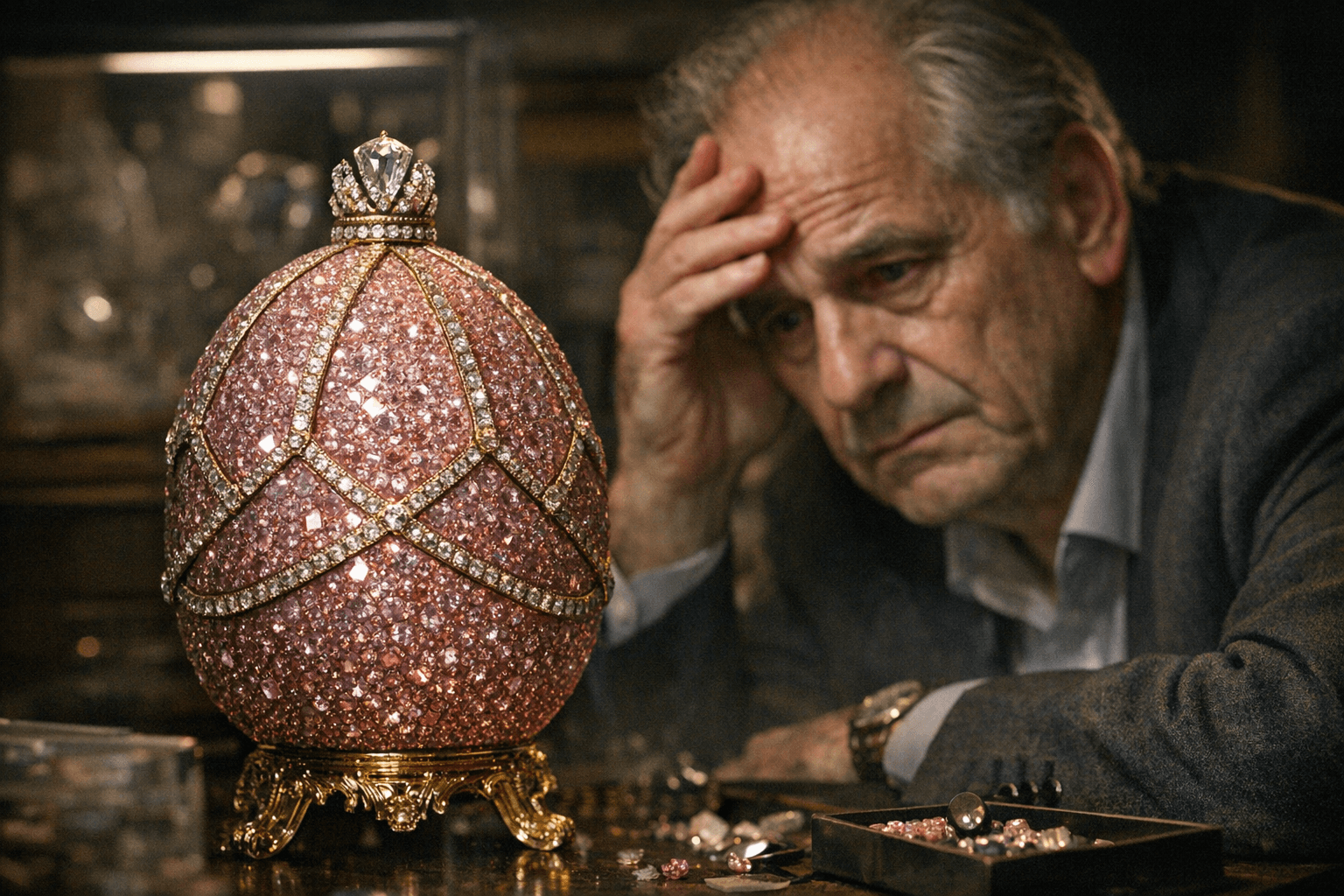
Thirty-three pounds of 18-carat gold. Twenty-four thousand pink diamonds, each one hand-selected by a single man who believed he was building something for the ages. Six master craftsmen in a London workshop, logging 7,000 hours across ten months. The Argyle Library Egg, completed in April 1990 by Paul Kutchinsky, stands as one of the most technically extraordinary objects ever produced by a jeweler. It is also the object that destroyed him.
That paradox sits at the center of Serena Kutchinsky's debut memoir, "Kutchinsky's Egg: A Family's Story of Obsession, Love, and Loss," published by Simon & Schuster. Serena, a journalist who serves as head of news at The i Paper and has previously worked at Sky News, BBC News, and Newsweek, spent a decade tracing the story of her father Paul and the two-foot jeweled behemoth that collapsed his business, ended his marriage, and shortened his life. When she was nine years old, Paul had confided to her: "I'm going to make a giant golden egg, the biggest in the world. Bigger than Fabergé's." He promised it would be "nearly as tall and beautiful as you, with thousands of pink diamonds in it." He was not wrong about the diamonds.
A Hundred-Year House
The House of Kutchinsky did not begin in Knightsbridge. It began in 1893 with a more urgent kind of ambition: Serena's great-great-grandparents fled the pogroms of Grabow, Poland, intending to emigrate to America. They stopped in London. Her great-great-grandmother Leah had sewn jewelry heirlooms into her skirts for the journey; those pieces funded the tools that allowed Hersh Kutchinsky to begin working as a watchmaker. From that immigrant ingenuity, a dynasty grew.
By mid-century, the house had relocated to Brompton Road in Knightsbridge, where its client list came to include Elton John, Elizabeth Taylor, and the Sultan of Brunei, who commissioned jeweled golden figurines of Simpsons characters for his children. (No public photographs of these exist; their copyright status was quietly finessed by the simple fact that almost no one has ever seen them.) Paul himself, the heir who would eventually take the reins alongside his brother Roger, once chatted with Prince Charles about Aston Martins. The house's aesthetic was distinctive: bold cabochon stones in tiger's eye, turquoise, lapis lazuli, and malachite, often offset against diamonds or onyx, with a recurring use of coral that gave the work an organic richness uncommon in London fine jewelry. It was a house with a recognizable signature and a loyal, international clientele. Then Paul became fixated on an egg.
The Object Itself
The Argyle Library Egg was conceived as a direct challenge to Fabergé, whose jeweled eggs for the Russian imperial family had defined the upper limit of ornate goldsmithing for a century. Paul partnered with the Argyle diamond mine in Australia, at the time the world's only significant producer of pink diamonds, and had the egg fabricated at the De Vroomen Alexander workshop in London. Standing just over 60 centimeters tall, it was fashioned from sheets of 18-carat gold engraved with elaborate rococo-style patterns. Its interior, honoring Fabergé's tradition of hiding a "surprise" within each egg, was designed to open and reveal a rotating miniature library and portrait gallery, its five enameled frames modeled on a design that Fabergé had originally made for the Russian tsars. To activate this interior, Paul installed a complex electronic mechanism capable of pulling back the shell and spinning the display.
That mechanism would prove to be a recurring problem. After the egg's debut at a Victoria and Albert Museum showcase of British craftsmanship in 1990, it traveled to the Melbourne Cup in Australia the same year, then continued a world tour in search of a buyer. The electronic system reportedly developed technical faults along the way. A two-foot gold object with 24,000 hand-set stones and a motorized interior was not engineered for the indignities of repeated international shipping.
The 1991 Guinness Book of World Records named it the world's largest jeweled egg, a designation that did not translate into a sale. Paul Kutchinsky had estimated its value at £7 million. He found no takers.
Precision at Scale
For any jeweler who considers the Argyle Library Egg's construction, the tolerance demanded at the intersection of its disciplines is what commands the deepest respect. Pink diamonds from the Argyle mine, among the rarest gemstones on earth, were set into the curved gold surface using claw and pavé techniques precise enough to maintain structural integrity across a compound form. Each stone was placed individually, under magnification, with fine-tipped tools. The 7,000 hours logged by six craftsmen is not a round number invented for press releases: it reflects the actual cost of setting thousands of individual stones on a surface where a single misaligned prong would disrupt the visual continuity of the whole.
This is the detail that connects the egg's extreme scale to the humbler precision of delicate everyday jewelry. A wafer-thin pavé eternity band set with 1.5-millimeter diamonds demands the same fundamental tolerances, per millimeter, that the De Vroomen workshop applied per centimeter across the egg's surface. The difference is one of spectacle, not of skill. If anything, the thinness of a fine everyday piece leaves less room for error, because there is less metal to absorb it.
The Collapse
Paul's primary market for a sale was the wealthy Middle Eastern clientele who had sustained Kutchinsky through the go-go luxury years of the 1980s. The Gulf War demolished that market just as the egg was completing its world tour. "The thing is, darling," a former colleague of Paul's told Serena during her research, "discretion is everything in our business." It was a maxim Paul had conspicuously abandoned in his pursuit of global attention for an unsellable object.
The financial failure cascaded through every part of his life. Paul had an affair with a sales assistant at the pink diamond dealership, the same firm that had supplied the stones for his great project. In Serena's mother's telling, the egg was the origin of every subsequent sorrow. The House of Kutchinsky collapsed. A hundred years of jewelry heritage was sold within a year. Paul sank into drink and drugs. He died in March 2000, two days after his 50th birthday, in a car crash in Spain. He was 50.
"In our family," Serena writes, "the egg was less an object and more a fault line. It ran right through my childhood."
The Daughter's Search
For years after the business collapsed, the egg simply disappeared. Possession had reverted to Argyle Mining, which used it as a promotional centerpiece and displayed it in the Australian Pavilion at the 1992 Universal Exposition in Seville. It sat afterward in a bonded warehouse. Eventually it was sold to Kenichi Mabichi, a Japanese businessman in Tokyo, who purchased it for approximately ¥800 million (around £4.3 million) and placed it in the foyer of his chateau. The unsellable egg had, finally, sold.
Serena knew none of this until she began reporting. The memoir originated as a Father's Day pitch to a publication she contributed to, a story she had previously shared only as an anecdote to entertain friends. Writing it changed the nature of the material. "Once I started telling the story properly," she has said, "I realized it wasn't complete unless I knew what had actually happened to the egg." The investigation ran for a decade and led her to archives, former colleagues, and ultimately to the egg itself. "There was a sense of lineage I didn't quite know how to step into," she has said of the jewelry world she had spent years holding at arm's length.
The memoir she produced from that search, which Publishers Weekly called "spellbinding" in a starred review, does not traffic in simple condemnation of her father. It holds him with the complexity he deserves: a craftsman with genuine taste and skill who allowed one idea to override every discipline that had made the house worth inheriting. Serena's account of Paul standing backstage at a promotional event, invisible alongside Engelbert Humperdinck and boxer Nigel Benn, reaching for a hip flask before presenting the egg to the room, is the memoir in miniature: a man who built something extraordinary and could not find the world willing to receive it.
The Lesson the Egg Leaves
There is a persistent temptation in high jewelry to equate scale with mastery. The Argyle Library Egg complicates that equation permanently. Six craftsmen, 7,000 hours, 24,000 hand-selected pink diamonds: the technical achievement is genuine and should be read as such. But the egg also demonstrates what becomes of engineering ambition when it outruns commercial reality. A singular object priced at £7 million, in a market suddenly frozen by geopolitical crisis and stripped of its primary buyers, is not a triumph of craft. It is a liability wearing a very fine coat of gold.
Paul Kutchinsky built something that earned a place in the record books. His daughter spent a decade finding it, and in the process constructed something more durable: a lucid account of what happens when a jeweler mistakes spectacle for purpose, and pays for it with everything he had.
Know something we missed? Have a correction or additional information?
Submit a Tip