Tiffany's Beijing Flagship Translates Elsa Peretti's Sculptural Forms Into Architecture
Tiffany's four-story Beijing flagship wraps Elsa Peretti's Bone Cuff in architecture: MVRDV's recycled glass fins shift through shades of Tiffany Blue as the light moves.
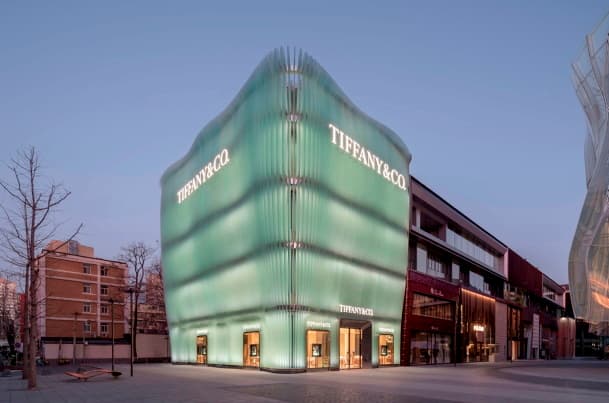
The Bone Cuff, Elsa Peretti's sculptural bracelet that wraps the wrist in one smooth, body-contoured arc, has now been scaled to 20 meters.
Tiffany & Co. opened its Beijing flagship at Taikoo Li Sanlitun on March 14, marking the jeweler's most explicit attempt yet to let designer heritage drive not just the cases inside but the skin of the building itself. Dutch architecture firm MVRDV, led by founding partner Jacob van Rijs and head of interior Aser Gimenez Ortega, sheathed the four-story, 1,000-square-meter store in translucent glass fins that curve and layer along the facade's full height, deriving their formal logic directly from the Bone Cuff's organic silhouette.
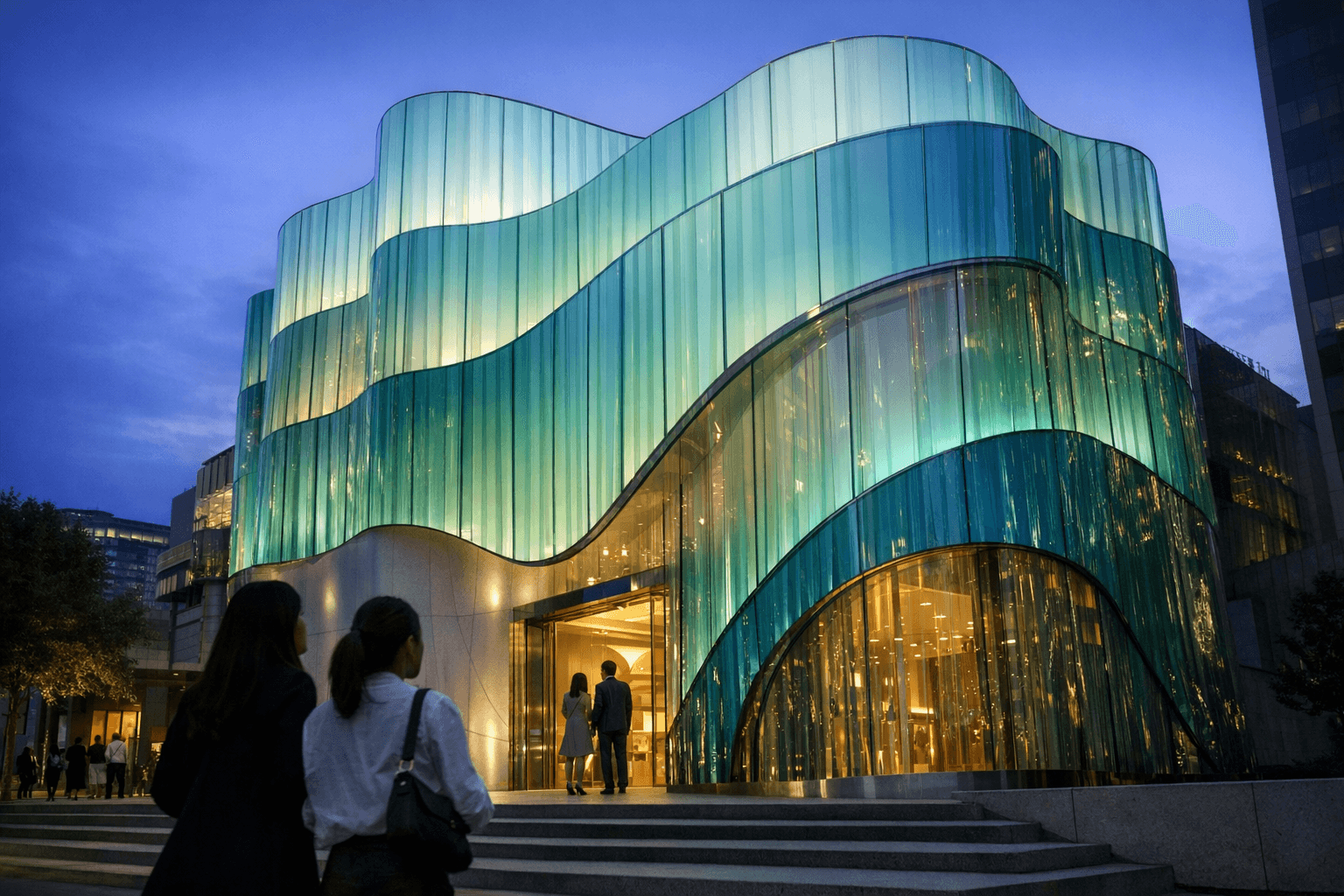
The glass carries a natural blue tone that deepens as light passes through multiple overlapping layers, cycling through what anyone familiar with the brand immediately recognizes as Tiffany Blue. At night, integrated lighting embedded in the mounting brackets illuminates the fins evenly from within, turning the building into a lantern at the luxury crossroads in the northern section of Taikoo Li Sanlitun. The fins were locally manufactured in China from recycled glass, and the facade was engineered to be demountable: fins and brackets can be removed and recycled at the end of their lifespan.
"When viewed from an angle, the layering effect of the dense glass fins amplifies the effects of the light, highlighting the facade's shape," van Rijs said. "As you pass close to the building, you see glimpses in between the fins to the jewellery inside."
The Beijing store is the fifth MVRDV-designed facade for Tiffany, following earlier collaborations including stores in Shanghai's Taikoo-Li Qiantan and Singapore's Changi Airport. It is the first in the series to derive its form from a single named piece.
Peretti, who died in March 2021 at 80, began designing for Tiffany in 1974 and fundamentally reframed what sterling silver could command. Her sensibility was rooted in the body and in nature: smooth finishes, organic geometries, pieces meant to be worn rather than displayed. The Bone Cuff, the Beans, the Open Heart each traced the same conviction that jewelry and skin should feel continuous. Scaling that logic onto a building facade is an act of institutional faith in a designer who has been dead for five years.
Inside, a champagne gold leaf ceiling and crystal chandeliers greet visitors on the first floor, with handcrafted walls carrying gilded accents throughout. The floor plan, at 1,000 square meters across four stories, presents the Tiffany HardWear, Lock, Knot, and T collections alongside high jewelry, making the store a full-range destination rather than a category boutique. CEO Anthony Ledru described the space as "a cultural hub" that extends beyond traditional retail.
Tiffany first opened on the Chinese mainland in 2001 and now counts more than 40 stores across the country. The Beijing flagship positions Peretti's design vocabulary as the house's most durable architectural argument: what holds a bracelet together holds a building together just as well.
This article was produced by Prism’s automated news system from verified source data, official records, and press releases, then run through automated quality and moderation checks before publishing. The system is built and supervised by the people who set the standards it runs under. Read our full AI policy.
Did this article answer your question?


