Moissanite size guide explains DEW and millimeter dimensions
DEW can flatter moissanite on paper, but millimeters decide how it looks and fits. Here is the sizing logic to check before you buy.
Charles & Colvard lists one round Forever One stone at 7.75 ct DEW with dimensions of 13.0 mm. That gap between DEW and millimeters is the trap in moissanite shopping: a stone can sound large in DEW and still look nothing like you expected once it is set. Diamond-equivalent weight is a comparison language, not a physical measurement, and the millimeter figure is the number that tells you what the stone will actually occupy in a ring head, a halo, or a bezel. If you want the center stone to meet a wedding band cleanly or sit correctly in a stock setting, you need to read the listing the way a setter would.
Why DEW is only part of the story
DEW stands for diamond equivalent weight, a way to compare a gemstone’s weight to a diamond of similar size because stones such as moissanite have a different density than diamonds. Grace Von uses the term that way. That distinction is the whole point of the label: DEW tells you what the stone is meant to resemble, not what it literally measures. That is why moissanite listings can feel familiar and misleading at the same time.
Against that 13.0 mm round stone, Charles & Colvard lists a marquise stone at 0.13 ct DEW with dimensions of 5.0 x 2.5 mm. Those two stones are not interchangeable just because both carry a weight-equivalent label; the round stone presents a far larger face-up footprint, while the marquise is narrow and pointed, with a very different presence in a mounting.
Millimeters are the number that affects fit
Millimeter dimensions tell you what the setting must physically hold. That matters whether you are choosing a bezel, a prong setting, a halo, or a ring that needs to line up with a contoured wedding band. A 13.0 mm center stone asks a very different question of a setting than a 5.0 x 2.5 mm marquise, even if a listing uses language that makes both sound like size equivalents.
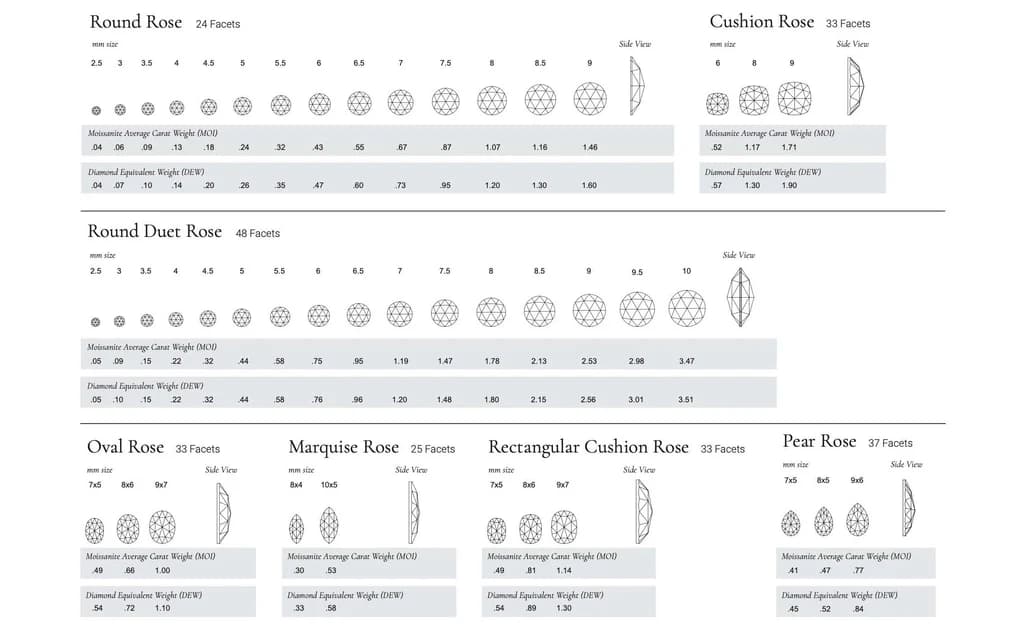
Charles & Colvard’s size chart puts that logic in writing: “all carat weights [are] expressed in comparable millimeter (mm) sizes to scale; approximate moissanite average carat weights and approximate diamond equivalent weights.” The chart treats millimeters as the scaled reference and carat-style numbers as comparison tools, not the other way around.
Shape changes the visual weight
A round stone at around one carat is about 6.4 to 6.5 mm, while the same nominal weight in other shapes produces different millimeter footprints. On Brilliant Earth’s downloadable chart, a 1 carat round diamond is about 6.4 mm, but oval, pear, marquise, emerald, and heart shapes do not occupy the same space face-up.
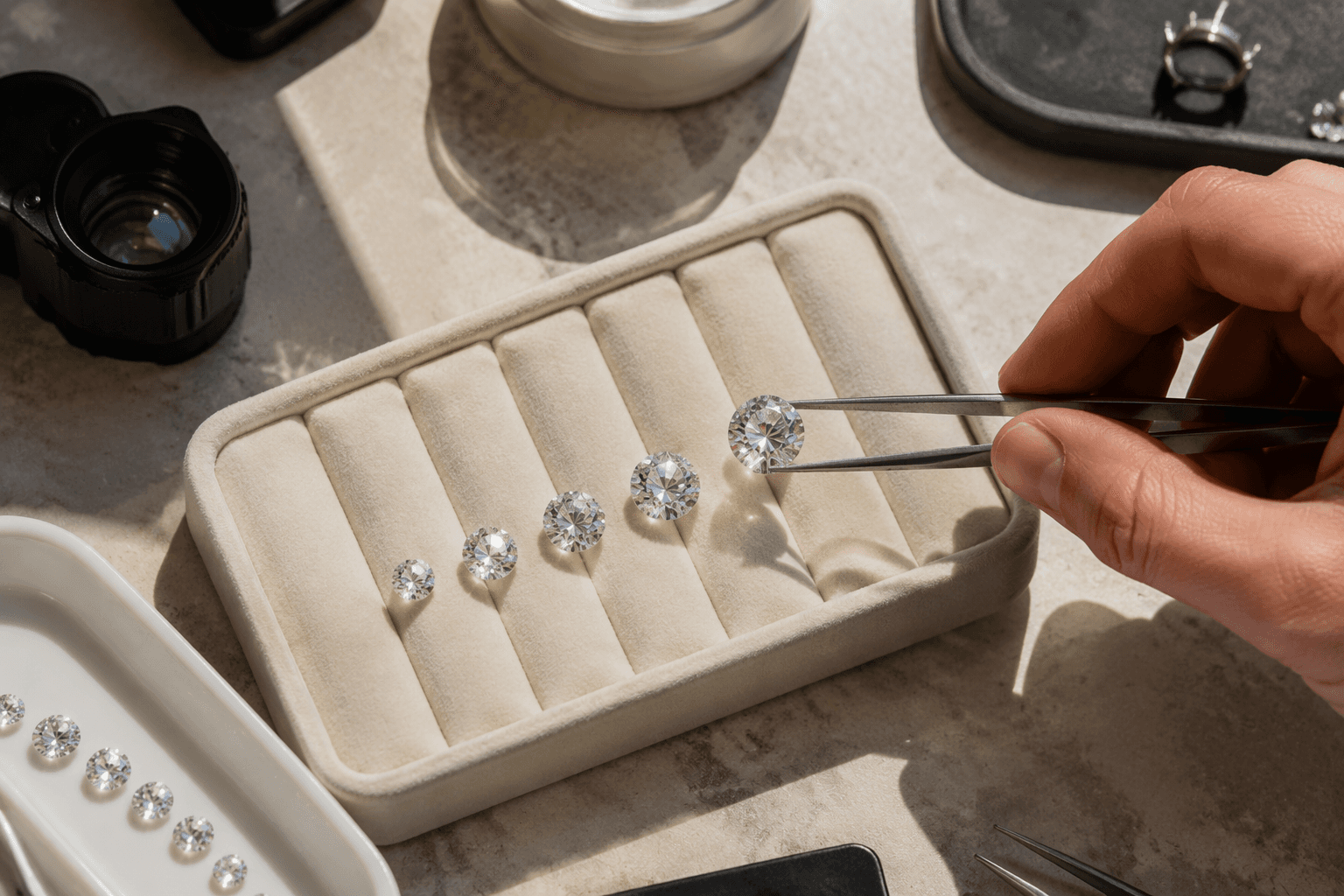
That is why two stones with the same DEW can look dramatically different on the hand. A 1 ct-equivalent round and a 1 ct-equivalent pear are not visual twins, and their differences become more pronounced once a setting frames them. DiamDB measures a 1ct round cut diamond at 6.4 x 6.4 x 4 mm.
What moissanite sellers are really trying to say
Moissanite is not diamond, and it has its own terminology. It is an extremely rare mineral discovered in a meteor crater by French chemist Henri Moissan, and that origin story helps explain why shoppers encounter specialized labels like DEW and TDW. Charles & Colvard has a glossary for the same reason: moissanite jewelry needs its own vocabulary, not a borrowed diamond script.
Retail size guides point buyers back to the same discipline: compare millimeters, compare shape, and treat carat-equivalent language as a shorthand, not a sizing guarantee.
A practical comparison method before you buy
Before you choose a moissanite stone, read the listing in this order:
1. Start with the shape. Round, oval, marquise, pear, and emerald do not present the same face-up size at the same weight.
2. Find the exact millimeter dimensions. If the listing gives only DEW, you do not yet know how much space the stone will occupy.
3. Compare the mm figure to a known reference point. A round stone around 1 carat is about 6.4 mm, which gives you a useful visual benchmark.
4. Check the setting. A bezel demands different proportions than prongs, and a halo or band contour has to accommodate the stone’s actual footprint.
5. Compare like with like. A round 1 ct-equivalent and a pear 1 ct-equivalent are not the same buying decision, even if the DEW appears identical.
This article was produced by Prism’s automated news system from verified source data, official records, and press releases, then run through automated quality and moderation checks before publishing. The system is built and supervised by the people who set the standards it runs under. Read our full AI policy.
Did this article answer your question?