Moissanite vs diamond, key differences in sparkle, hardness and value
Moissanite gives you bigger-looking sparkle for less, but its rainbow fire, resale trade-offs and disclosure rules make the choice more than cosmetic.
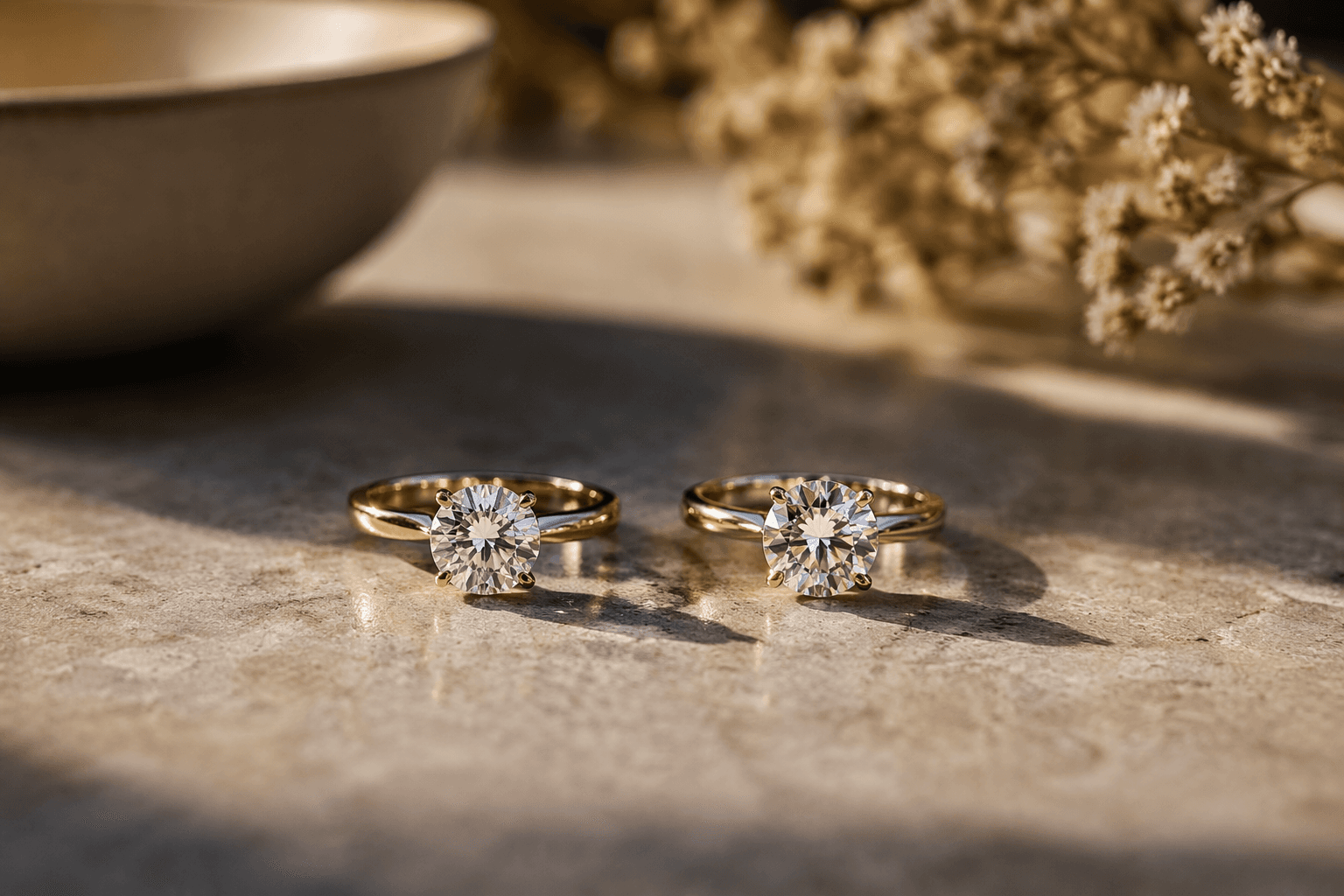
Moissanite sold in jewelry today is lab-created synthetic silicon carbide. It flashes with a bright, rainbow-heavy fire, costs far less than diamond, and is hard enough for everyday wear, yet it is not a diamond substitute in the legal or gemological sense. The smartest buy starts with how you want the stone to look on the hand, how you plan to wear it, and how much transparency you expect from the seller.
Sparkle is the first difference you will notice
Near-colorless synthetic moissanite entered the jewelry market in the late 1990s, which helps explain why it is still treated as a modern alternative rather than a long-established classic. Its refractive indices, 2.648 and 2.691, and its dispersion of 0.104 give it a bigger, more colorful light return than diamond.
Under bright store lighting, moissanite throws off more rainbow flashes, while diamond usually reads as a steadier mix of white light and colored fire. If you love a lively, high-contrast sparkle, moissanite can look dramatic in a solitaire, halo, or three-stone ring. If you prefer a cleaner, more restrained sparkle that many buyers associate with the traditional diamond look, diamond still holds the edge.
Moissanite can also show facet doubling because it is anisotropic, which means some of its internal optical behavior splits light in a way diamond does not. Trained gemologists use that feature to tell the two stones apart, but even an untrained eye can sometimes notice the difference in the way the facets seem to split or blur under magnification.
Hardness makes it practical, but not identical to diamond
On the Mohs scale, synthetic moissanite measures 9.25, close enough to diamond for most daily jewelry. That puts it well above stones such as sapphire and ruby in everyday scratch resistance, which is why it has become a common choice for engagement rings, travel pieces, and earrings that are meant to be worn often. Diamond remains the hardest commonly worn gemstone at 10, so it still has the cleanest record for long-term abrasion resistance.
There is another practical wrinkle: moissanite’s thermal properties are close enough to diamond that traditional thermal diamond testers can react to it as if it were a diamond. A piece can look convincing, pass a basic test, and still need proper gemological screening before anyone treats it as a mined diamond.
Value at checkout is the biggest reason people choose it
Moissanite’s strongest selling point is value. It is marketed as a lower-cost, lab-created alternative to mined diamonds, which means buyers can usually spend less for a larger center stone or redirect budget toward a better setting, stronger metalwork, or a more elaborate design.
A 2026 market report valued the global moissanite market at US$43.3 million in 2024 and projected US$57.3 million by 2030.
De Beers said natural diamonds supported livelihoods directly, indirectly, and through partnerships in 2024, while the Natural Diamond Council said up to 80% of rough diamond value can remain with local and indigenous communities through local purchasing, employment, social programs, healthcare, and infrastructure.
At the same time, the diamond business is under pressure from lab-grown stones and changing consumer preferences, forcing the industry to adapt.
Engagement rings: choose the look before you choose the label
For an engagement ring, moissanite makes the most sense when the goal is visual impact at a lower price. A larger moissanite center stone can deliver a striking presence in a round brilliant, oval, or cushion shape without the same checkout shock as a comparable diamond. That is especially useful if you want to allocate more of the budget to platinum, a heavier band, or a setting with finer detail.
Diamond still has the stronger emotional and resale narrative for many buyers, especially if the ring is meant to be a long-held heirloom. Moissanite is not lacking in durability, but it is usually purchased for wear and style, not for the long market history attached to mined diamonds. If the ring is meant to be a daily signature piece, both can work. If you want the stone itself to carry conventional prestige, diamond remains the more established choice.
Travel jewelry and upgrade buys reward moissanite’s practical side
Moissanite is especially appealing for travel jewelry, where a convincing look matters but the cost of loss matters more. A well-cut moissanite ring or pendant can give you the same visual scale you enjoy at home, without carrying the emotional or financial risk of a high-ticket diamond. That is why many buyers use it as a duplicate piece, an airport piece, or a piece for active days when they do not want to think about insurance first and sparkle second.
Upgrade buys follow a similar logic. If you are moving from a modest center stone to something that feels more dramatic, moissanite lets you test size, shape, and setting style without committing diamond-level capital. A bezel setting can make a moissanite look sleek and modern, while claw prongs can heighten its flash.
What to ask before you buy
The most important consumer-protection rule is simple: jewelry marketers need truthful, non-deceptive descriptions, and in April 2019 the FTC warned eight companies about ads that could mislead buyers about simulated or laboratory-created diamonds. Moissanite should never be presented ambiguously as a diamond.
- An explicit label that says moissanite or synthetic silicon carbide
- A clear statement that the stone is lab-created, not mined
- A description of the metal, setting style, and any warranties or return terms
- Language about provenance that is specific, not vague
Before you buy, look for:
If a seller talks about ethics but never says what the stone is, where it came from, or whether it is mined or lab-created, the claim is not disclosure.
This article was produced by Prism’s automated news system from verified source data, official records, and press releases, then run through automated quality and moderation checks before publishing. The system is built and supervised by the people who set the standards it runs under. Read our full AI policy.
Did this article answer your question?