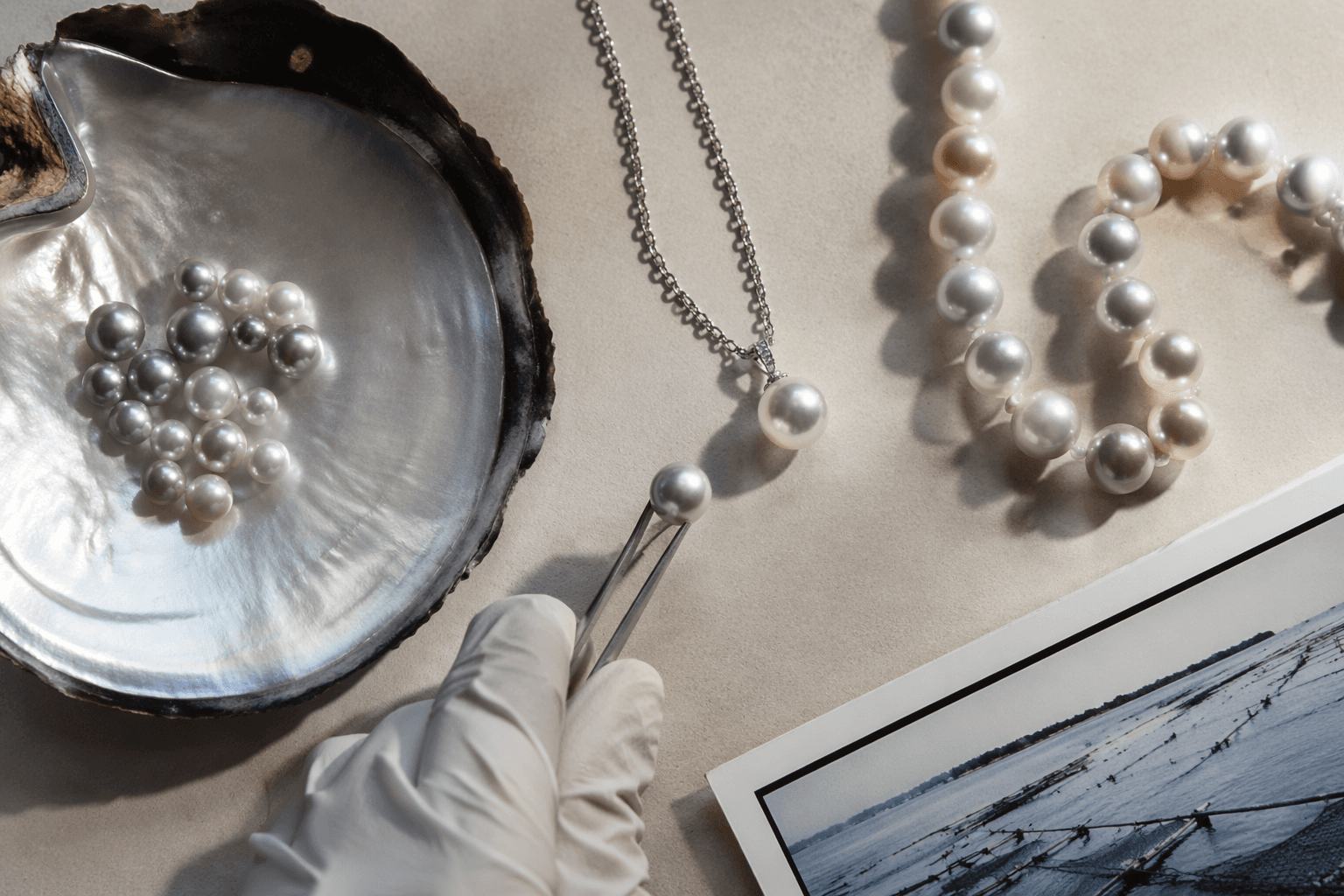
AGS Guide Covers Pearl Types, Quality Factors, and Essential Care Tips
Pearls are heading toward a $48 billion market by 2034; most owners are already dulling their nacre with perfume timing, steam cleaners, and hanging storage.
Pearls occupy a singular position in the gem world: they are the only fine jewelry material produced by a living organism, and by most historical accounts, the oldest type of gemstone ever worn by humans. The global pearl jewelry market, valued at USD 13.53 billion in 2024 according to Zion Market Research, is projected to reach USD 48.14 billion by 2034, a compound annual growth rate of 13.53% that outpaces most luxury categories. Freshwater pearls are expected to hold the largest share by type, necklaces remain the dominant product category by revenue, and Asia-Pacific leads both production and consumption globally.
What that commercial momentum obscures is this: the layer of nacre that gives a pearl its glow is genuinely fragile. Most damage happens quietly, through daily habits that feel harmless.
Understanding Pearl Types
The American Gem Society (AGS) divides pearls into two broad families: saltwater and freshwater. Within saltwater, the three major commercial types are Akoya, Tahitian, and South Sea.
Akoya pearls, primarily produced in Japan, are the classical benchmark: round, white or cream-toned, with a sharp, mirror-like luster that set the standard for what a cultured pearl could look like. Tahitian pearls, grown in French Polynesia in the black-lipped oyster Pinctada margaritifera, range from slate grey and forest green to deep aubergine; their large size and dark body colors have made them a consistent presence in contemporary design. South Sea pearls, harvested primarily in Australia, Indonesia, and the Philippines from the silver-lipped and gold-lipped Pinctada maxima oyster, are the largest commercially available type, often reaching 15mm or more, and among the most valuable.
Freshwater pearls, produced predominantly in China, are cultivated in mussels rather than oysters and can yield multiple pearls per mussel per harvest cycle. They tend toward softer, more irregular shapes and a wider color range, from white and pink to lavender. Their accessibility has made them the volume engine of the global market, and steady quality improvements over recent decades have positioned them as a serious alternative to saltwater varieties for everyday wear.
What Makes a Pearl Worth Protecting
The AGS identifies four key quality factors: luster, surface condition, size, and shape. Luster is the most important of the four by a wide margin. It refers not to surface shine but to the depth of reflective glow that seems to come from within the pearl, the product of how light interacts with successive layers of aragonite crystals inside the nacre. A high-luster pearl shows crisp, bright reflections almost like a mirror; a low-luster pearl reads as chalky or flat. Luster is also what chemical exposure degrades first and most visibly.
Surface condition covers blemishes, pits, and irregularities on the nacre's outer face. Even high-quality pearls carry some natural surface characteristics; what matters is their number, size, and position. A single inclusion near the drill hole is less significant than a cluster of pits across the face. Abrasives, including rough cloth, other gemstones stored alongside pearls, and synthetic stringing materials, can introduce new surface damage over a pearl's working life. Size and shape are determined at the point of formation and cannot be altered by care, making preservation of the original nacre surface the central goal of every handling decision.
The History Embedded in Every Strand
Knowing how cultured pearls are made explains why they demand such specific care. Chinese farmers were cultivating blister pearls in freshwater mussels as early as the 13th century, sometimes inserting small Buddha-shaped molds to shape the nacre. But those early specimens were flat and hollow, nothing like the spherical gem the market recognizes today. The defining transformation came in Japan. In 1888, Kokichi Mikimoto began experimenting with pearl cultivation on Ago Bay. By 1893, working under the guidance of Kakichi Mitsukuri, a professor at Tokyo Imperial University (now the University of Tokyo) and the first director of the Misaki Marine Biological Station, Mikimoto succeeded in culturing hemispherical blister pearls by seeding a living oyster with an irritant and prompting nacre deposition around a foreign nucleus.
The fully spherical cultured pearl came through a parallel line of innovation. In 1902, Tatsuhei Mise implanted 15,000 mollusks with lead and silver nuclei. Two years later, he harvested small, round cultured pearls, and in 1907, he received Japan's first patent for round cultured pearl production.
This history carries practical weight. Cultured pearls, which now constitute virtually the entire commercial pearl market, are built around a nucleus coated in thin nacre layers. That coating, however luminous, is measured in microns. Every acid, every heat source, every vibrating ultrasonic chamber threatens those layers structurally.
The Mistakes That Are Quietly Ruining Your Pearls
Most pearl damage is preventable. It comes from four recurring errors:
- Applying perfume or hairspray after putting on pearls. Fragrance compounds and aerosol propellants react chemically with nacre, dulling luster and, over time, degrading the surface permanently. The rule is unambiguous: pearls go on last, after all cosmetics, perfume, and hairspray have been applied and settled.
- Swimming or showering while wearing pearls. Chlorine in pool water and the heat and pressure of a shower both degrade nacre and weaken silk thread. Saltwater is similarly damaging. No pearl strand should be submerged, not in a pool, not in the sea, not under a tap.
- Storing pearls on a hook or piled with other jewelry. Hanging a necklace from a hook puts sustained tension on the silk thread, stretching and weakening it gradually. Storing pearls loose alongside metal clasps, diamond pavé settings, or other gemstones introduces constant micro-abrasion to the nacre surface. Pearls should be stored flat, in a soft pouch or a lined compartment, separated from every other piece.
- Using ultrasonic or steam cleaners. These tools are designed for hard gemstones and metals. For pearls, ultrasonic vibrations can crack nacre and loosen the pearl from its setting; steam heat can cloud the surface irreversibly. The correct cleaning method is a soft, damp cloth after every wear to remove perspiration and skin oils, followed by air drying before storage.
The Restringing Schedule: Setting an Actual Date
The silk thread in a pearl necklace weakens gradually through perspiration, skin oils, and the mechanical weight of the pearls. There is also a critical technique detail often overlooked: a properly restrung strand has individual knots tied between each pearl, so that if the silk breaks, only one pearl can escape rather than the entire strand scattering.
The industry consensus on frequency is consistent across specialist jewelers. CJ Charles Jewelers recommends restringing once a year for frequently worn pieces and every two to three years for those worn less often. Les Olson Jewelers sets a three-year restringing cycle and recommends an annual professional inspection in between. Dempsey & Baxter advises every 12 to 24 months depending on wear frequency. Les Olson also notes a practical sizing detail: small pearls require a two-strand thread, while larger pearls need three- or four-strand thread for adequate support.
Silk remains the material of choice because it is strong, flexible, and non-abrasive against nacre. Lower-quality alternatives, including cotton, fishing line, and synthetic thread, can accelerate both nacre damage and thread wear. When choosing a jeweler for restringing, ask specifically about the thread material and whether they tie individual inter-pearl knots. If they cannot answer, look elsewhere.
The Routine, Made Simple
The entire AGS care framework reduces to a sequence that takes seconds to learn:
- Last on: apply all perfume, hairspray, and cosmetics first; pearls go on last.
- First off: remove pearls before anything else at the end of the day.
- Wipe every time: a soft, damp cloth after each wear, then air dry completely before storage.
- Store flat and alone: in a soft pouch, never hung, never touching other jewelry.
- Restring on schedule: annually for frequent wear, every two to three years otherwise; verify silk thread and inter-pearl knots.
- No machines: no ultrasonic, no steam, no soaking.
At a projected market size of nearly USD 48 billion by 2034, pearls are being worn by a wider, younger audience than at any point in recent memory. International designers are incorporating them in sculptural and unconventional formats; brands like Mikimoto, Tasaki, Tiffany & Co., and Chow Tai Fook are scaling to meet that demand. The care principles that protect a strand, however, have not changed since Mikimoto's oyster beds on Ago Bay. A well-maintained pearl necklace can outlast its first owner. That is still the clearest argument for buying one.
This article was produced by Prism’s automated news system from verified source data, official records, and press releases, then run through automated quality and moderation checks before publishing. The system is built and supervised by the people who set the standards it runs under. Read our full AI policy.
Did this article answer your question?