Walter Price Channels Pearl Imagery in New Hong Kong Exhibition
Walter Price opened Pearl Lines, his first solo exhibition in Asia, at David Zwirner Hong Kong on March 24, making a decade-long title into a visual guide to pearl luster, color, and form.

Walter Price doesn't make jewelry. But the Brooklyn-based painter, who opened Pearl Lines at David Zwirner's Hong Kong gallery on March 24, has spent nearly a decade constructing a visual language around "pearl" that gem graders and jewelry collectors would recognize immediately: layered luminosity, color shifts that resist fixed description, and a surface that holds light differently depending on where you stand.
The exhibition, on view through May 9 at 5-6/F, H Queen's, 80 Queen's Road Central, is Price's first solo presentation in Asia and his second with David Zwirner since the gallery announced his representation in 2024. Born in 1989, Price served four years in the US Navy before breaking through in 2016 with simultaneous solo shows at Karma in New York and The Modern Institute in Glasgow. In the decade since, he has given the title Pearl Lines to the majority of his solo presentations, at venues including Greene Naftali, the Walker Art Center in Minneapolis, and multiple editions at The Modern Institute before arriving at David Zwirner Hong Kong. That recurrence is intentional. The gallery notes that each Pearl Lines exhibition "expands beyond the confines of its own time and place, becoming part of a larger body of work." The title celebrates drawing as the foundation of Price's practice. "Everything starts with a line," Price has said. And the "pearl" half of the phrase refers not to the gemological object but to beauty rooted in language and utterance, in activity and repetition rather than in any physical thing.
That conceptual separation matters for anyone reading Price's work through a materials lens. Pearl as a noun describes something formed in layers, over time, under pressure. It also describes a category of light: the nacre-derived sheen that the Gemological Institute of America's Pearl Description System codifies as luster, one of its seven named value factors alongside size, shape, color, surface quality, nacre thickness, and matching. Price is not thinking about Pinctada oysters, but his paintings perform the same optical operation that nacre does. They build meaning through accumulation and reflection, never resolving into a single fixed image. The question in front of any Price canvas and in front of any untested pearl is identical: how deep does this go?
The works in Hong Kong make that accumulation visible through chromatic intensity. Price's signature blue palette runs through the canvases with the insistence of a recurring motif. The artist mines the full range of blue's cultural and historical associations in Western art: the cerulean of early photographic cyanotype processes, Yves Klein's International Klein Blue, the traditional mantle of the Virgin Mary, the sadness and calm and linguistic obscenity that the word carries in English. Curator Ashley James has described Price's process as "still an informed and prepared one" despite its apparent spontaneity, noting that drawing is "key for Price, both as a model for a painting practice that can remain loose and guided, and as the very literal practice that allows Price to confidently tackle the infinitely mutable medium." In the canvases themselves, disembodied heads in profile, floating planes, umbrellas, and overstuffed couches surface and submerge within swaths of bold color. Warm scarlet flames and fields of stamped stars interrupt the dominant cool. The compositions move between the real world and the dream world, between a memory and its residue, without fully arriving at either.
For those who think in materials and settings and wear, these canvases function as something close to a palette guide. Filtered through the GIA's seven-factor framework, Price's chromatic range at David Zwirner Hong Kong suggests three distinct pearl directions, each keyed to a specific pearl type and a specific approach to wearing it.
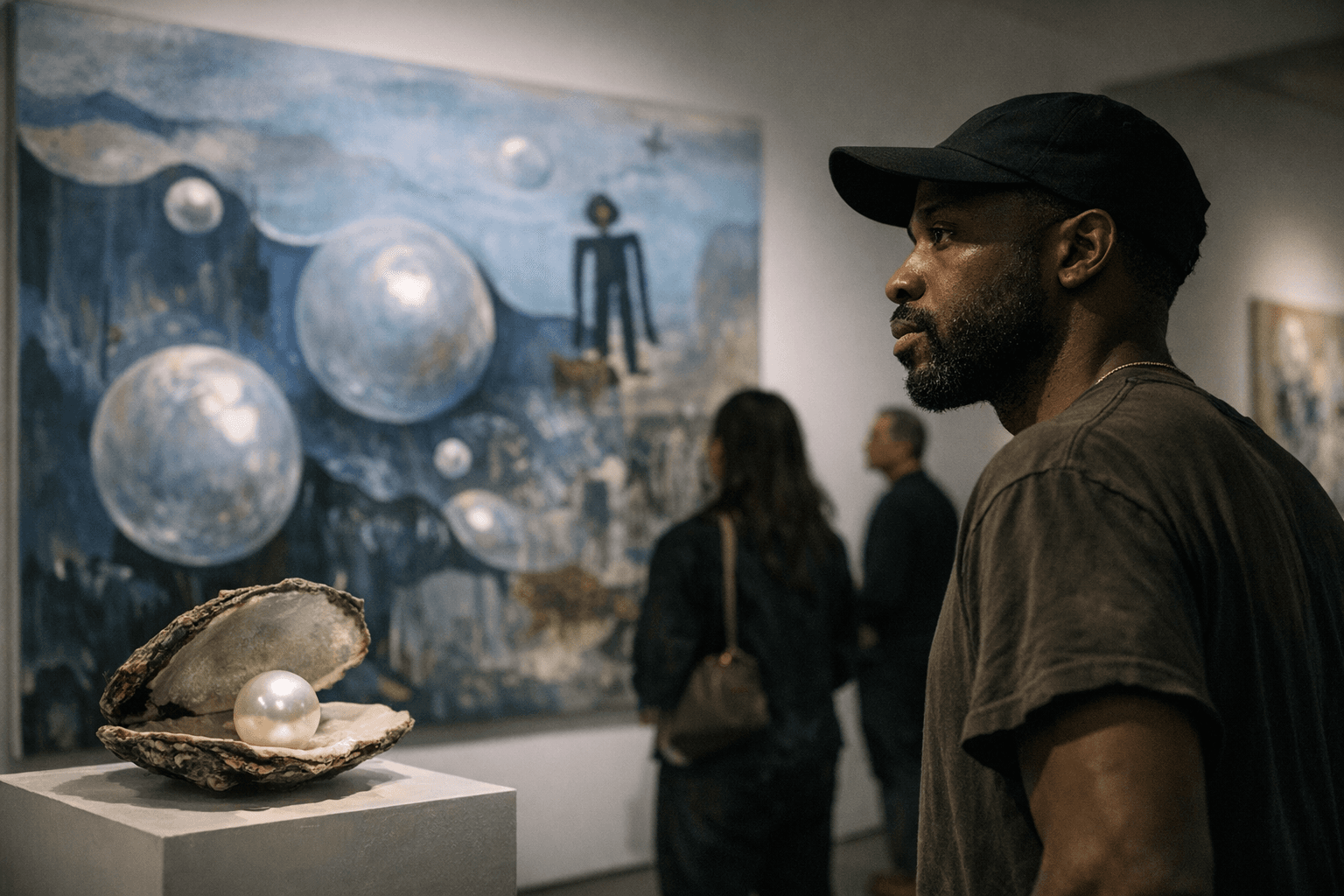
The dominant color temperature in the show is a cool, luminous blue-silver. The closest material counterpart in cultured pearls is the Akoya, grown in the marine waters of Japan and China in Pinctada fucata martensii oysters. Akoya pearls are the gemological archetype of crisp, high-contrast luster: their nacre, which must meet a minimum thickness of 0.4mm to qualify for hanadama certification from Japan's Pearl Science Laboratory or the GIA, produces sharp, mirror-like reflections where both the light source and the viewer's own outline are cleanly visible. When Price layers cool cobalt and ultramarine over lighter grounds, the effect is exactly this: reflective clarity over depth, brilliance that reads as coolness. The standard Akoya strand for everyday wear runs 6.5mm to 7.5mm in diameter. Top-tier hanadama strands in the 8mm to 8.5mm range, where nacre depth exceeds 0.5mm, carry a faint blue overtone in direct light that corresponds directly to the cyanotype references running through Price's work. Against a structured white shirt or a monochrome jacket, a single strand of high-luster Akoya functions the way Price's blue passages do: quietly insistent, without announcement. Quality hanadama strands typically run from $1,200 to $4,000 depending on size and nacre depth.
Where Price's compositions soften into creamy, atmospheric fields, warmer and more ambient, South Sea pearls offer the more direct material parallel. White South Sea pearls, produced by the large Pinctada maxima oyster in waters off Australia, Indonesia, and the Philippines, carry nacre averaging 2.0 to 4.0mm thick, the deepest of any cultured saltwater variety. That nacre depth produces what pearl specialists consistently describe as a "satiny" luster: softer and more diffused than the Akoya's mirror finish, with warmth that results from light penetrating multiple nacre layers before returning to the eye. This is depth brightness rather than surface brightness, the same quality Price achieves when he works thinly scumbled pale paint over a richer ground below. South Sea pearls range from 9mm to 20mm and beyond; in the 11mm to 13mm range they carry enough visual weight to anchor a look built around Price's quieter, more atmospheric passages. A South Sea drop pendant on a simple gold cable chain over unstructured linen is the wearable version of standing in front of a canvas where the paint breathes. White South Sea pearls in that size range from certified Australian farms typically begin around $500 for a loose pearl and climb sharply with luster grade and nacre documentation.
Price's most kinetically charged works are the ones where forms fragment and blur, where a silhouette, a landscape, and a stored memory occupy the same painted surface simultaneously, and where color refuses resolution. Those passages have a direct counterpart in baroque freshwater pearls. Grown in Chinese freshwater mussels, baroque freshwater pearls are solid nacre throughout with no bead nucleus, which gives them an unexpectedly deep luster relative to their price. Coin pearls, elongated baroque drops, keshi formations that arise without any introduced nucleus: none of these conform to the uniformity that the GIA lists as its matching criterion, and that structural resistance to convention is precisely what makes them worth consideration for an art-forward jewelry approach. A single large baroque freshwater drop in lavender or copper-rose, worn as a pendant or mismatched deliberately against a different-sized baroque on the opposite ear, carries the same visual energy as Price's most unresolved passages, the ones that stay with you longest after leaving the room. Quality solid-nacre baroque freshwater pieces typically run from $80 to $600 depending on size, shape, and surface quality, with keshi pearls at the upper end for their rarity and superior luster.
Across all three types, what Price's exhibition adds to the concept of pearl is something the GIA's seven value factors do not measure: context and intention. A strand of Akoya means something different layered over a tailored blazer at an art opening than it does in a wedding portrait, and the difference is entirely in how the wearer frames it. Price has built a decade-long career on the same principle, returning to Pearl Lines as a title not because the work stays the same but because the title grows to accommodate what each new body of work needs it to hold. Pearl Lines is on view at David Zwirner Hong Kong through May 9, 2026.
Know something we missed? Have a correction or additional information?
Submit a Tip