Brunk Auctions Offers Aaron Faber Pearl and Rhodonite Gold Earrings
Freshwater pearl retail prices nearly doubled in 18 months; a sculptural Aaron Faber lot at Brunk's April 22 sale shows what construction quality should look like.

The GIA Pearl Description System names seven quality factors for evaluating any pearl: luster, surface quality, shape, color, size, matching, and nacre thickness. Those benchmarks are essential, but when shopping sculptural pearl drop earrings at auction, particularly vintage pieces in mixed-material settings, none of those seven factors will tell you whether the pair will survive six months of regular wear. For that, you need to look at construction.
A pair of 14-karat yellow-gold drop earrings heading to Brunk Auctions' April 22 Form & Vision: Modern Art, Furniture, and Sculptural Jewelry sale in Asheville, North Carolina illustrates exactly why construction deserves its own scrutiny. The lot pairs two oval cabochon rhodonite stones with four freshwater pearls in a drop format that runs approximately 1-3/8 inches in length, stamped 14k, and arrives accompanied by an Aaron Faber Gallery box. It is precisely the kind of piece where design complexity can either obscure structural vulnerability or reward careful examination.
Aaron Faber Gallery was founded in 1974 by Edward Faber and Patricia Kiley Faber near 53rd Street and Fifth Avenue in Manhattan, with an unusual mandate for its era: a gallery devoted exclusively to one-of-a-kind, studio-made jewelry. Now at 589 Fifth Avenue, Suite 1155, the gallery expanded into collectible vintage and contemporary timepieces in 1980 and has spent five decades bridging 20th-century estate jewelry with contemporary studio practice. A piece arriving at auction with an Aaron Faber provenance suggests it passed through a gallery that was selective by design, one whose long focus on studio-made work meant pieces were acquired with connoisseurship. That provenance reduces, but does not eliminate, the need for structural inspection.
Brunk Auctions, founded in 1983 and operating from a 26,000-square-foot multimedia gallery at 117 Tunnel Road in Asheville, holds sales every six to eight weeks with a staff of 18 full-time specialists. The house has grown from a regional auction service into a national operation with international clientele, and its Form & Vision category, which encompasses modern art and furniture alongside sculptural jewelry, draws collectors who treat these objects as design artifacts first. The April 22 sale runs from 10:00 AM to 5:00 PM.
The rhodonite cabochons at the heart of this lot carry considerable material history. Rhodonite, a manganese silicate mineral whose name derives from the Greek "rhodon" (rose), was first discovered in the Ural Mountains of Russia in 1790 and formally named by German naturalist Christoph Friedrich Jasche in 1819. By 1913 it had been designated Russia's national stone, having been carved by imperial craftsmen into palace decorations and ornamental objects; mined blocks called "orletz" could weigh up to 48 tons. Banded rhodonite gained renewed popularity as an ornamental stone in the 1930s following new discoveries, and its characteristic rose coloration veined with black manganese oxide inclusions has made it a recurring choice for studio jewelers working in a sculptural idiom.
The cut matters structurally as well as aesthetically. Rhodonite has a perfect cleavage, the same physical property that allows a diamond to be split, but one that makes aggressive faceting a risky proposition. The overwhelming majority of rhodonite in jewelry appears as polished cabochons, tumbled stones, or beads; faceted examples are rarer and command premium prices because the lapidary risk is genuine. Oval cabochons, as in this lot, are the format in which rhodonite performs best: the domed surface distributes light across the stone's coloration without introducing stress at the cleavage planes that faceting can expose.
The four freshwater pearls complete a design that arrives at auction in one of jewelry's most active market categories. Global pearl jewelry sales reached approximately 13 billion dollars in 2024 and are projected to reach 28 billion dollars by 2032, driven by a compound annual growth rate of roughly 13 percent. Freshwater pearls held the largest share of pearl-type market volume in 2024. Factory-level prices for top-grade AAAA freshwater round pearl strands climbed from roughly 150 dollars to 220 dollars per strand over the 18 months preceding early 2026; retail prices for comparable strands moved from approximately 600 dollars to 1,100 dollars in the same period, an expansion in both price and margin that reflects genuine demand. Search data from December 2024 through December 2025 confirms that "pearl earrings" consistently ranked as the most-searched pearl jewelry category globally, a tailwind that makes this drop-earring format particularly well-positioned.
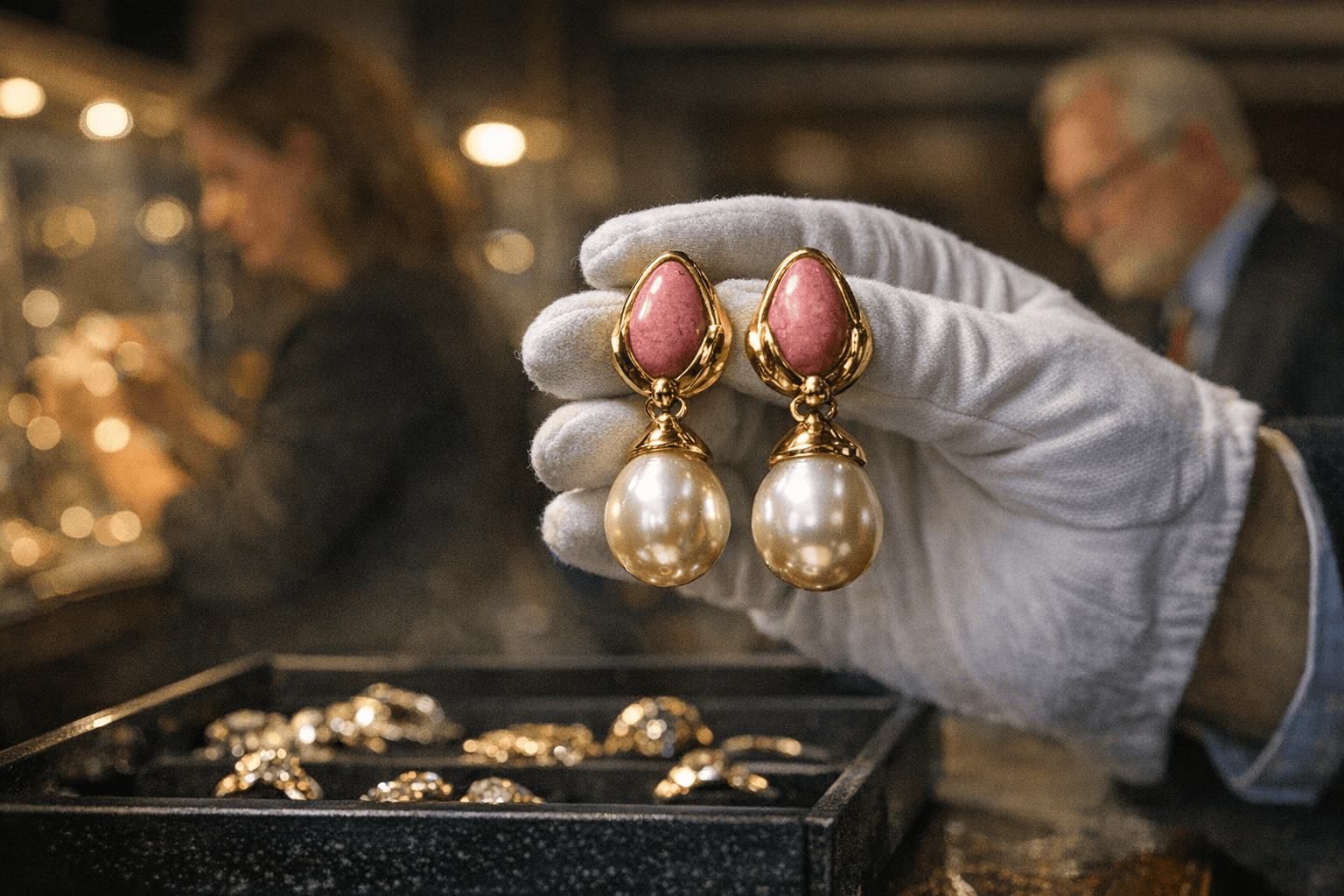
In mixed-material designs, freshwater pearls behave differently than bead-nucleated varieties such as Akoya pearls. Freshwater pearls are solid nacre throughout, which makes them generally more durable and less prone to surface chipping than pearls built over a shell nucleus, where the nacre layer can wear thin at contact points. That structural resilience matters in a drop earring that places a pearl in proximity to rhodonite, which rates 5.5 to 6.5 on the Mohs hardness scale, a range sufficient to abrade a pearl's nacre surface if the two materials contact each other under pressure. This happens routinely when earrings are stored loosely rather than in individual pouches or compartments. The Aaron Faber box accompanying this lot, assuming its interior is fitted, provides exactly the kind of separated storage these mixed-material pieces require.
When examining a lot like this one through auction photography alone, four construction questions are worth directing at the catalogue images before bidding. How is the rhodonite cabochon secured? A bezel setting, which wraps the stone in a continuous metal border, offers the most protective mount for a cabochon and presents no prongs to flex, snag, or fatigue over decades of wear. If prong-set cabochons appear in the photographs instead, look carefully for any lifting at the prong tips, a common sign of wear in vintage pieces that have been worn regularly. How is the pearl attached to the metal? Pearls in drop earrings typically use either a pin-and-cap or a drilled-and-strung configuration; neither is inherently problematic, but pin-and-cap settings in yellow gold can work loose in earrings that experience daily motion, and close-up photographs of the pearl-to-metal junction are worth requesting from the auction house specialists before bidding.
Third, examine the ear wire gauge and shape. A 14-karat gold shepherd's hook should show consistent, unkinked wire with an opening calibrated for standard piercing diameter. Excessive flex at the shepherd's hook's narrowest bend fatigues the gold at that point over time, eventually requiring professional repair or replacement. Finally, consider weight distribution. At 1-3/8 inches, a drop earring carrying both rhodonite cabochons and freshwater pearls needs to balance so that the heavier component hangs correctly without pulling the ear wire forward on the lobe. An earring that tilts forward persistently becomes an earring left in a drawer. Without a gram weight in the catalogue listing, the practical step is to contact Brunk's specialists directly before the April 22 preview.
Brunk's standard condition disclaimers note that gem testing and maker's mark verification are the buyer's responsibility and that in-person inspection is expected before the sale. For bidders outside Asheville, condition reports form a baseline, not a substitute for asking pointed structural questions about bezel integrity, pearl attachment, and wire gauge. The lot's 14k stamp, Aaron Faber provenance, and placement within a sale specifically curated around sculptural jewelry provide meaningful context. The construction questions above determine whether the piece is also sound enough to wear.
The Form & Vision framing is deliberate. A pearl drop earring containing the gemstone history of imperial Russia, the structural logic of solid-nacre freshwater pearls, and the studio-jewelry ethos of one of New York's most enduring gallery founders is asking to be evaluated as a designed object. The construction that holds it together is what makes that evaluation worth having.
This article was produced by Prism’s automated news system from verified source data, official records, and press releases, then run through automated quality and moderation checks before publishing. The system is built and supervised by the people who set the standards it runs under. Read our full AI policy.
Did this article answer your question?