Catherine Wears Queen Elizabeth's Bahrain Pearls at Easter Matins Service
Catherine wore Queen Elizabeth's Bahrain Pearl Drop earrings at Easter Matins, pearls gifted to the late queen by the Hakim of Bahrain at her 1947 wedding and carried now into a seventeenth royal appearance.
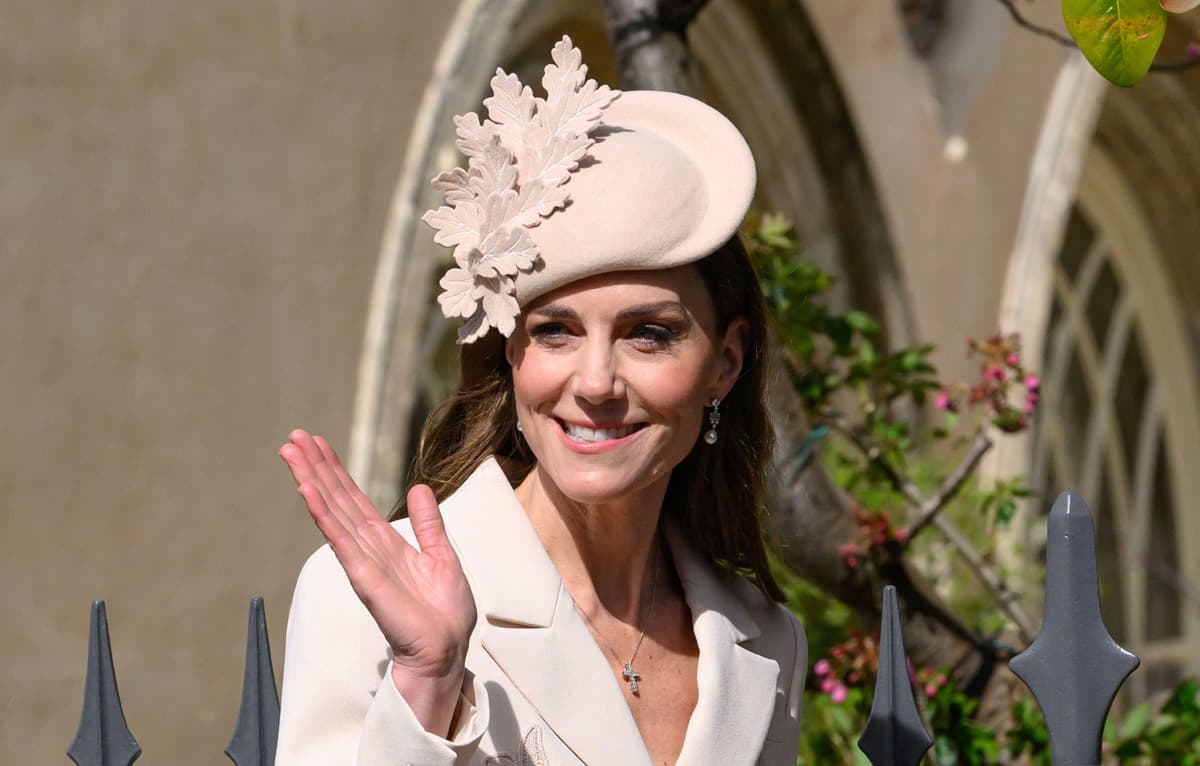
The GIA Pearl Description System evaluates every cultured gem against seven named quality factors: luster, surface quality, nacre quality, shape, color, size, and matching. The Bahrain Pearl Drop earrings that Catherine, Princess of Wales, wore to Easter Matins at St. George's Chapel on April 5, 2026, would score well across every category. But their defining quality exists entirely outside any grading rubric: two of seven pearls given to then-Princess Elizabeth in November 1947 by the Hakim of Bahrain as a wedding gift, now in their seventeenth confirmed appearance on Catherine's ears since 2016.
The setting was St. George's Chapel at Windsor Castle, where the British royal family gathered for the Easter morning service. Catherine arrived in a cream blazer and matching skirt, a pairing of two pieces from Queen Elizabeth II's personal collection: the Bahrain Pearl Drop earrings, and a diamond cross necklace. The combination was precise in its restraint. Easter's liturgical associations with resurrection, purity, and light read as cream fabric, white diamonds, and two natural pearls suspended below the ear, with no competing color to fracture the composition.
The earrings' construction explains why they work for formal daywear where a simple stud or a full strand would not. Each piece begins with a round diamond stud, below which a cascade of round and baguette-cut diamonds in an Art Deco arrangement suspends the original Bahraini pearl as a final drop. The architecture of the setting lifts the pearl into the frame of the face, so the gem catches light from above rather than disappearing against a lapel. The drop format introduces movement and vertical line without the scale of a chandelier, which means it pairs cleanly with a structured jacket without fighting the silhouette. These are the precise mechanics Catherine's Easter look demonstrated against a cream blazer collar.
The earrings' path to Windsor began at the 1947 royal wedding. Princess Elizabeth received among her gifts a shell containing seven large natural pearls from the Hakim of Bahrain. Shortly after the wedding, two were set into earrings with round diamond studs and that cascading Art Deco diamond mount. The pieces were worn periodically through the early years of the Queen's reign and surfaced again for an exhibition marking the 60th wedding anniversary at Buckingham Palace, before being lent to Sophie, then Countess of Wessex. Catherine first wore them on Remembrance Sunday in November 2016, and from that point they became one of the most consistently returned-to pieces in her jewellery rotation: Royal Ascot in 2017, a Balmoral church service in 2018, Trooping the Colour in 2019, the State Funeral of Prince Philip in April 2021, the Platinum Jubilee Service of Thanksgiving in June 2022, and the State Funeral of Queen Elizabeth II in September 2022. That last appearance, at the most-watched royal funeral in recent memory, remains the emotional center of the earrings' contemporary story. Catherine wore the late Queen's pearls to mark the late Queen's passing.
Since September 2022, the earrings have reappeared at the Festival of Remembrance in November 2022 and again in 2023, a Commonwealth reception lunch in May 2023, the Qatar State Welcome in December 2024, Holocaust Memorial Day in January 2025, the Queen Elizabeth II Award for British Design in May 2025, and Trooping the Colour in June 2025. The Easter 2026 service was also Catherine's first attendance at the Windsor Matins since 2023, after two consecutive years away while the family observed private celebrations in 2024 and 2025.
Princess Anne, the Princess Royal, worked from a contrasting premise. Her turquoise tweed served as a vivid ground against which classic pearl drop earrings read with particular clarity, demonstrating the second principle of the format in formal daywear: color contrast amplifies luster. A pearl suspended against cream reads as tonal harmony; against turquoise, it asserts itself as a jewel. Anne completed the look with a gold-and-diamond ribbon brooch worn with the relaxed authority of a piece carried through decades of public appearances without requiring introduction.
The pearl's place at royal ceremony traces to Queen Victoria, who adopted the gem as mourning jewelry following the death of Prince Albert in 1861 and wore it for the remaining forty years of her life. Victorian convention linked pearls to tears and their colorless luster to solemnity. Easter complicates that lineage slightly, drawing on pearls' additional associations with purity and new beginning, a dual register the British royal family appears to navigate by selecting pearl drops that are ceremonial without being funerary. At St. George's Chapel, where royal ceremonies have been held since the fifteenth century, the choice of pearls at Easter is rarely coincidental.
The Royal Pearl Playbook: Three Drop Formats for Spring Occasions

The Easter looks from Windsor offer a direct translation for anyone navigating a spring wedding, a formal luncheon, or a significant outdoor ceremony where formal daywear is required and the question of jewellery is genuinely open.
Pearl drops outperform studs at formal daytime occasions for a specific reason: they create vertical movement that a stud, flush against the lobe, cannot, and they allow the gem to catch light from multiple angles rather than from one fixed point. The format's advantage over a multi-strand pearl necklace is proportion: a strand worn with a structured blazer or jacket reads heavily, anchoring attention below the chin and competing with whatever architectural detail the garment has at the collar. The drop at the ear allows the neckline to remain open and clean. Catherine's diamond cross necklace worked alongside the Bahrain drops because it was singular, vertical, and defined; a pearl strand in the same position would have dissolved the composition.
At the entry level, Mejuri's freshwater pearl drop earrings in gold vermeil, typically priced below $100, demonstrate the principle at its most accessible. Freshwater baroque pearls carry an organic irregularity that creates soft luster rather than the mirror brightness of a classic Akoya, and the simplified gold connector keeps the drop reading as jewellery rather than costume. The point is not to replicate the Bahrain earrings' complexity but to use the same geometry: pearl suspended below the ear, setting subordinate to the gem.
In the mid-range, Mikimoto's classic Akoya pearl drop earrings in white gold, available roughly between $650 and $1,200 depending on pearl grade, represent the closest functional equivalent to Catherine's choice that current retail offers. Mikimoto's grading system for Akoya pearls maps closely to GIA standards; at the upper tiers, luster approaches the mirror quality that makes the drop format most effective in daylight. These are earrings made for occasions where the Bahrain drops would be appropriate but are, for obvious reasons, unavailable.
At the investment level, South Sea pearl drop earrings from houses such as Assael or Autore, typically ranging from $3,500 into five figures depending on pearl size and setting, introduce a satiny luster distinct from Akoya's bright gleam. South Sea pearls, cultured primarily in Australian and Philippine waters, grow between 9mm and 20mm, and at the larger sizes a single South Sea drop carries enough presence that no supporting setting is needed beyond a clean gold mount.
The One Rule Worth Carrying Into Spring
Whether worn against cream, turquoise tweed, or any formal spring palette, the styling principle that both Catherine and Princess Anne demonstrated at Windsor on April 5 is this: when pearl drops are the primary ear statement, the neckline should offer contrast, not repetition. One strong neckline element, whether a cross, a brooch, or an open collar, allows the drops to remain the definitive pearl note. Adding a pearl strand beneath pearl drop earrings creates tonal repetition without rhythm, and the drops recede into an overall pearl field. Choose the ear as the pearl register, keep the neckline plain or geometrically distinct, and the format does the rest. It is a rule the most observed royal wardrobe in the world has now applied, in variation, seventeen times with the same pair of earrings.
Know something we missed? Have a correction or additional information?
Submit a Tip