Audrey Hepburn’s Faux Pearl Look in Breakfast at Tiffany’s Endures
Before you buy pearls, decode the image: Hepburn’s five strands worked because of proportion, not preciousness, and that’s the lesson for modern necklace shopping.
The image everyone recognizes
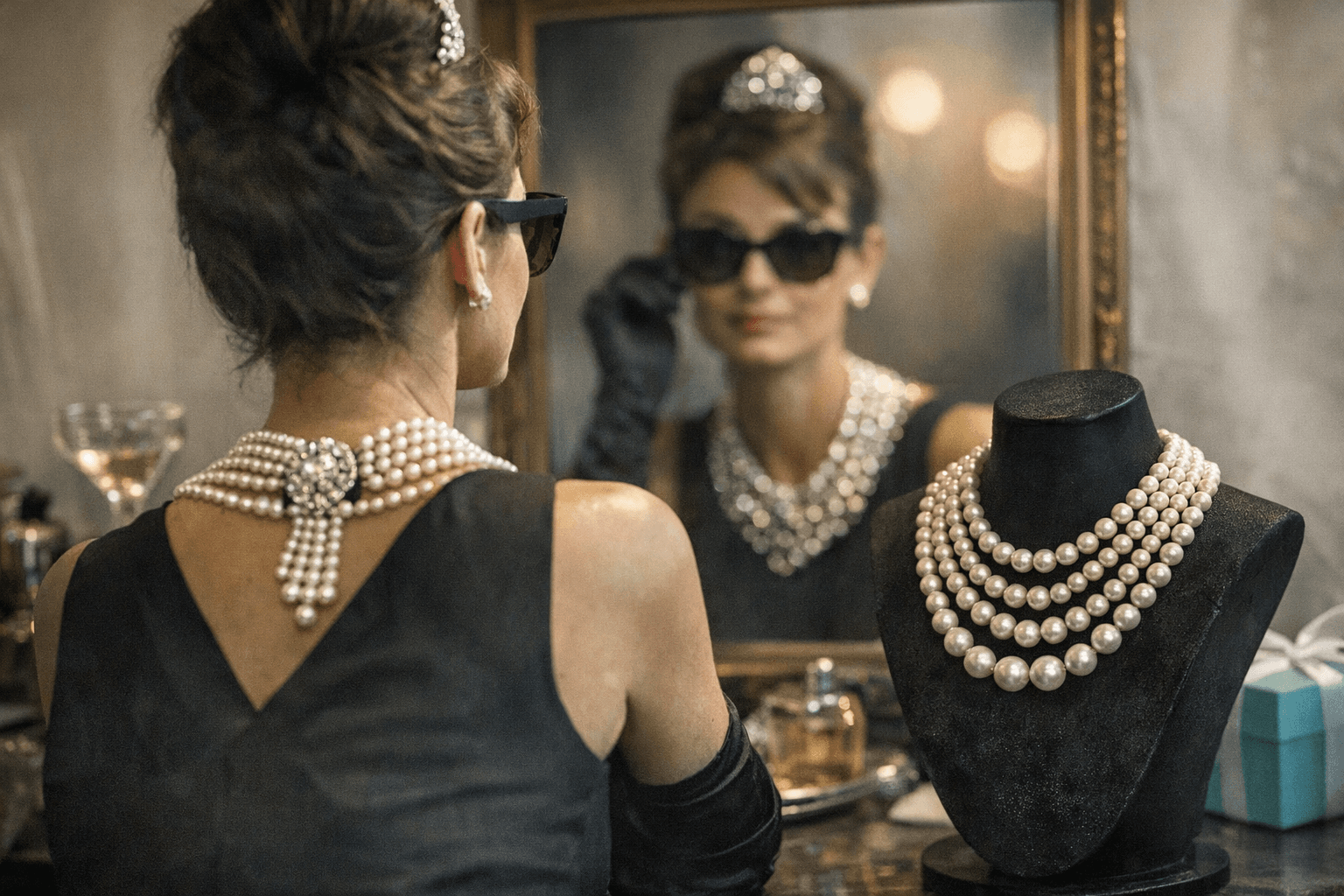
Before you evaluate pearl quality, understand what you are actually looking at: not a simple necklace, but one of cinema’s most efficient style signals. Audrey Hepburn’s opening look in *Breakfast at Tiffany’s* is so instantly legible that the black Givenchy dress and layered pearls function almost like a logo, and that is exactly why it still travels so well across generations.
Released in 1961, the film turned Holly Golightly’s imagined glamour into a visual shorthand for polished restraint. Tiffany & Co. says the movie was its cinematic debut and the first film ever shot at the Fifth Avenue flagship in New York City, which gives the look an extra layer of cultural gravity: the scene is not only remembered as fashion, but as the moment a jewelry house and a character became inseparable.
Why the necklace worked on screen
The necklace at the center of the look was not made of real pearls at all. It was costume jewelry created by Roger Scemama, the French jewelry designer and parure-maker who frequently collaborated with couture houses including Givenchy, and that detail matters more than it might seem. The power of the piece came from how it framed Hepburn’s face, sat against the dark fabric, and layered light across the throat in a way that read as composed, not precious.
Scemama’s design used a five-strand pearl look with a jeweled front clasp, and that front closure is one of the reasons the necklace feels so deliberate. The clasp acts like a focal point, pulling the eye upward and keeping the composition from collapsing into a generic rope of beads. On screen, that kind of structure does the work of expensive-looking jewelry without needing the materials to be expensive at all.
The styling is also anchored in Truman Capote’s novella, where Holly Golightly is introduced wearing “a slim cool black dress, black sandals, a pearl choker.” That sentence captures the same principle the film exaggerates with its layered strands: the pearls are not there to suggest literal wealth, but to build a persona. Holly’s glamour is invented, and the necklace makes that invention visible.
How to translate the formula into modern pearl buying
If you are shopping for a multi-strand pearl necklace, the Hepburn reference teaches a useful lesson before you even think about price. Strand count changes the mood immediately. Five strands create volume and visual authority, but the look only feels refined when the strands are balanced and the necklace sits in proportion to the neckline, the face, and the wearer’s frame.
A single strand is usually about understatement. Two or three strands start to layer in softness and dimension. Five strands, like Hepburn’s, move into statement territory, which means the rest of the styling has to quiet down so the necklace can lead. That is why the black dress in *Breakfast at Tiffany’s* works so well: it gives the pearls a field of negative space.
Length matters just as much as strand count. A shorter, collar-like fit feels close to the throat and keeps the necklace crisp against tailored clothing, while a longer drape reads more relaxed and can lose the graphic punch that makes the Hepburn look so recognizable. The original film styling succeeds because the pearls sit firmly within the face-to-neckline zone, where they can sharpen expression rather than drift into decoration.
The clasp deserves attention too. A front clasp, especially one with a jeweled finish, can transform a multi-strand necklace from ordinary to architectural. It gives the piece a point of view, which is often what separates a composed jewelry look from one that merely looks busy.
What keeps a multi-strand pearl necklace from feeling like costume
The difference between a glamorous pearl necklace and a costume piece often comes down to restraint. Hepburn’s look is memorable because every element is controlled: the black dress, the short gloves in the broader styling, the dark sunglasses, and the layered pearls all belong to the same sentence. Nothing competes with the necklace, and nothing is accidental.
For modern buyers, that means the most convincing multi-strand pearl necklaces usually have some combination of these qualities:
- Clear structure, so the strands hang evenly rather than bunching
- A clasp that feels intentional, not merely functional
- Proportion that matches the wearer’s neckline and frame
- Enough visual weight to read from across a room, but not so much that the necklace overwhelms the face
The original necklace also reminds you that faux pearls can still be visually sophisticated. Material value and style value are not the same thing. A well-made costume piece can deliver stronger image-making than a mediocre strand of real pearls, especially when the design understands silhouette, rhythm, and contrast.
Why Tiffany keeps returning to the film
Tiffany has continued to trade on the movie’s legacy because the association is too powerful to leave in the past. The brand’s heritage materials still reference *Breakfast at Tiffany’s*, and its contemporary experiences do the same, including the Blue Box Café at The Landmark in New York City, where Daniel Boulud brings a seasonally inspired menu to breakfast, lunch, afternoon tea, and dinner. The company has also expanded the film connection through immersive Audrey experiences, which extend the fantasy without stripping away its original elegance.
Tiffany says the film was followed by other productions shot at the flagship, including *Sleepless in Seattle* in 1993 and *Sweet Home Alabama* in 2002, which shows how the store’s image became part of a larger cinematic language. But no later reference has eclipsed Hepburn’s first entrance. The reason is simple: the five-strand pearl look is not merely famous, it is instructive, proving that the most enduring jewelry moments are built from proportion, contrast, and a clear idea of who the wearer wants to be.
This article was produced by Prism’s automated news system from verified source data, official records, and press releases, then run through automated quality and moderation checks before publishing. The system is built and supervised by the people who set the standards it runs under. Read our full AI policy.
Did this article answer your question?