Noor Fares’ Inayat Explores Meaning and Form (collection uses mother-of-pearl and carved inlays)
Noor Fares' Inayat uses painted mother-of-pearl and Arabic calligraphy not as surface decoration but as structural elements, with 30 pieces priced from £2,625 to nearly £8,000.
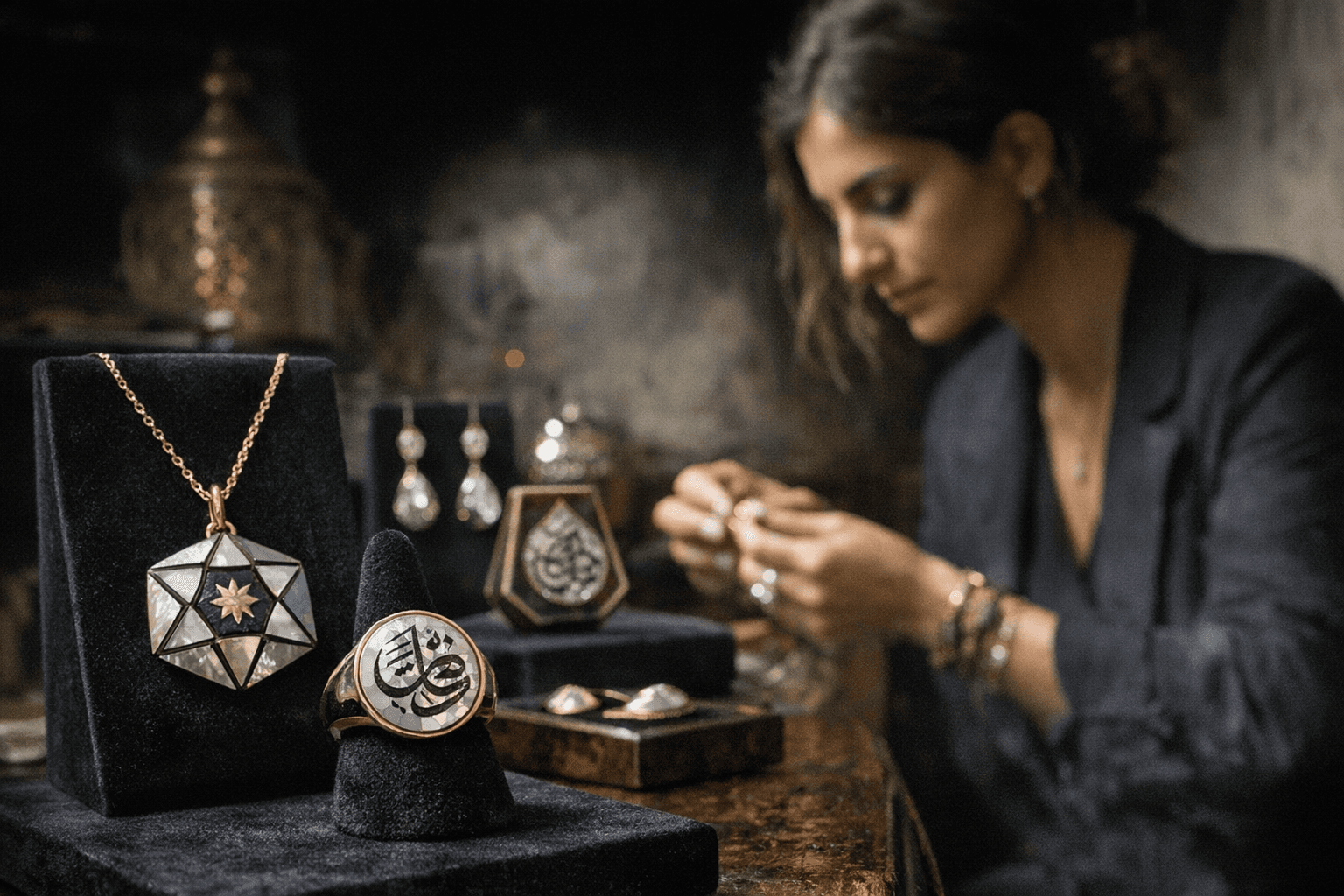
Painted mother-of-pearl, when Noor Fares is the designer setting it, does not function as a quiet background wash. In Inayat, her 30-piece collection released in March 2026, nacre is the primary structural and luminous statement: shaped, layered, and sometimes painted before being mounted alongside rock crystal, polki diamonds, and engraved 18k gold. The name itself announces the collection's intent. In Arabic, "inayat" means care or compassion, and that word carries a kind of precision that the pieces themselves are built to honor.
A Name Built from Calligraphy
Central to Inayat's visual identity is Arabic lettering, developed in collaboration with calligrapher Farah Behbehani. What makes this significant, from a craft perspective, is that the script does not sit on the surface of the metal as applied ornament. It is integrated into each design, shaping proportions, guiding layout, and becoming part of the piece's underlying architecture. This is the difference between decoration and structure: in Inayat, language does load-bearing work.
The collection draws equally on architectural forms and celestial geometry, two reference points that Fares has used before but here weaves into tighter, more articulate compositions. The result reads less like adornment and more like miniature wearable amulets: objects that carry meaning in the way their proportions are organized, not just in what is engraved on them.
Mother-of-Pearl as the Lead Material
Fares has worked with mother-of-pearl across previous collections, but Inayat advances the material's role considerably. Here, it appears both painted and as an inlaid structural plane, held within gold settings that are themselves engraved. The Inayat painting pendant in 18k yellow gold pairs mother-of-pearl with 6.5 ct. rock crystal, 0.5 ct. ruby, and 0.09 ct. t.w. diamonds, priced at £2,625 (approximately $3,480). A second painting pendant, this time in 18k gray gold, scales up dramatically: 17.5 cts. t.w. rock crystal, 0.45 ct. t.w. moonstone, and 0.65 ct. t.w. diamonds frame a larger mother-of-pearl element, bringing the price to £7,995 ($10,580).
The price gap between those two pendants reflects not just material volume but the cumulative weight of technique. Gray gold, an alloy achieved by mixing yellow gold with palladium or manganese, provides a cooler, more architectural ground for the nacre's iridescence, while moonstone introduces a second luminous register against the mother-of-pearl's warmer glow. Neither piece would read the same without the other's contrast.
Polki, Salt-and-Pepper, and the Diamond Choices
Inayat's diamond vocabulary is deliberately unflashy. Polki diamonds, which are uncut, flat-bottomed stones used in traditional Indian jewelry for centuries, appear in one of the collection's key pieces alongside aquadite and 0.09 ct. t.w. diamonds, priced at £3,650 ($4,830). The use of polki is consistent with Fares' sourcing philosophy. They retain their natural surface rather than being cut for maximum brilliance, which means they scatter light rather than reflect it, producing a softer, more diffuse effect that suits the collection's meditative tone.
Salt-and-pepper diamonds, which carry visible inclusions and typically present in grey, white, and black speckling patterns, extend that same logic: they are chosen for character over conformity, fitting the broader narrative of materials that look handmade because they are.
Engraving Pendant and the Geometry of Color
The engraving pendant in 18k yellow gold, featuring mother-of-pearl, 5.4 ct. rock crystal, and 0.2 ct. t.w. diamonds, is priced at £4,995 ($6,610) and demonstrates how Fares uses transparency strategically. Rock crystal, which is colorless and glassy, permits the engraved gold beneath to remain visible through the stone, effectively doubling the legibility of the surface work. It is a technique that rewards close attention.
The earrings in 18k yellow gold with 23.5 cts. t.w. green amethyst, 1.6 cts. t.w. rock crystal, 0.5 ct. t.w. abalone, and 0.04 ct. t.w. diamonds (£3,100, $5,000) bring chromatic warmth to the collection's cooler geometries. Green amethyst, also known as prasiolite, is heat-treated quartz rather than a naturally occurring stone in most commercial supply chains, worth noting for buyers who ask about provenance. Abalone, like mother-of-pearl, is an iridescent shell material, and its inclusion alongside nacre suggests Fares is building a specific visual language around organically luminous materials rather than leaning on precious stones for reflective power.
The Heritage Behind the Design
Fares' design practice is rooted in her Lebanese heritage and her extensive travel to India, where, as she has described, the quality of light over landscapes and architecture carries a spiritual dimension. This dual cultural gravity, Middle Eastern geometry meeting Indian color and luminosity, shapes Inayat more explicitly than many of her previous collections. She studied History of Art at Tufts University before completing her gemological training at the GIA's London campus and earning an MA in fine jewelry design at Central Saint Martins, a background that combines scholarly analysis of material culture with hands-on craft training.
Fares launched her label in 2009 and has since received the Positive Luxury Awards in both 2017 and 2018, and the COUTURE Design Award in 2019. Her company holds the Butterfly Mark from Positive Luxury, a certification awarded for verified sustainability commitments across a brand's operations, and her diamonds are sourced from conflict-free supply chains. She is also a board member of the environmental charity Dirt and has supported Creatives For Lebanon. For a collection built around the Arabic word for compassion, those commitments are not incidental: they are part of the same ethical posture the jewelry is trying to articulate.
Why Inayat Lands Now
The current market appetite for jewelry with documented provenance and artisanal depth makes Inayat well positioned. Buyers who have spent years watching brands claim "meaningful design" while delivering little more than generic engraving will find the specificity here genuinely refreshing. The calligraphy is not cosmetic. The mother-of-pearl is not filler. The polki diamonds are not simply a trend gesture. At price points from £2,625 to nearly £8,000, these pieces ask for real investment; the craftsmanship and material intelligence behind them make an honest case for why they are worth it.
This article was produced by Prism’s automated news system from verified source data, official records, and press releases, then run through automated quality and moderation checks before publishing. The system is built and supervised by the people who set the standards it runs under. Read our full AI policy.
Did this article answer your question?