Pearls Evolve From Heirloom Staple to Versatile Everyday Fashion Accessory
Timothée Chalamet's pearl harness at the 2025 Met Gala crystallized what runway designers have been signaling for seasons: pearls are no longer heirlooms, they're everyday armor.

When Timothée Chalamet stepped onto the 2025 Met Gala carpet in a custom pearl harness layered over a satin blazer, the internet split predictably: half the comments called it genius, the other half called it costume. Both sides missed the point. What Chalamet demonstrated was a bold and modern reinvention of the traditional pearl strand, one that distilled exactly what has been happening on runways for several seasons: pearls are shedding their finishing-school associations and becoming one of the most versatile building blocks in a contemporary wardrobe.
The question is not whether pearls are having a moment. They clearly are. The more useful question is: which pearl, worn how, with what, and bought from whom?
The Coco Chanel Blueprint, Updated
Pearl necklaces are experiencing a powerful resurgence, redefining what it means to be both elegant and edgy, and are no longer reserved solely for traditional or formal events. But this shift did not arrive without precedent. Coco Chanel built a fashion philosophy around the pearl: she wore ropes of them over jersey knits, layered them with chains, and insisted that an accessory worn by working women carried as much authority as one locked in a vault. The impulse she pioneered, using pearls to complicate and elevate an otherwise plain silhouette, is precisely what designers are doing now with chokers, embellished garments, and pearl-trimmed denim.
The difference today is the breadth of price points, the diversity of pearl types available, and a growing demand that those pearls be sourced with some accountability. All three factors have converged to pull pearls out of the heirloom category entirely.
The Runway-to-Real-Life Playbook: Three Looks Worth Copying
Look 1: The Oversized Choker
The single most transferable runway development of the past two seasons is the oversized pearl choker: a band of 10mm-plus pearls sitting flush against the collarbone, with no pendant, no chain, nothing competing for attention. Paired with an open collar, whether a button-down shirt with two buttons undone, a wide-neck sweater, or a V-cut blazer, the choker reads as a deliberate choice rather than an afterthought.
- At work: Wear a single-strand baroque pearl choker (14mm to 18mm) with a crisp white Oxford shirt, collar open to the second button, and a structured blazer in camel or charcoal. The proportion rule: the choker should sit close enough to the throat that there is no gap between pearl and skin. Loose fits and turtlenecks kill this look.
- On the weekend: The same choker over a plain cotton crew-neck in a muted tone, tucked into straight-leg jeans. No other jewelry. The pearl does the work.
- For evening: Layer the choker over a low neckline, or stack it with one thin gold chain that falls two inches lower. The contrast in scale, one bold, one delicate, is what separates intentional styling from jewelry-box randomness.
Don't: Pair an oversized choker with a printed or embellished neckline. You will get a collision, not a contrast. The choker needs a clean canvas.
Look 2: Pearls Against Industrial Metal
This is the runway tension that stylists have been mining most aggressively: soft, organic pearls placed in deliberate proximity to chunky chain links, silver hardware, and structured metal cuffs. The friction is the point. Bella Hadid has incorporated pearls into her model-off-duty wardrobe in exactly this way, threading delicate freshwater strands alongside thick chain necklaces.
- At work: A pearl pendant on a short gold chain, worn inside a blazer that has pronounced metal buttons or hardware details. The pearl catches the light differently from the metal, creating depth without effort.
- On the weekend: Freshwater pearl stud earrings with a chunky silver cuff on the opposite wrist. Asymmetry, not symmetry, is the styling principle here.
Don't: Use pearls to match metal tone. A pearl next to yellow gold reads classic; a pearl next to silver reads modern. Either works. What does not work is over-coordination, stacking pearl earrings with a pearl bracelet and a pearl ring in an attempt at a set. The effect collapses into costume.
Look 3: Pearls as Textile Detail
Designers including those shown at recent Paris and Milan weeks have moved pearls off the neck entirely, embedding them into garments, stitching them onto denim jackets, attaching them to handbag straps, and threading them through belt loops. This is where Chalamet's harness concept becomes genuinely wearable for most people: not a full harness, but one pearl-accented accessory that is not a necklace.
- A single freshwater pearl sewn onto a denim jacket collar functions as a modern brooch substitute.
- A handbag with pearl trim on the clasp or strap follows the same logic as a pearl choker: it softens any outfit without demanding formal dressing.
- A thin leather belt with small pearl accents worn with wide-leg trousers and a plain shirt brings the runway proportion principle (one statement element, everything else muted) into workwear instantly.
Do: Keep pearl-embellished accessories to one per outfit. The point is a considered detail, not a theme.
Knowing Your Pearl Before You Buy
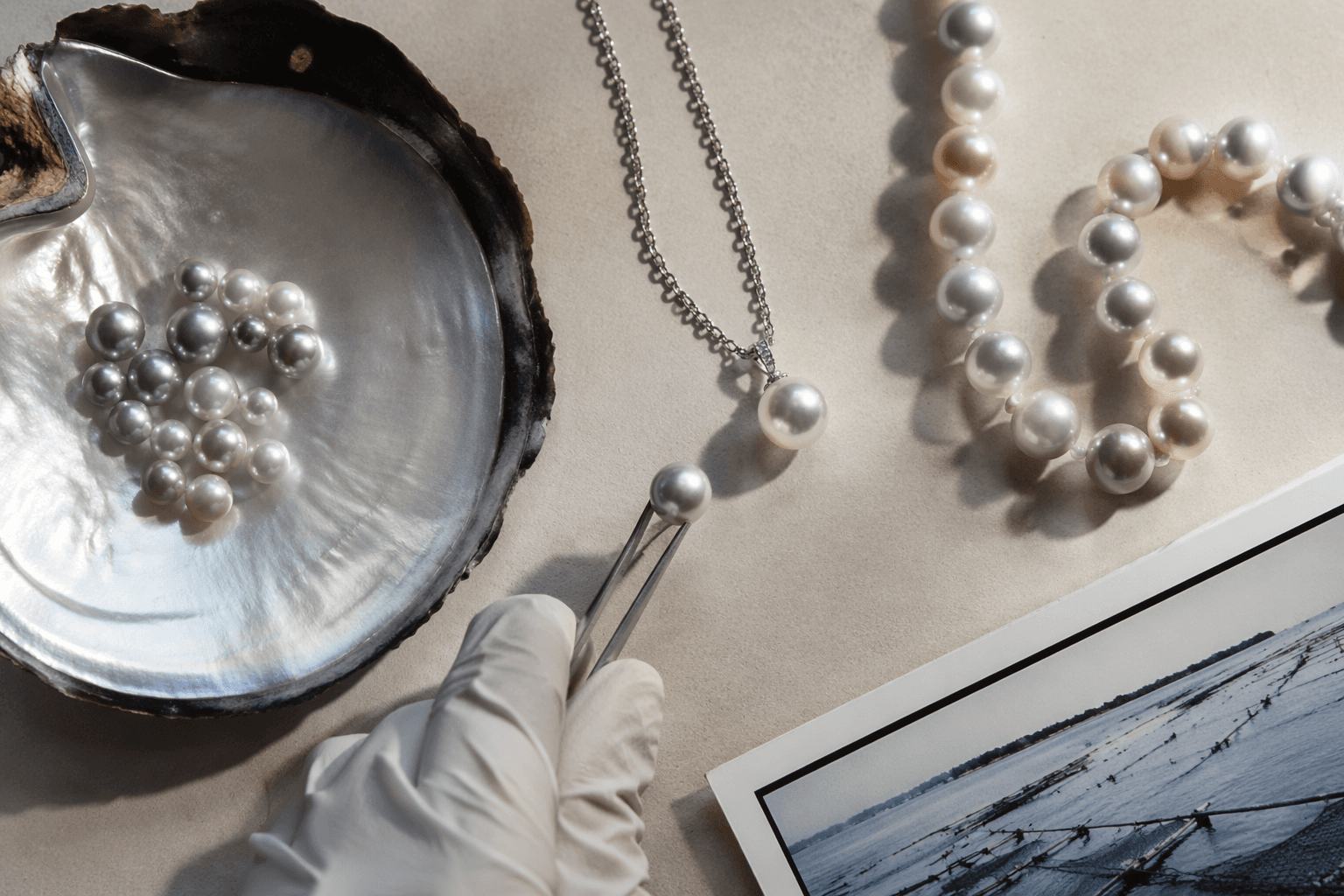
Not all pearls occupy the same price tier or carry the same set of sourcing questions. The main categories, in roughly ascending order of cost, are freshwater, Akoya, Tahitian, and South Sea.
Baroque pearls, perfectly imperfect in their irregular shapes, are in high demand. Freshwater baroque pieces represent the most accessible entry point into real pearl ownership, typically starting well under $200 for a strand, making them the obvious starting point for the looks described above. Oversized pearl earrings, pearl studs, and large freshwater pearl earrings are projected to be widely adopted in 2026, meaning supply is expanding and prices at the accessible end are likely to remain competitive.
Akoya pearls, cultivated primarily in Japan, deliver the high-luster, round white pearl of classical imagination and command a meaningful price premium for that uniformity. Tahitian pearls, grown in French Polynesia, run from dark silver to deep green-black and suit the industrial-contrast look particularly well. South Sea pearls, from Australia and the Philippines, are the largest and most expensive: a single strand can reach several thousand dollars, at which point the asset-protection consideration becomes genuinely relevant.
Classic pearl looks often feature Akoya or White South Sea varieties, prized for their size and luminosity. For the everyday styling playbook described here, freshwater baroque and Akoya pieces offer the best balance of visual impact and practical investment.
The Ethical Question You Should Be Asking
Pearls are a biological product, which means their sourcing story is inseparable from the health of the water systems where they are grown. When shopping for ocean-sourced jewelry, look for trusted certifications including MSC, Fair Trade, or CITES; these labels confirm that a piece meets strict ethical and environmental standards.
Beyond certification labels, farm-level practices matter. Kamoka Pearl, a French Polynesian operation, farms pearls with the highest ecological standards, relying on natural fish populations to clean oysters rather than mechanical pressure hoses, a practice with measurably lower environmental impact. Mejuri's cultured pearls are responsibly sourced from oysters and mussels, with the brand committed to transparency and traceability throughout its supply chain.
The brands that cannot tell you where their pearls were grown, or who farmed them, are the ones worth scrutinizing. Vague claims about "sustainably sourced" or "responsibly crafted" without certification or farm-level disclosure are the jewelry equivalent of greenwashing. Ask the question directly before you buy.
Protecting What You've Bought
As pearls move from occasional-wear heirlooms to genuinely everyday pieces, the case for insuring them strengthens. A South Sea strand worn regularly faces real-world risks, scratching, breakage at the stringing knots, loss, that a piece kept in a velvet box simply does not. Fine pearl jewelry, particularly Akoya, Tahitian, and South Sea pieces, qualifies as a scheduled item under most jewelry insurance policies, meaning it can be covered for replacement value independent of a homeowner's policy.
The practical step is straightforward: get any fine pearl piece appraised when you buy it and update the appraisal every three to five years, since the pearl market, like any commodity market, shifts. A strand appraised in 2018 may be significantly undervalued today.
Where This Is Headed
What began as a high-fashion aesthetic has now become an everyday favorite. The most telling signal is not which celebrities wore pearls on the red carpet, but where pearls are turning up off it: on handbag straps, woven into denim, clipped to the collars of workwear blazers. Pearls have always been a democratic accessory at heart; Coco Chanel proved that a century ago. What is new is the breadth of entry points, the willingness to wear them imperfect and baroque rather than matched and formal, and the expectation that a pearl comes with a traceable story. The jewel has not changed. The standard we hold it to has.
This article was produced by Prism’s automated news system from verified source data, official records, and press releases, then run through automated quality and moderation checks before publishing. The system is built and supervised by the people who set the standards it runs under. Read our full AI policy.
Did this article answer your question?