Trending Earrings 2026: Real Pearls Style
Pearl earrings are 2026's fastest-growing jewelry segment, in a $13B market expanding at over 11% annually; baroque drops and asymmetrical pairs are where the real momentum lies.
Here is the number that reframes the entire pearl conversation: the global pearl jewelry market, valued at $13.1 billion in 2024, is projected to reach $34.4 billion by 2033, a compound annual growth rate of 11.5%. That is not the modest tick of a heritage category coasting on tradition. That is the velocity of a material being rediscovered by buyers who are younger, more independent financially, and more specific about what they want than any previous pearl-buying generation.
Earrings are where that energy is most concentrated. Necklaces still hold the largest slice of the pearl jewelry market overall, but earrings are the category's key growth segment, driven specifically by asymmetrical pairs and baroque-drop styles. Google Trends data shows clear search spikes in 2026 for "real pearl drop earrings" and "real pearl stud earrings," and the word "real" in both queries is not incidental. It signals that buyers are already doing their homework before they reach a product page. Asia-Pacific leads global demand, while North American buyers are searching with unusual specificity for vintage-inspired and ethically sourced styles. Sustainability has become a genuine purchase criterion in this category, not a marketing layer applied after the fact.
If you are planning to buy pearl earrings this year, the following is what the market data actually translates to at the jewelry counter.
The five shapes defining 2026
Classic round stud
The round stud is the benchmark pearl earring because it absorbs context rather than demanding it. A single pearl, 7 to 9 millimeters for most proportions, in a four-prong or bezel setting works across every occasion without adjustment.
- Who it flatters: Square face shapes benefit most. The circular softness of a round pearl directly counterbalances a wide, defined jawline. Oval faces, considered the most proportionally flexible, can wear any size; if you have an oval face, consider sizing up to 9 or 10 millimeters for genuine presence rather than a whisper of pearl.
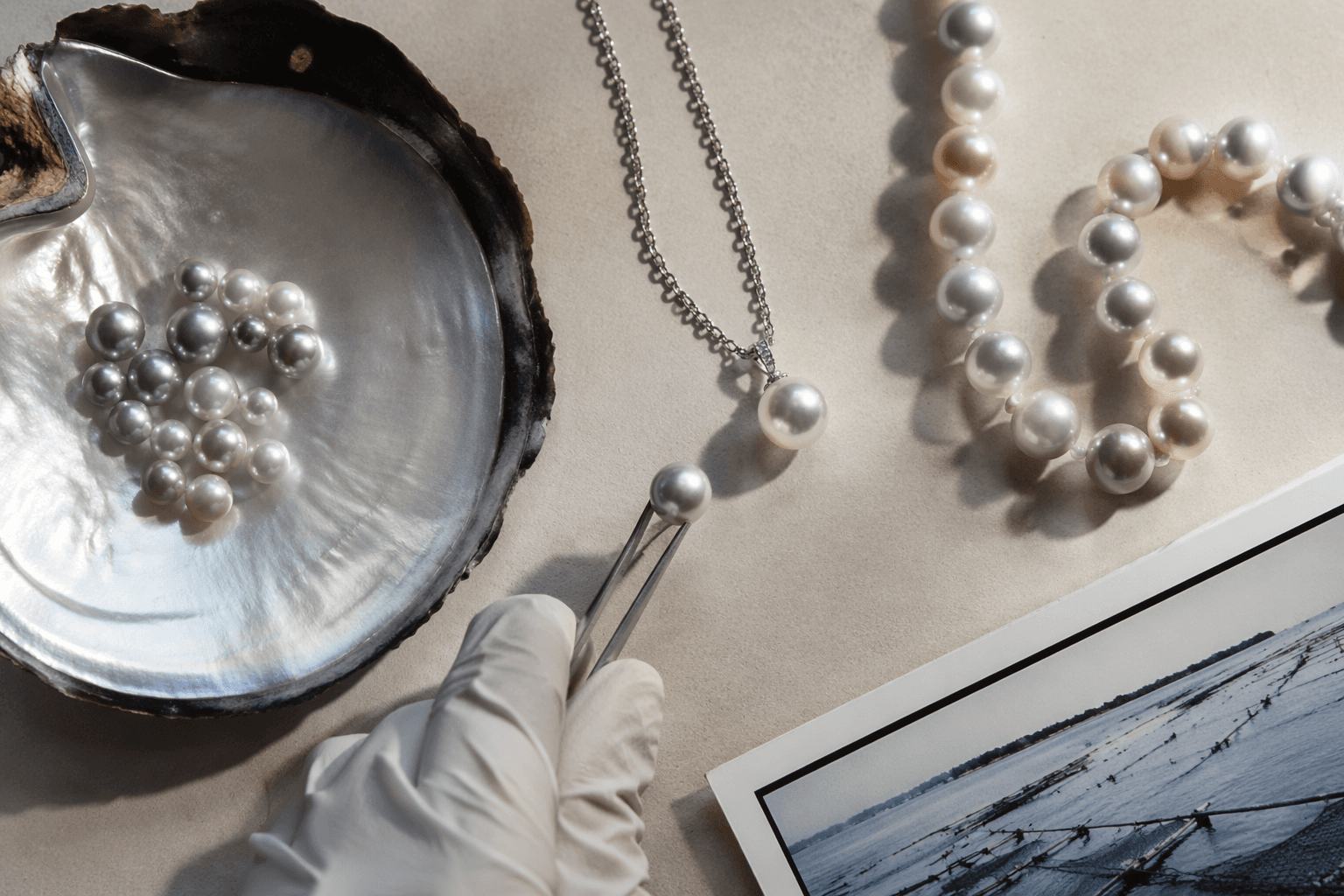
- What to look for: Luster is the only metric that matters at the point of purchase. Hold the earring under a direct light source and look for a reflection sharp enough to read your own outline in the pearl's surface. A hazy or chalky finish means thin nacre, and thin nacre deteriorates with wear. Akoya pearls, grown primarily in Japan, are the traditional choice for round studs because their surface finish is crisp and their reflections are mirror-bright. For metal pairing: Akoya pearls with white and cream overtones read cleanest against white gold or platinum; freshwater pearls in peachy or lavender hues are grounded by yellow gold.
Baroque drop
Baroque pearls are irregular by definition, shaped by a nacre-layering process that follows the mollusk's own geometry rather than producing a sphere. In 2026, this is the style carrying the most cultural momentum, and the shift makes gemological sense. A baroque pearl on a simple gold drop finding is the rare piece of jewelry that reads as both considered and effortless.
- Who it flatters: Round face shapes benefit from the vertical pull of any drop earring, and a baroque pearl adds that length without the severity of a geometric drop. Square faces are also well served; the organic curves of a baroque pearl soften angular features more effectively than a sharp linear drop. Heart and diamond face shapes, which already carry vertical elongation, can wear baroque pearls with lateral dimension rather than purely vertical drop.
- What to look for: Surface irregularity is expected and is part of a baroque pearl's appeal; do not grade it against a round pearl's standards. What you are evaluating is the depth of luster across those irregular surfaces. The nacre should glow even on the ridged and folded areas, not only at the pearl's highest point. South Sea and Tahitian baroque pearls carry the thickest nacre of any cultured variety. A Tahitian baroque drop in gray or peacock green set on oxidized silver or blackened gold is one of the most striking earring choices available at any price point, precisely because nothing else looks quite like it.
Asymmetrical pair
The asymmetrical earring is 2026's most photographed pearl format, and it is more wearable than editorial coverage suggests. The premise: two distinct earrings, worn intentionally together, unified by a shared material or metal tone. One side might carry a small freshwater pearl stud; the other, a longer drop or a partial hoop threaded with a single baroque pearl.
- Who it flatters: Oval and long face shapes carry asymmetrical pairs most naturally, as the visual disruption created by different earring heights adds interest without distorting proportions. For rounder faces, position the longer earring on your dominant presentation side and keep the shorter earring on the opposite ear.
- What to look for: The discipline of a well-executed asymmetrical pair lies in its unifying element. Both pearls should share the same pearl type so that their luster character and overtone read as family, not coincidence. A disparity in nacre quality between sides reads as a quality error rather than a design choice. If you are assembling a pair from separates, bring both pearls into the same light source and confirm the surface reflections have the same depth and warmth.
Pearl-accent hoop
A thin hoop, typically 15 to 25 millimeters, with a single pearl or a cluster of small pearls set at the base or graduated along the arc. This format bridges the discretion of a stud and the movement of a drop, which is why it has become the format most associated with genuinely daily wear that still registers as intentional.
- Who it flatters: Oval faces have the most latitude here. Square faces should seek oval-shaped hoops rather than perfectly circular ones, since the slight vertical bias creates flattering length. Round faces benefit from a style where the pearl drops slightly below the hoop's lowest point, adding the elongation that a purely circular hoop does not.
- What to look for: Setting security is more critical on a hoop than on any other pearl earring format. Pearls on hoops sustain more incidental contact than studs. A bezel setting, which wraps the pearl's girdle in a continuous band of metal, offers substantially more protection than a prong setting. Freshwater pearls in 3 to 5 millimeter sizes are ideal for hoop accent work: durable, available in a wide color range, and produced by farming operations that generally carry a lower environmental footprint than saltwater pearl cultivation.
Ear climber with pearl detail
An ear climber sits against the lobe and curves upward along the ear's inner edge. In 2026, this format is appearing with a single pearl placed at the curve's peak or with a graduated line of small freshwater pearls ascending the ear. The visual effect is a pearl that appears to float against the ear with no visible finding.
- Who it flatters: Round and square face shapes benefit most directly because the upward trajectory creates a vertical line that a stud cannot produce. The climber is also particularly effective if you have a single lobe piercing but want the visual complexity of a curated ear; one climber with nothing above it reads as intentional rather than incomplete.
- What to look for: Fit determines everything about how a climber performs. A climber that gaps away from the ear or sits loosely will not display the pearl placement as the setting intends. Try the piece before committing. On a graduated climber, matching is non-negotiable: variations in overtone or size that charm in a baroque drop read as quality inconsistencies when pearls are meant to graduate evenly up the ear.
The actual buying decision
Trend reporting is useful as context. It does not tell you what to buy. Three real-life scenarios cover most purchases in this category:
For everyday wear, the round stud or pearl-accent hoop is the correct answer. Choose Akoya or freshwater pearls in the 6.5 to 8 millimeter range. White gold or solid sterling silver holds its finish better under daily contact than gold-plated settings. A bezel setting eliminates the prong-snag risk that plagues pearl studs worn with knit fabrics.
For a statement earring, go baroque drop or asymmetrical pair. Size up, and consider color. Tahitian pearls in peacock green or aubergine, Edison freshwater pearls in copper and rose, and South Sea pearls in champagne gold are commercially available and considerably more distinctive than a standard white round. The metal can be assertive; brushed yellow gold, oxidized silver, or mixed metals read as modern when the pearl's overtone connects them.
For a gift, the classic round stud remains the most universally flattering, lowest-risk option in the category. For a first-time pearl wearer, 7 to 8 millimeter Akoya studs in white gold carry enough quality to feel significant without requiring the recipient to have an existing jewelry sensibility. For someone who already owns pearls, a single baroque drop with an open ear wire gives them something worth pairing asymmetrically with what they already have, which is both a more personal gift and a more interesting one.
The pearl jewelry market's 11.5% annual growth rate is partly a function of e-commerce making once-inaccessible pearl types visible to buyers who had no idea freshwater, Akoya, South Sea, and Tahitian pearls were four distinct materials with four distinct price ranges. The buyers driving that search spike for "real pearl earrings" are asking the right question. The answer is that real pearls, once you know what you are looking at, are among the most legible quality stories in jewelry: the nacre either glows or it does not, and that glow is something no coating can replicate for long.
This article was produced by Prism’s automated news system from verified source data, official records, and press releases, then run through automated quality and moderation checks before publishing. The system is built and supervised by the people who set the standards it runs under. Read our full AI policy.
Did this article answer your question?