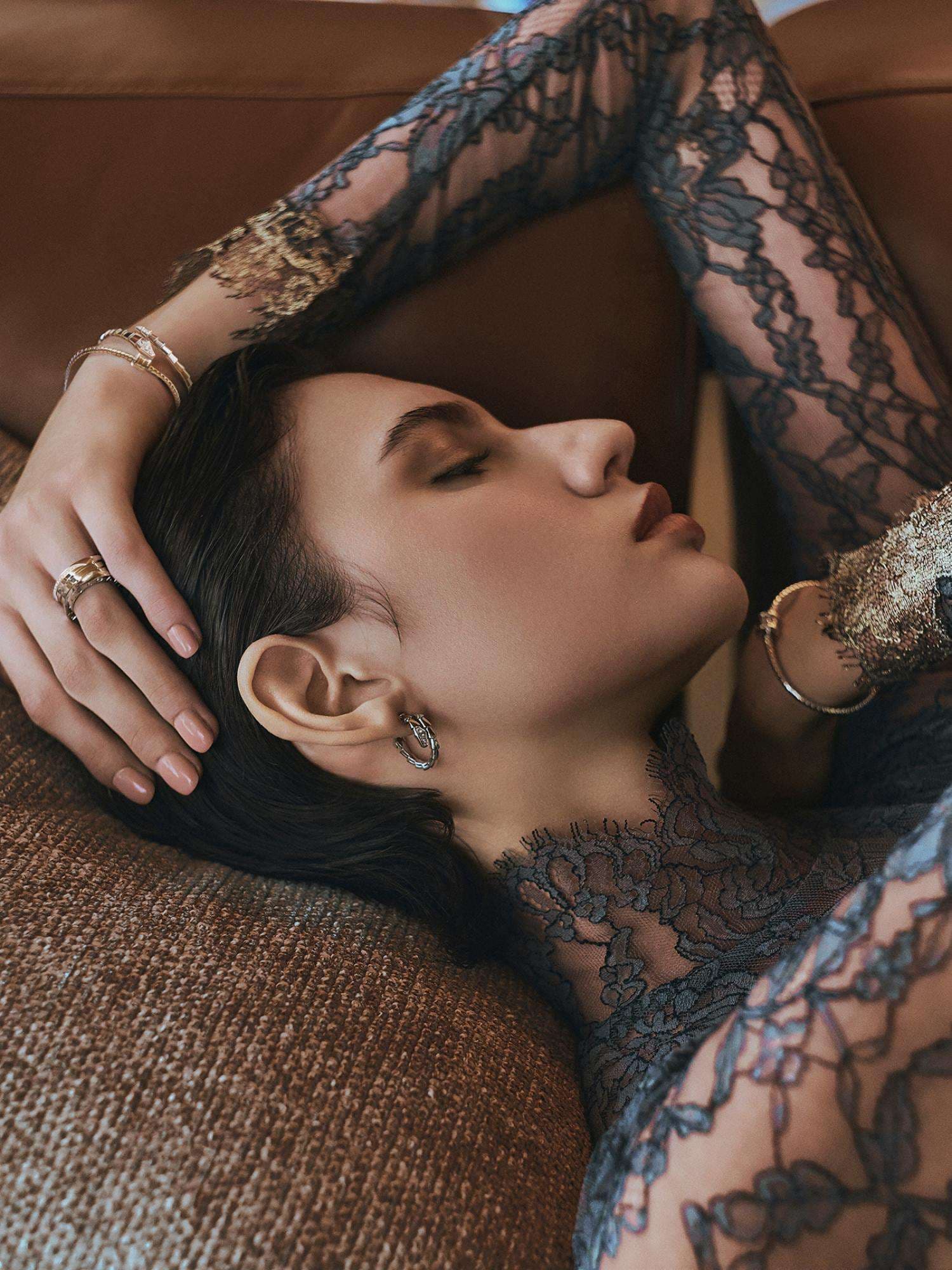
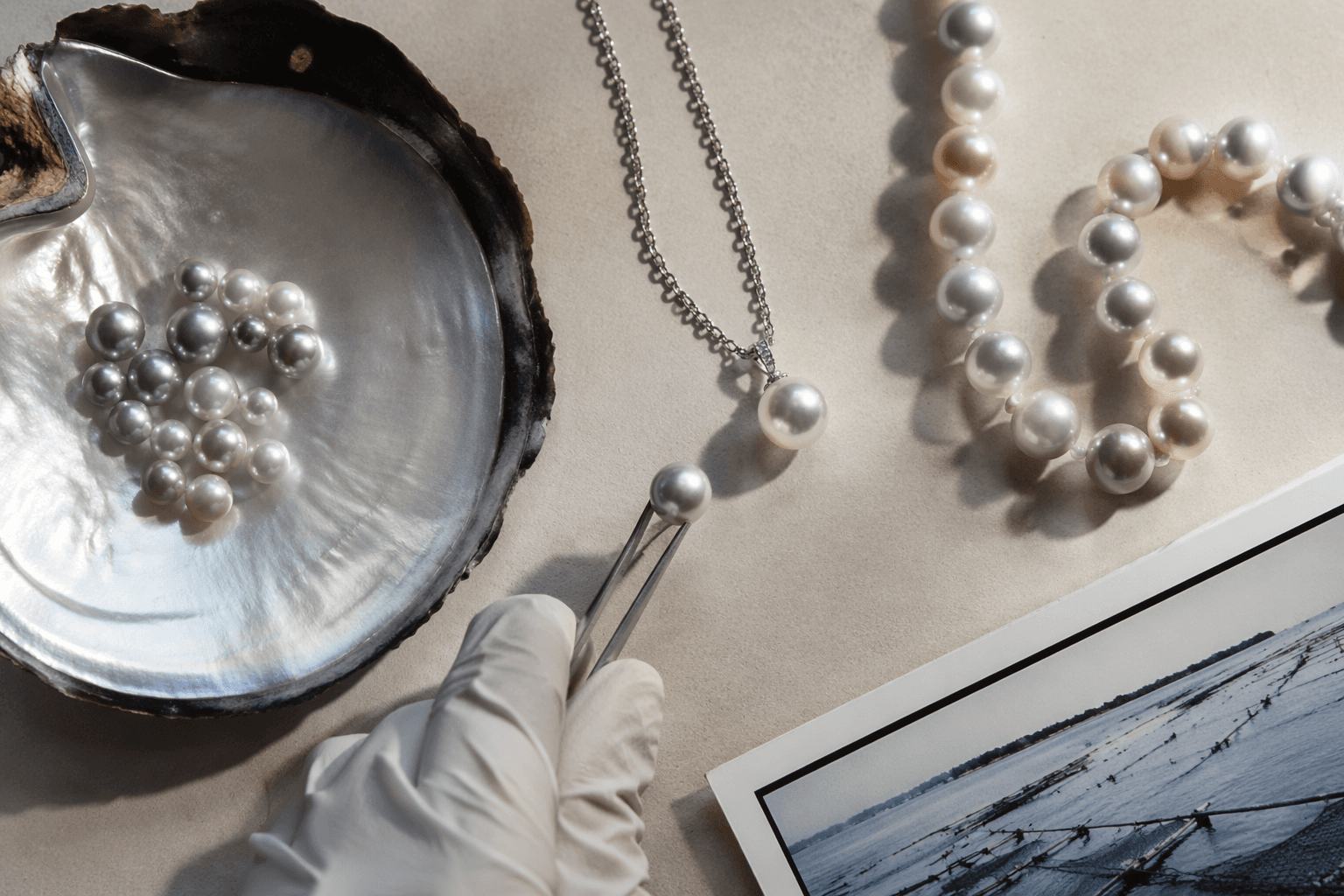
Pearls, sculptural gold, and maximalism set spring accessory tone
Baroque pearls and sculptural gold are displacing quiet luxury as the language of spring dressing, with major runways from Chanel to Givenchy making the case for intentional maximalism.
The quiet luxury era had a good run. For several seasons, jewelry whispered: slim gold bands, delicate chains, nothing that dared compete with the clothes. Spring/Summer 2026 has decisively ended that conversation. From the Paris ateliers to the retail floor, the message arriving this season is the same: adornment is back as the point, not the punctuation.
At the center of this shift sit three interlocking forces: pearls reimagined for a less precious age, sculptural gold that treats metal as architecture, and a maximalism calibrated enough to feel considered rather than chaotic. Together they define the dominant accessory language for the season ahead.
The Pearl, Reborn
The classic pearl strand never really disappeared, but it was doing something quietly conservative for years: sitting close to the collar, speaking of restraint and occasion. What is arriving on SS26 runways and in consumer styling is a fundamentally different proposition. Chanel, Celine, and Ralph Lauren have each sent pearls down the runway this season, but none of them in the form your grandmother would recognize.
Matthieu Blazy's debut ready-to-wear collection for Chanel was the most closely watched fashion event of the cycle, and his treatment of the house's most iconic material signaled the shift clearly. Where his predecessor Virginie Viard deployed the giant pearl necklace as a literal brand statement, Blazy literally squished those codes, proposing a layered, complex interpretation that earns its references without leaning on them. At his Haute Couture outing, fine chains and pearls were sewn directly into the translucent hems of opening looks: structural, unexpected, intimate. Pearls as construction detail rather than decoration.
At Celine, Michael Rider's second collection styled looks with stacks upon stacks of pearl and beaded necklaces, mixing lengths, diameters, and surface textures in a way that felt genuinely new. The point was abundance and intentionality in equal measure. Ralph Lauren's runway approach nodded to the pearl's heritage while anchoring it to heavier gold forms, anticipating the season's broader appetite for mixed materials.
The pearl shape driving most of the energy is baroque: irregular, non-spherical, organically surfaced. Its appeal is partly gemological and partly cultural. A perfectly round Akoya pearl signals precision; a baroque pearl signals personality. The irregularity that was once considered a quality deficit has become the thing buyers are actively seeking. Independent jewelers are meeting this demand with mixed-material pieces that pair baroque drops with oversized chain links, matte cord, or pavé-set gold hardware. Single baroque drops worn alongside a simple huggie hoop have become one of the season's most-spotted real-world combinations, appearing consistently in street style documentation across fashion weeks.
For buyers approaching pearl jewelry this season, the most useful frame is one of contrast: a baroque pearl reads most powerfully when its soft organic surface is set against something harder and more deliberate, whether that is a chain-link backing, a sculptural gold setting, or an asymmetric arrangement with a structured earring alongside it.
Sculptural Gold: Metal as Architecture
At Balenciaga, Pierpaolo Piccioli's debut collection reimagined the necklace as modern armor, sending models down the runway in metal collars and thick gold links that wrap the body with architectural precision. This is not the gold of heritage sentimentality or investment signaling. It is gold as a design medium in its own right, closer to sculpture than to jewelry in any traditional sense.
Ralph Lauren's runway offered hefty golden shapes, while Balenciaga pushed into architectural metal collars. Valentino, Saint Laurent, Acne Studios, and Chanel all showed versions of this trend in varying materials and scales. The 2026 interpretation is not about delicate gold whispers; it is about weighted, architectural presence: thick hoops with hammered texture, asymmetrical drops that frame the face with genuine dramatic intent, and sculptural forms that read from across a room.
Sculptural gold cuffs, candy-colored beaded necklaces, reimagined pearls, and oversized earrings are the statement jewelry categories dominating the conversation this season. Nordstrom fashion director Linda Cui Zhang, commenting on the gold trend, argued that "Deco-inspired gold jewelry makes an impact and an elegant accent. From a brooch, chunky ring, or cuff, a bold gold piece adds warmth to looks."
The practical styling advice that follows from the runway is clear: when the jewelry is doing significant architectural work, the rest of the look should yield. Whether you choose silver or gold (or mix the two), for maximum impact, treat the statement pieces as outfit-makers and keep the rest of the accessories simple. The sculptural cuff that "would blend in at a modern art museum," as Marie Claire put it, does not want competition from a stacked ring set or a layered necklace situation. Restraint elsewhere amplifies the impact of the piece.
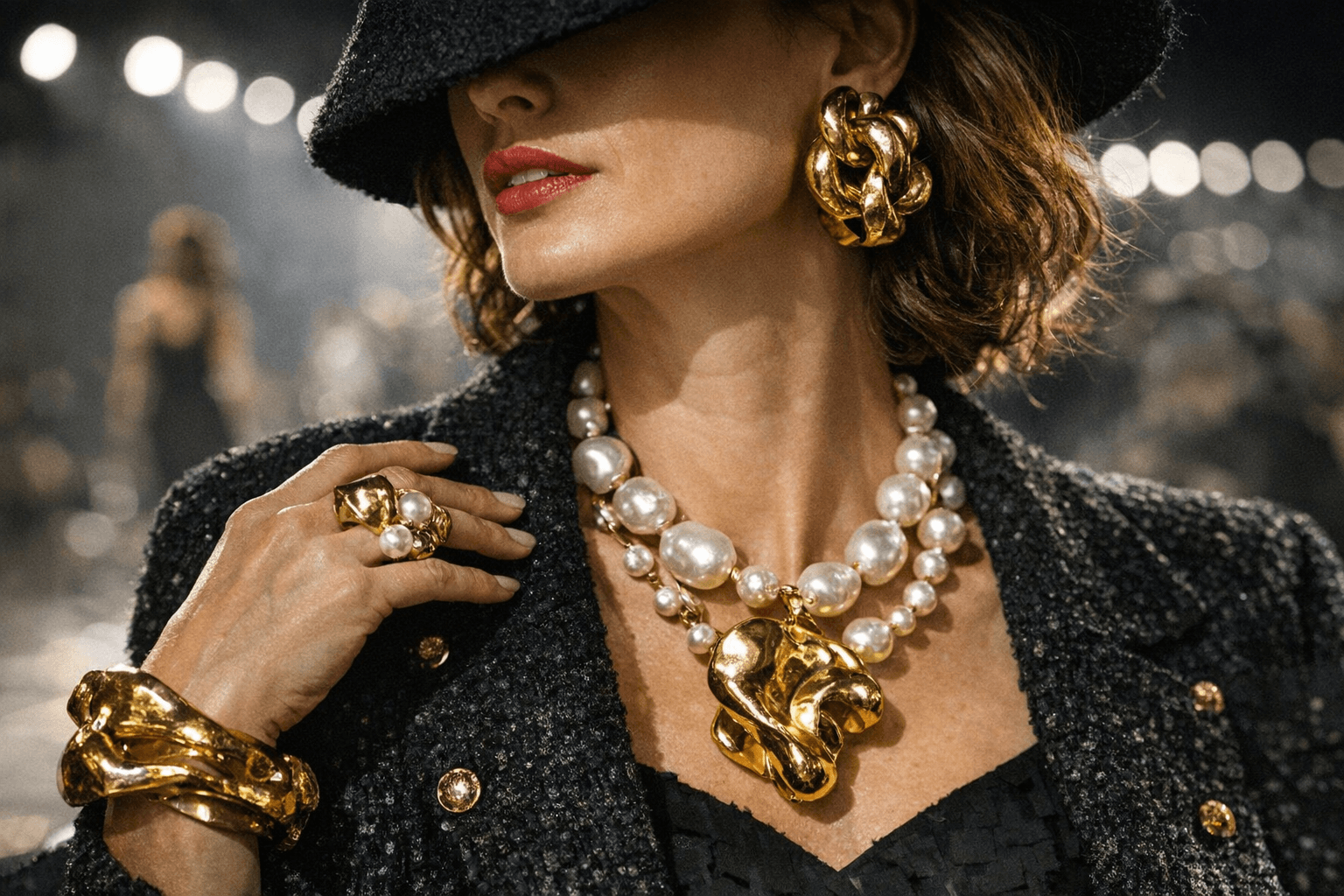
Yellow gold continues to dominate the metal conversation, but silver made a confident return this season in architectural, polished shapes. Both are having major moments in bold, sculptural forms, and the most modern approach is to mix both; the era of perfectly matching metals is behind us.
Maximalism with Intent
The most obvious shift this season is sculptural movement, which treats precious metals more as fluid objets d'art than jewels. But the broader context for all of it is a maximalism that has moved some distance from the more-is-more excess of previous boom cycles. After years of quiet luxury and pared-back minimalism, jewelry has found its voice again. Sculptural gold cuffs, candy-colored beaded necklaces, reimagined pearls, and oversized earrings are the statement jewelry categories dominating the conversation, and they are doing it with an intentionality that elevates maximalism from excessive to considered.
Spring 2026 is the season where jewelry stops "finishing" an outfit and starts being the outfit. This reframing has real implications for how to build a look. A single baroque pearl drop and a sculptural gold cuff, worn with an otherwise simple silhouette, constitute a complete styling decision. The instinct to keep adding is not the right one here.
Geometrically bold earring shapes have been a dominant subnarrative within the maximalism story. Designer Sarah Burton turned Givenchy's runway into a geometry lesson, showing puffy squares as supersized studs, drop earrings, and multi-strand earrings. At Louis Vuitton, Nicolas Ghesquière showed center-cube bracelets. Ferragamo and Brandon Maxwell contributed to the sculptural earring moment as well, confirming that the form is a cross-house consensus rather than an individual creative decision.
Asymmetry has emerged as maximalism's smartest tool. Marie Claire identified it as "Spring 2026's easiest jewelry trend to try yourself": wearing a single earring, or deliberately mismatching a hoop with a stud in the same ear. It requires almost no investment to execute and produces an immediate visual result that reads as intentional rather than arbitrary.
How the Runway Translates to Real Dressing
The gap between what happens on a Paris runway and what actually gets worn is usually significant. For SS26, it is narrower than usual, partly because the styling idioms being proposed are genuinely accessible. Layering pearl strands with gold chain necklaces is something that can be assembled from pieces already in a collection rather than requiring entirely new acquisition. Pearl stacking, whether at the wrist or the ear, scales from costume to fine jewelry without losing coherence. The single baroque drop worn opposite a huggie hoop is a configuration that works across price points and contexts.
The pearl trend for spring 2026 is about baroque shapes, mixed textures, modern proportions, and pairing pearls with unexpected partners including chain link, gold hardware, and colored stones. The classic single strand has been replaced by something more personal and assembled-feeling.
Beaded necklaces are an It jewelry trend for 2026, with Chanel, Celine, and Ralph Lauren having spoken from the runway, and Instagram influencers already catching onto the trend. Etro and Chanel went further still, showing gold and pavé-diamond beaded necklaces that elevate the format into fine jewelry territory. The luxury-ification of the beaded necklace, as Marie Claire framed it, is "well underway."
What makes this particular convergence of trends durable is that it is driven by a genuine shift in what jewelry is being asked to do. For several seasons, a piece of jewelry's highest ambition was to be invisible enough not to disturb the clothes. The SS26 runways have collectively proposed the opposite: that the right piece of jewelry is not the one that disappears, but the one that, worn alone against something simple, makes the entire outfit make sense. Pearls, sculptural gold, and intentional maximalism are not three separate trends competing for attention. They are three answers to the same question about what personal adornment is for.
This article was produced by Prism’s automated news system from verified source data, official records, and press releases, then run through automated quality and moderation checks before publishing. The system is built and supervised by the people who set the standards it runs under. Read our full AI policy.
Did this article answer your question?