Spring 2026 Fine Jewelry Collections Embrace Pearls as Nature-Inspired Focal Points
Pearls are no longer accents — Emily P. Wheeler's Fenua and Bibi van der Velden's Enchanted Forest use them as narrative anchors in spring 2026's most sculptural fine-jewelry collections.
The pearl has spent decades playing a supporting role, strung obediently in matched lines or dropped as a single pendant on a gold chain. What spring 2026's most ambitious fine-jewelry collections make clear is that designers are no longer content with pearls as punctuation. In collections like Emily P. Wheeler's Fenua and Bibi van der Velden's Enchanted Forest, the pearl becomes something more complex: a textural collaborator, a narrative device, a material with provenance and purpose.
Fenua: When a Place Becomes a Collection
For the people of Tahiti, the word "fenua" translates as "land," "earth," or "territory" — but its cultural meaning goes far deeper, representing the spiritual connection between the Tahitian people and their ancestral roots. For Los Angeles designer Emily Wheeler, founder and creative director of Emily P. Wheeler, the word evokes her own ties to the island, a place she has returned to many times over the years.
Wheeler describes the relationship plainly: "It has left a lasting imprint on my creative vision. The colors of the flowers, the richness of the earth, and the vibrancy of the landscape are unlike anywhere else. Fenua is my tribute to the island — a collection that captures its natural beauty and the deep connection I feel each time I visit."
Fenua is the first of a three-part collection, which means what's visible now is an opening argument rather than a complete statement. The collection's design language draws on Tahitian floral motifs — plumeria, tiare, hibiscus — rendered in 18k yellow gold and set with a range of stones that reflect the island's palette: peridot, tourmaline, pink sapphire, and, critically, pearls.
The pricing reflects the collection's high-craft ambitions. The Mana Stud in an ombre diamond and pearl configuration is priced at $14,000, while the Mana Necklace in the same combination reaches $5,600 and the Mana Ring sits at $4,400 — making it one of the more accessible entry points in a collection that climbs steeply. The Tiare Earring, a flagship piece, is listed at $42,000, and the Tiare Ring at $46,000. The Marama Earring, a one-of-a-kind piece, is set in 18k yellow gold and titanium with 11.01 carats total weight of peridot and 3.12 carats total weight of tourmaline, priced at $28,000.
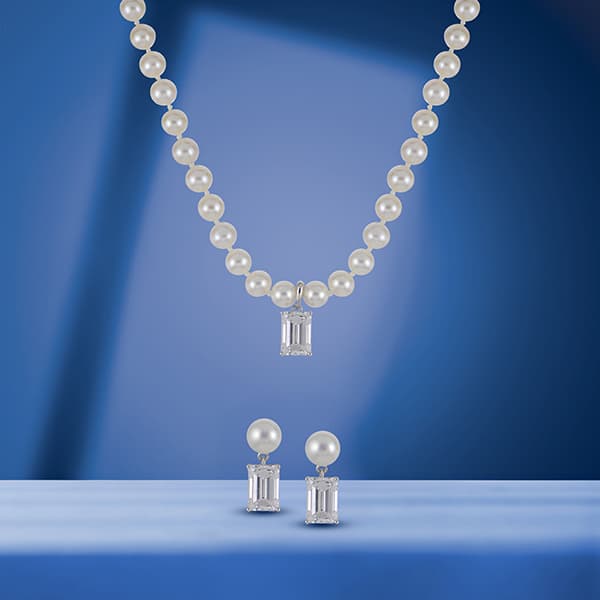
What distinguishes the pearl-incorporating Mana pieces is how Wheeler uses the stone within the collection's ombre concept: diamonds fade into pearl in a gradient that reads as organic transition rather than gemological contrast. The pearl doesn't fight for attention here. It absorbs the surrounding brilliance and softens it, which is exactly the kind of material intelligence that separates a considered collection from a trend response.
Enchanted Forest: Memory as Material
Bibi van der Velden's Enchanted Forest began with a memory: growing up in an old English house surrounded by woods and open fields, and the quiet thrill of leaving a school uniform behind to disappear into something untamed. That biographical anchor gives the collection a specificity that is unusual in fine jewelry, where nature "inspiration" often amounts to leaf motifs and green stones.
Van der Velden has described her jewelry as "miniature sculptures," and that framing is essential to understanding how Enchanted Forest works. The Dutch designer, who trained at the Gerrit Rietveld Academy in Amsterdam and the Royal Academy of Arts in The Hague before launching her brand in 2006, hand-sketches and sculpts each piece in wax before it is cast in precious metal. The result is jewelry that carries the evidence of a hand, not a mold.
The centerpiece of the collection, as profiled in JCK's spring 2026 feature, is the Guardians of the Forest necklace: an 18k yellow gold piece set with brown diamonds, rock crystal, abalone, selenite, opal, moonstone, and pearl, available at price on request. The material list reads like a field inventory of the forest floor. Each element was chosen not for rarity alone but for how it reads against its neighbors.
Opal and moonstone contribute softer light, while selenite beads and pearls create contrast through matte and translucent surfaces. Brown diamonds are dispersed throughout, contributing warmth and controlled brilliance without disrupting the overall composition.
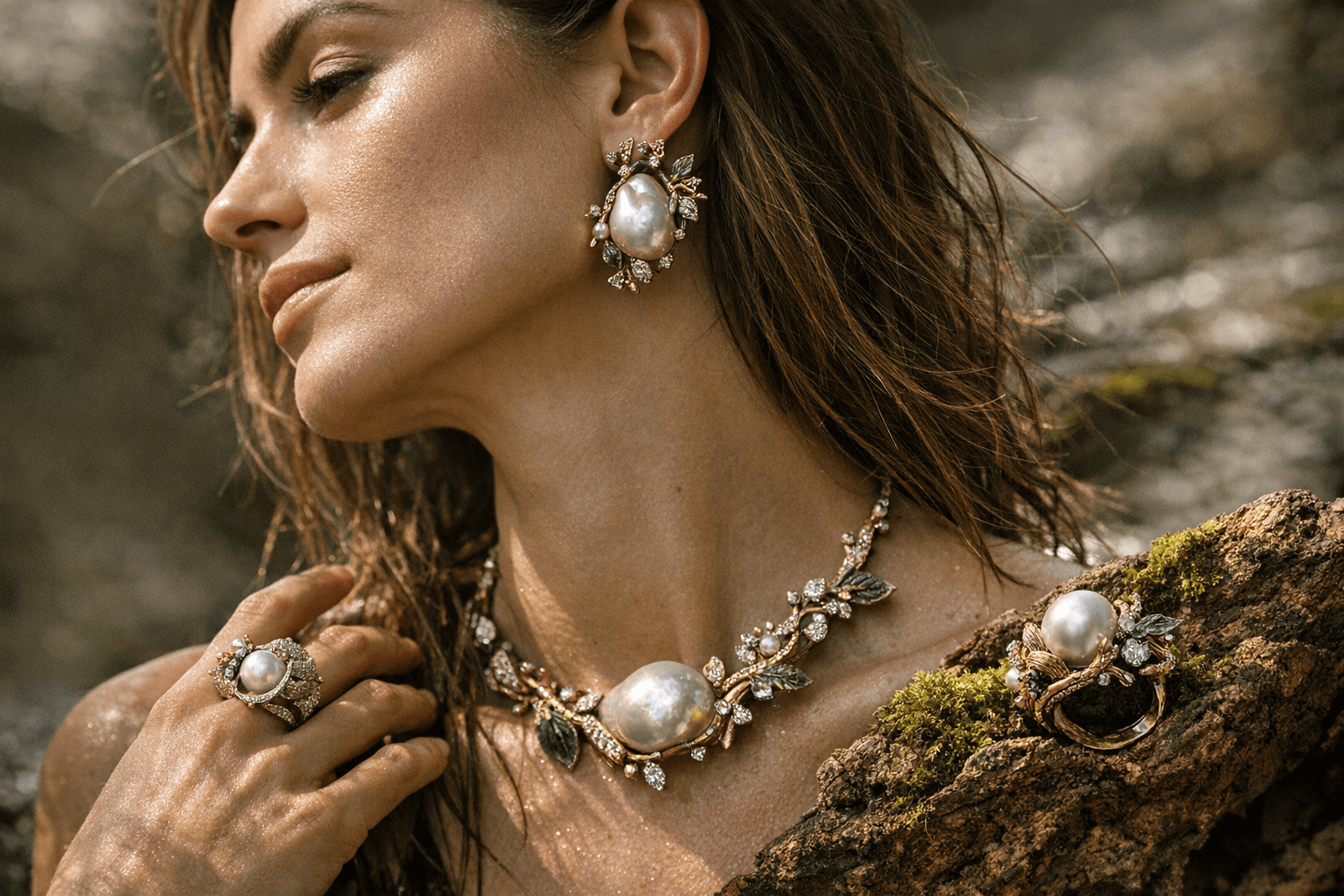
Despite its complexity, the piece remains structured. Each element is hand-crafted and assembled with consideration for balance, allowing the necklace to carry visual density without appearing chaotic. Its physical weight reinforces that presence, giving the piece a sense of permanence as well as scale.
The decision to use pearl alongside abalone is particularly deliberate. Both are products of the mollusk, both carry iridescence, but their surface character is entirely different. Abalone reflects in broad, almost metallic sweeps; pearl holds light more quietly, with depth rather than flash. Placing them in the same composition forces a conversation between two related materials, one cultivated and refined, the other raw and structural. The Guardians of the Forest operates as a complete composition, a layered, interconnected structure that reflects the collection's central idea of transformation through form, material, and movement.
Why Pearl Works as a Nature-Narrative Material
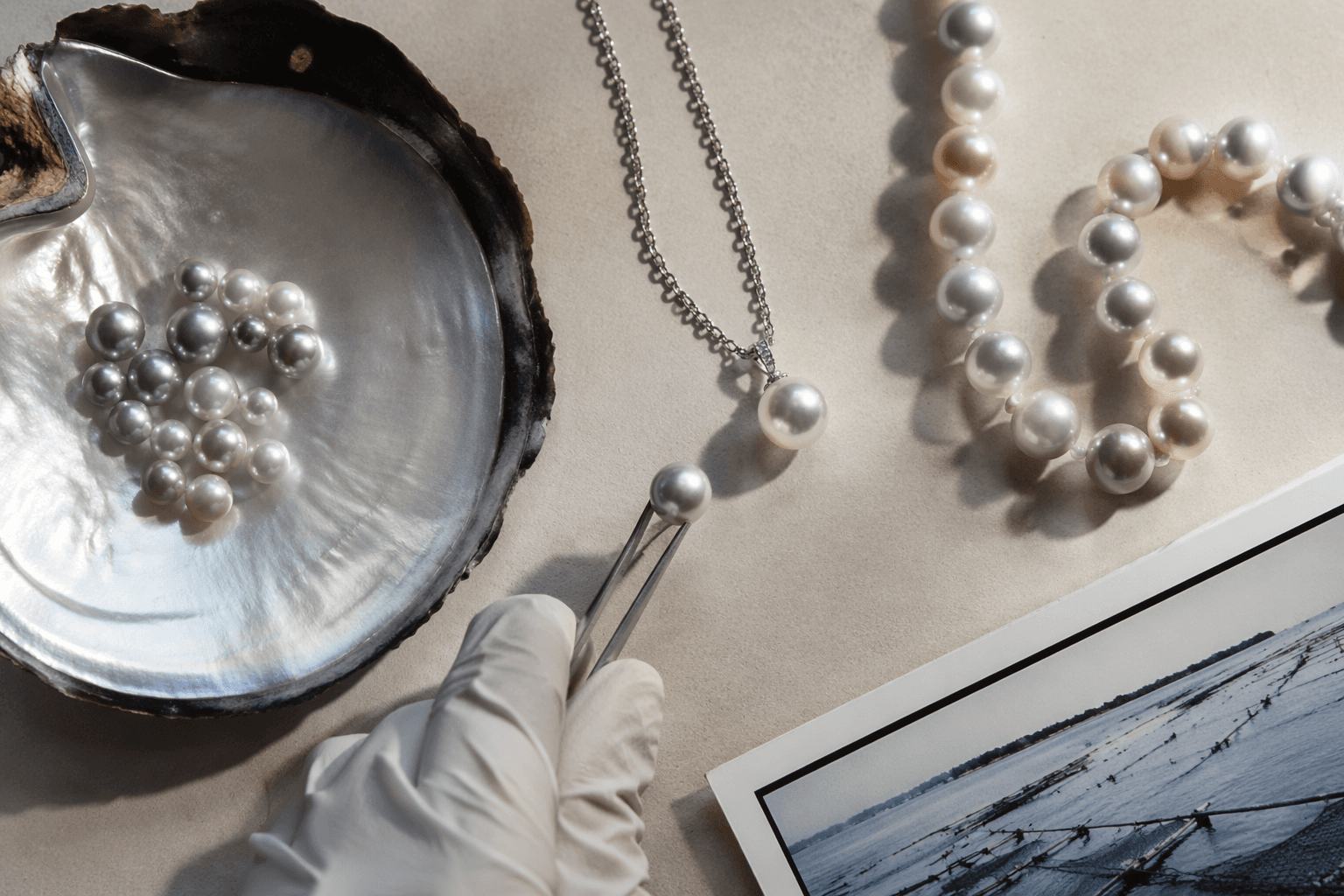
The convergence of these two collections at this moment is not coincidental. Pearl has properties that no other stone can replicate when a designer needs to evoke the organic world. It is literally grown; it carries biological history. Its luster is the result of accumulated nacre layers, each one deposited over time around an irritant. That origin story, when a designer is building a collection around natural connection or childhood memory in the wilderness, is part of the material's expressive value.
What Wheeler and van der Velden share, despite working from entirely different cultural reference points — a Pacific island paradise and an English woodland — is a refusal to treat pearl as a default luxury material. In Fenua, the pearl earns its place within an ombre gradient alongside diamonds, requiring the viewer to read the piece as a gradation rather than a collection of stones. In Enchanted Forest, the pearl is one voice among many in a complex material choir, valued precisely because its quiet surface holds still while abalone, opal, and moonstone perform around it.
Material Ethics and Maker Standards
For buyers who care about provenance, van der Velden's commitment to materials is traceable. Her pieces are crafted in 18k fairtrade gold, a certification that requires the gold to meet Alliance for Responsible Mining standards from mine to market. That applies across her collections, including Enchanted Forest. The brand's first flagship store recently opened at Van Baerlestraat 46 in Amsterdam, where the full collection is available for examination in person.
Emily P. Wheeler's Fenua does not publicly disclose pearl sourcing specifics on her website, which is worth noting for buyers who prioritize supply-chain transparency. The collection's clear connection to Tahiti as creative origin raises legitimate questions about whether the pearl elements in the Mana series draw from Tahitian pearl aquaculture. That is a detail worth asking when purchasing pieces at this price level: Tahitian cultured pearls, grown in French Polynesia's black-lipped oyster, carry their own industry certifications and export regulations, and a piece priced at $14,000 should come with documentation of what exactly is around your ear.
Pearl Jewelry as Storytelling
What spring 2026 demonstrates, in the hands of Wheeler and van der Velden, is that pearl's real power is not status but specificity. When a designer can tell you that a pearl sits in a necklace because its translucency holds still in a composition of moving, reflective materials — or that a pearl stud fades into diamonds as a landscape fades from sea to shore — then the material becomes legible in a way that pure gemological value never quite achieves. The collections that will age well are the ones built on a reason, and both Fenua and Enchanted Forest have one.
This article was produced by Prism’s automated news system from verified source data, official records, and press releases, then run through automated quality and moderation checks before publishing. The system is built and supervised by the people who set the standards it runs under. Read our full AI policy.
Did this article answer your question?