Buccellati's Century of Hand-Engraving Redefines Personalized Jewelry Through Craft
Buccellati's five hand-engraving methods, from silk-like rigato to lacework openwork, are now a blueprint for commissioning personalized jewelry that carries craft — not just a name.
Run your fingertip across a Buccellati bracelet and you understand immediately why the house has spent a century refusing to leave gold smooth. The surface moves under your touch: finely ridged, almost woven, warm in a way that mirror-polished metal never is. That tactile quality is not accidental. It is the result of five distinct hand-engraving techniques, each developed to make gold behave like fabric, and each one a potential vocabulary for anyone who wants personalized jewelry to carry meaning deeper than a laser-cut initial.
The Five Textures You Should Know
Mario Buccellati founded the house in 1919 on Via degli Orefici in Milan, drawing directly from Renaissance goldsmithing traditions and from the Venetian embroideries of Burano. He was 28 and had spent years as an apprentice to a Milanese goldsmith; what he brought to his own workshop was an obsession with surface. The techniques he formalized, and that subsequent generations of Buccellati artisans have refined, are specific enough to have names:
Rigato is formed by cutting parallel lines into gold with a burin, producing a surface that shimmers like woven silk. Telato introduces cross-hatching that recalls linen. Segrinato softens gold with a fine granular texture.
In the more complex ornato technique, a rigato-engraved background is further engraved with floral designs, with the lines criss-crossing in an intricate matt-gloss contrast to obtain a three-dimensional brocade effect. Burins of various thicknesses are used, depending on the design to be reproduced. The fifth technique, modellato, involves chiseling gold into three-dimensional relief, pushing the metal into sculptural form rather than simply incising its surface.
As Luca Buccellati, Special Sales and VIP Client Director of the maison, has explained: "You won't find plain gold in our jewellery as every single millimetre is engraved in a different technique. In rigato, for instance, we make tiny lines with a special tool in order to make it feel like silky gold when you touch it."
The combination most worth knowing: ornato and rigato are often seen together in Buccellati works, giving jewels the illusion of sparkling diamonds when in reality there are no stones at all. That alchemy is what makes a blank field of gold read as a jewel in its own right.
Openwork: The Technique That Takes the Most Time
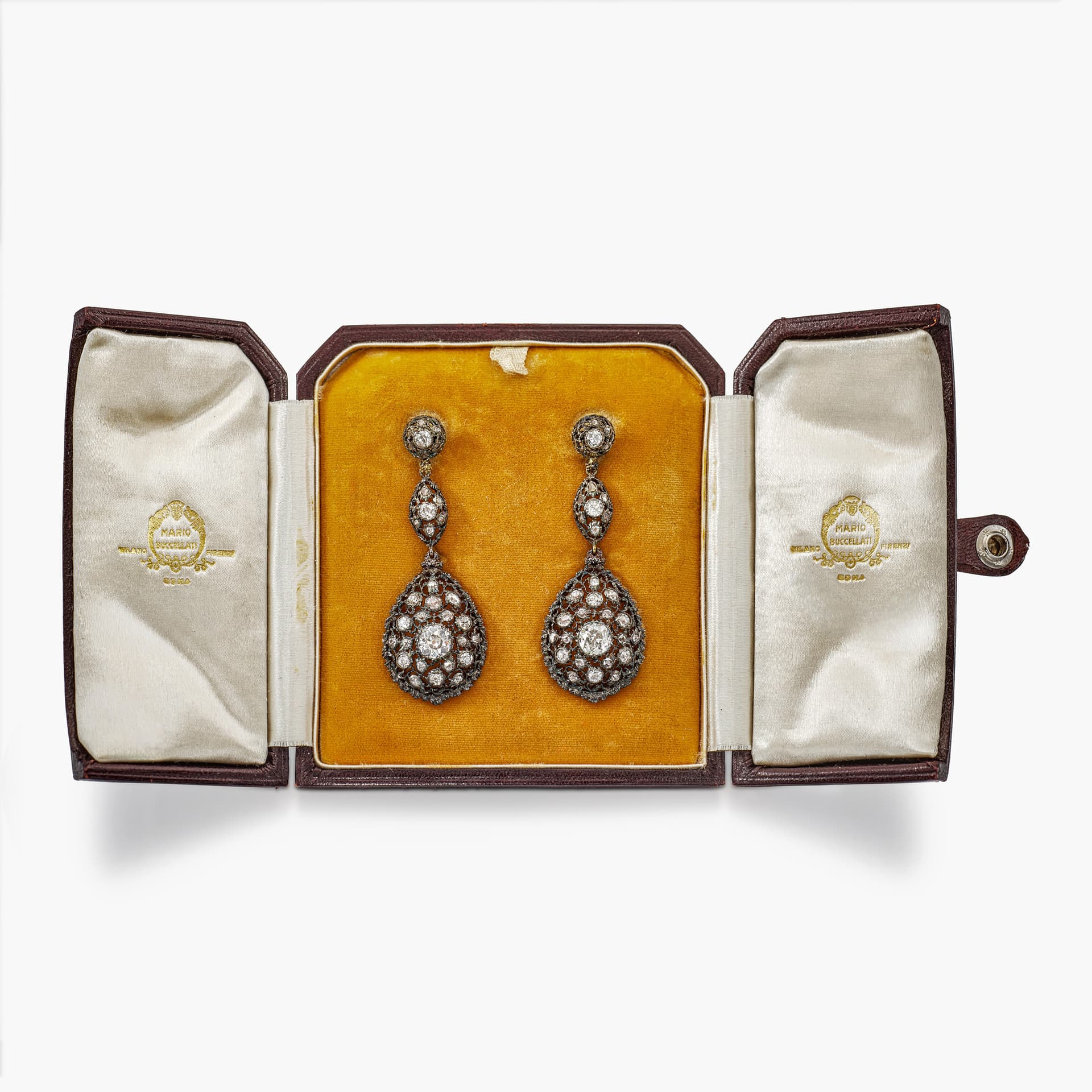
Beyond engraving, Buccellati's openwork tradition produces what the house calls the "tulle" technique. Also known as "honeycomb," tulle metalwork is an openwork technique designed to evoke the effect of the fabric of the same name. It is perhaps the most complex and time-consuming technique to master. Each piece of jewelry is pierced with tiny holes, and each of the resulting cells can be reworked a dozen times until perfection is achieved. The design, intricately executed using the openwork technique, usually follows either geometric and linear shapes or plant motifs. Chaining is also adopted when necklaces are made, whereby repeated single elements are chained together.
This is the technique most relevant for anyone interested in commissioning filigree-style personalized work. A nameplate pendant or initial pendant in openwork reads entirely differently from a solid stamped one: the letters carry air inside them, and the light passes through rather than reflecting off a flat front.
How to Commission Hand-Finish Details on Personalized Pieces
Knowing the Buccellati vocabulary gives you a working language to use with any skilled goldsmith. Most independent jewelers and specialist engravers can approximate at least the core techniques, though the execution varies considerably. Here is what to request, piece by piece:
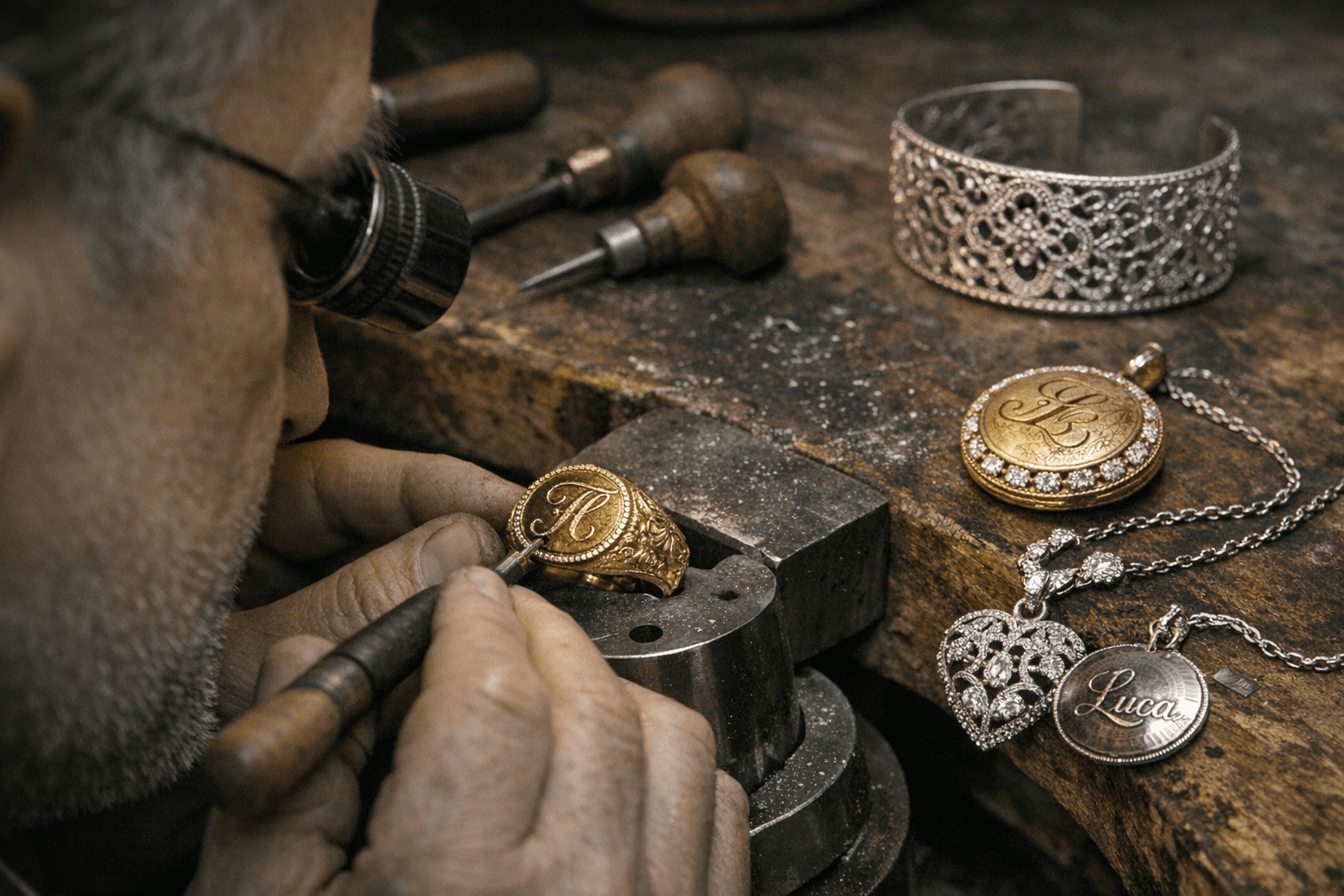
*For an initial signet ring:* Ask specifically for hand engraving rather than laser or machine engraving. These are not interchangeable terms. Laser engraving produces a uniform, slightly mechanical line; true hand engraving, done with a burin, leaves shallow variations that catch light differently across the face of the cut. Ask whether the engraver works freehand or uses a pantograph (a mechanical aid). Freehand is more expensive and more expressive. For the background field, request a matte or satin finish rather than a high-polish face: this is the closest consumer equivalent to rigato and creates the same contrast between a polished initial and a textured ground. Skilled artisans use fine engraving tools to engrave a series of very thin parallel lines by hand into the metal surface. The final result is a silky reflective effect that mimics luxurious textiles.
*For a nameplate pendant:* Instead of ordering a stamped nameplate, ask your jeweler whether they can engrave the letters into a flat or slightly domed plate, with a crosshatch or parallel-line background. This shifts the nameplate from a mass-market object into something that rewards close inspection. If budget allows, ask about openwork lettering, where the letters themselves are pierced through the metal.
*For a birthstone ring:* The stone setting is only one decision. The more interesting one is what happens to the band. Request a textured band finish, specifying whether you want something that reads as silky (parallel lines, rigato-adjacent) or more complex (crosshatch or mixed-direction engraving). Ask whether the engraving can extend to the inner shank: hidden inscriptions on ring interiors are among the oldest forms of personalized jewelry, and a date, coordinate, or initial inside a band is invisible to everyone except the person wearing it.
A Commissioning Checklist
Before meeting with a jeweler or engraver, bring clarity on the following:
- Hand or machine? Confirm the difference in writing. Machine and laser engraving cost less and take less time, but lack the micro-variation that makes hand-engraved surfaces feel alive.
- Finish type: Specify matte, satin, or high-polish; mixed finishes (matte background, polished lettering) most closely mirror the Buccellati approach.
- Line direction: Parallel (rigato-equivalent), crosshatch (telato-equivalent), or multidirectional (segrinato-equivalent). Most engravers can execute all three.
- Hidden inscription: Ask about interior shank engraving, underside engraving on a pendant, or text inside a locket-style element.
- Openwork or solid: Openwork takes significantly longer and commands a higher price, but transforms a standard initial into a piece with architectural depth.
What Is Realistic at Different Budgets
At the entry level, $100 to $300 covers laser or machine engraving on sterling silver or gold-fill pieces: initials, names, short dates. These are widely available, and the personalization is genuine even if the craft is not artisanal.
Between $300 and $800, you can commission hand engraving on a 14-karat gold band or small pendant from an independent goldsmith. At this range, expect one technique well executed: a clean monogram on a satin-finished signet, for instance, or a crosshatch-background nameplate in white gold.
Above $800, and particularly in the $1,500 to $2,000 range, true hand-engraved signet rings in forged gold with heraldic or complex pictorial designs become achievable with a master engraver. At this level, you are commissioning craft: the engraver's time accounts for the majority of the cost, and the result is a piece with the kind of surface information that changes with every light source.
Beyond $2,000, bespoke commissions can incorporate multiple engraving directions, openwork sections, and mixed-finish elements. This is where the Buccellati lineage becomes most instructive: not as a brand to replicate, but as a proof of concept for what deliberately worked gold can do.
Care for Matte and Engraved Finishes
The risk with any hand-finished surface is that well-meaning cleaning erases it. A few firm rules:
- Never use an ultrasonic cleaner on engraved or matte-finished jewelry. The vibration compresses the fine ridges that give these finishes their character.
- Avoid polishing cloths on matte surfaces: they are designed to remove micro-scratches, which means they will gradually smooth and brighten a finish that was deliberately left textured.
- For routine cleaning, use a soft-bristle toothbrush, mild soap, and lukewarm water. Work in the direction of the engraving lines where possible.
- For openwork pieces, a soft brush is essential: residue accumulates inside the pierced cells and is difficult to remove without one.
- Store engraved pieces separately to avoid contact scratches from harder stones or metals.
- Have the finish professionally reviewed every two to three years, particularly if the piece is worn daily. A skilled goldsmith can re-establish engraved lines that have softened with wear, restoring the contrast between matte and polished areas.
Why Technique Is the New Personalization
A century after its founding, Buccellati's hand-engraved gold, openwork techniques, and signature collections continue to reward connoisseurs who value heritage, craftsmanship and unique designs. What the house demonstrates, across five generations of artisans working largely in Lombardy, is that personalization does not require a name to be legible. A surface that carries the marks of how it was made is, in itself, a statement about the person who chose it.
For a buyer commissioning personalized jewelry today, the most useful lesson from a century of Milanese hand-engraving is this: ask how the surface was made. The answer tells you more about value and longevity than any gemstone certificate or karat stamp.
This article was produced by Prism’s automated news system from verified source data, official records, and press releases, then run through automated quality and moderation checks before publishing. The system is built and supervised by the people who set the standards it runs under. Read our full AI policy.
Did this article answer your question?