Personalization Has Become a Baseline Expectation for Today's Jewelry Shoppers
Custom pieces now account for 32% of U.S. engagement ring purchases — here's the five-step checklist to protect yourself before ordering any personalized jewelry.
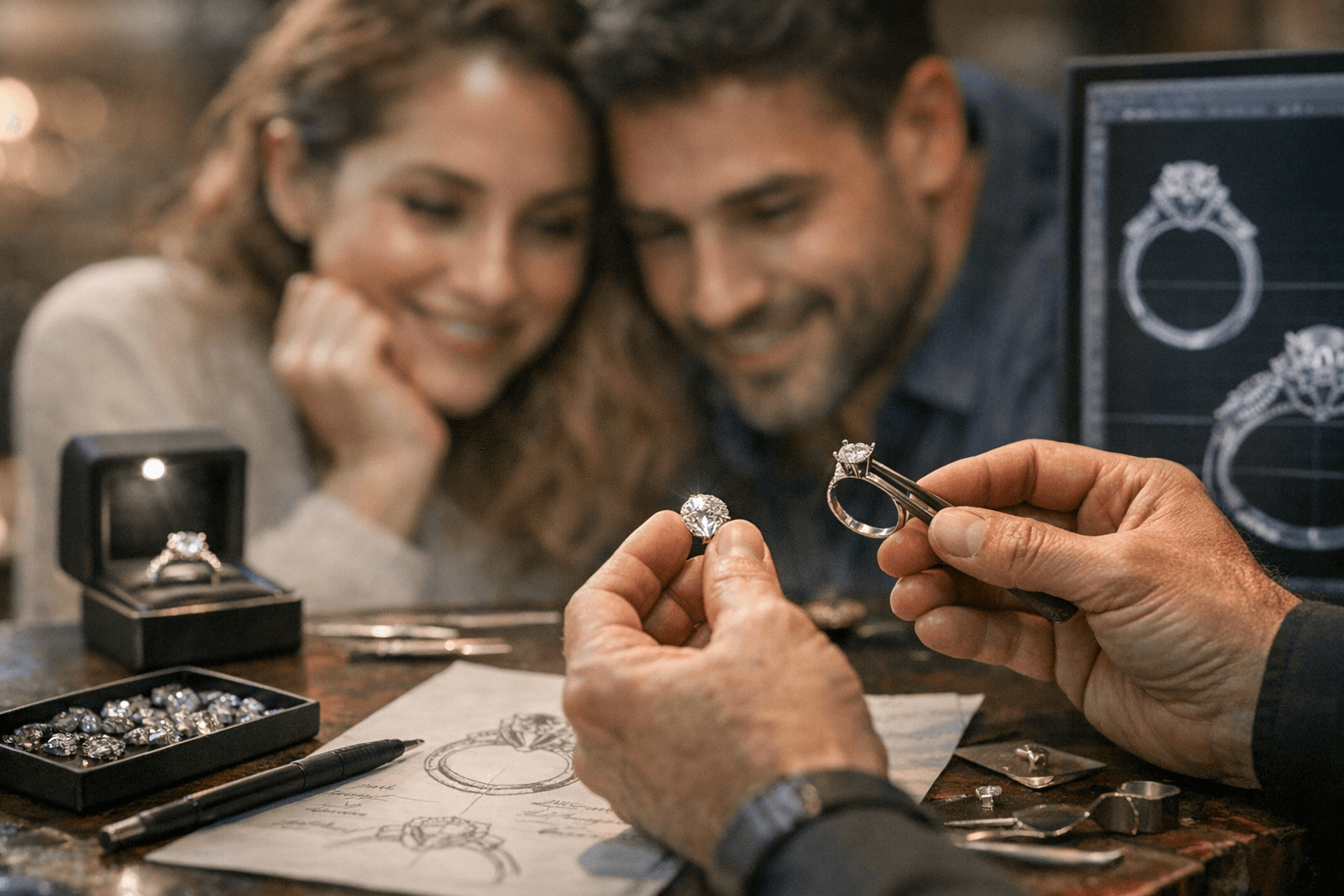
Personalized jewelry is growing 22% year over year, with custom pieces accounting for more than 32% of U.S. engagement ring purchases. And yet the contracts, approval workflows, and return policies that govern these orders have not kept pace. The result is a category where buyer enthusiasm routinely outstrips buyer protection: scope creep after verbal approvals, stones with no documentation, and remake fees that appear only after delivery.
Personalization has shifted from a luxury expectation to a baseline one, with customization requests increasing across every category, including gifts and bridal, as shoppers look for pieces that feel specific to them rather than being selected from a standard case. The informed buyer who arrives at a consultation having already compared three makers and read a dozen reviews deserves a process to match that preparation. This is that process.
The Market Behind the Demand
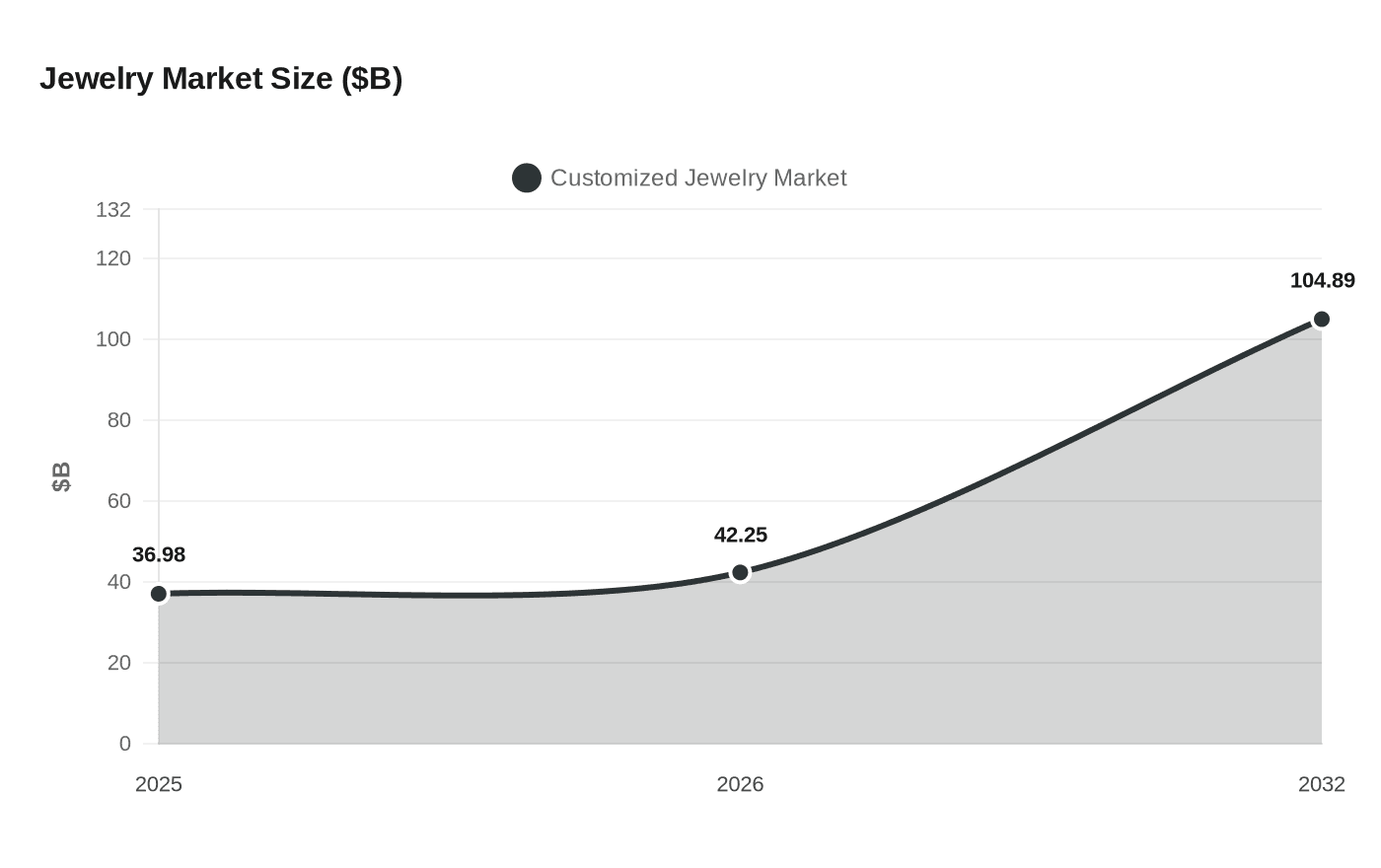
The customized jewelry market grew from USD 36.98 billion in 2025 to USD 42.25 billion in 2026, and is expected to continue expanding at a CAGR of 16.06%, ultimately reaching USD 104.89 billion by 2032. That growth isn't abstract. Customized and personalized jewelry is now a key growth driver, particularly among younger buyers who value individuality and meaning. What that market size doesn't capture is how many of those buyers are left with unexpected remake fees, approval processes that were "verbal only," and a center stone whose origin story amounts to a shrug.
The five steps below are built to close that gap, whether you're ordering a nameplate necklace from an Etsy studio or commissioning a bespoke engagement ring with a GIA-certified oval.
Step 1: Lock Down the Full Price Scope Before Design Begins
The most common failure point in custom jewelry is scope creep: a piece evolves through multiple revisions, costs shift, and none of it was disclosed upfront. Ask for a written price breakdown before any design work is commissioned.
That breakdown should include:
- The base price of the finished piece
- The cost, if any, per CAD revision beyond the first included round
- Whether the design deposit is credited toward the final price or charged separately (studios that itemize clearly typically charge around $300, applied to your final piece)
- What specific changes trigger a remake fee after approval: a stone swap, a setting style change, a sizing error on an engraved band
Reputable studios will quote CAD modeling and wax printing costs before anything happens, upfront, before any of that work is commissioned. If a maker's response to "what are all the fees?" is vague or deferred to later in the process, that is the answer.
*Question to send:* "Can you provide a written, itemized quote that covers design fees, revision fees, stone costs, setting labor, and any charges that could increase the final price after I give initial approval?"
Step 2: Treat the Render Approval as a Binding Document
CAD renderings and 3D previews are now standard at most custom jewelers. Studios typically deliver 3D renderings within 48 hours, with physical samples following in 7 to 10 business days for more complex pieces. What buyers often miss is that signing off on a render, whether via email, a click-through form, or even a casual "looks great!" in a DM thread, generally constitutes final approval.
"It didn't look like the render" is one of the most common post-delivery disputes in custom jewelry. Before approving anything:
- Zoom in on the prong count, setting style (bezel vs. prong vs. pavé), and stone orientation
- Confirm the metal color and finish in the render matches the written specification
- Request views from multiple angles, including the profile, which reveals prong height and stone depth
- If you're incorporating a heirloom stone, ask for a render using your stone's actual dimensions, not a standard placeholder
At studios with rigorous processes, the initial CAD design arrives in 7 to 10 business days after the order is placed, modifications are incorporated, and the piece only moves into production once the client has given sign-off. That structured workflow is the benchmark. If your maker is seeking approval through casual messaging without a formal confirmation step, ask them to put it in writing.
*Question to send:* "What does my written approval of the CAD render authorize you to begin? What changes can still be made after that point without additional charges?"
Step 3: Ask for Stone Provenance Documentation
A GIA diamond grading report functions as both passport and blueprint for a stone. It confirms identity through a unique report number and maps the diamond's physical and optical characteristics in a standardized language that gemologists, jewelers, and informed buyers share worldwide. For any custom piece built around a significant center stone, this documentation should be non-negotiable.
The Kimberley Process Certification Scheme provides conflict-free verification with a 99.8% global success rate across participating nations. GIA certificates with Diamond Origin Reports go further, tracking the specific mine location of a stone. Some studios have adopted blockchain-based supply chain records, where each stone's journey from mine to bench is logged on an immutable ledger. In 2026, provenance has emerged as the ultimate status symbol among buyers who want their investment aligned with their values.
Ask for the following before paying a deposit on any stone:
- The GIA or IGI report number, verifiable at gia.edu or igi.org
- KPCS documentation for natural diamonds
- The maker's Responsible Jewellery Council membership status or equivalent sourcing credentials
- For lab-grown stones: the growing method (CVD vs. HPHT) and the issuing laboratory
Claims like "ethically sourced" or "conflict-free" without documentation to back them are marketing language, not verification. Provenance is the minimum, not the premium tier.
*Question to send:* "Can you provide the GIA or IGI report number for my center stone before I commit to it, and what documentation do you carry for its country of origin?"
Step 4: Get the Timeline in Milestones, Not Just a Final Date
Bridal custom jewelry carries a longer research and production window; gift pieces are often ordered under calendar pressure. Either way, a single delivery date tells you almost nothing about where your order stands if something slips.
A realistic production schedule for a fully custom piece runs: initial CAD delivery (7 to 10 business days), revision rounds (3 to 5 business days each), optional wax or resin sample, production in precious metal (typically 2 to 4 weeks for fine jewelry), quality check, and shipping. That is 6 to 10 weeks for a straightforward piece, and longer for complex multi-stone or engraved work.
The failure point is when only a final date is given. If a revision round runs long, you have no visibility into whether your delivery window is still viable.
- Ask for a milestone-based schedule: CAD delivery date, revision window close date, production start date
- Clarify what happens to your delivery date if any milestone is missed
- For time-sensitive gifts, ask whether the maker offers rush production and what that costs upfront
*Question to send:* "Can you provide a production schedule showing the CAD delivery date, the revision window, and the production start date separately? What happens to my final delivery date if the revision phase runs long?"
Step 5: Understand What "Non-Returnable" Actually Means
Custom-designed pieces are non-returnable. That is standard practice across virtually every studio, and it is not inherently unfair: a nameplate, an engraved band, or a bespoke engagement ring set to your specific stone dimensions cannot be restocked. But "non-returnable" does not mean "no recourse."
Before finalizing an order, confirm in writing what the maker's remedy is if:
- The finished piece doesn't match the approved render in a material way (wrong prong count, wrong finish, wrong stone orientation)
- The stone arrives with inclusions or characteristics not disclosed in the grading report
- A sizing error renders an engraved piece impossible to resize without altering the design
Makers who have built systems for the modern buyer will offer a complimentary remake or credit for verified production errors. The critical distinction is between buyer's remorse (your problem) and production error (the maker's responsibility), and that distinction should be defined in writing before any deposit is paid.
Research from the University of Texas-Dallas found that lenient return policies lead to increased purchase rates and higher customer satisfaction, which is why more forward-thinking custom studios are beginning to offer limited satisfaction windows even on personalized work. If a maker won't extend any return provision, ask for a written satisfaction guarantee that specifies exactly what qualifies and what it delivers.
*Question to send:* "If the finished piece differs from the approved render in a material way that I didn't authorize, what is your written remedy and how do I initiate that process?"
The Complete "Send This Before You Buy" Checklist
Before committing to any custom or personalized jewelry order, send these five questions:
1. Can you provide a written, itemized price quote covering all possible fees, including revision and remake charges, before design work begins?
2. What does my written approval of the CAD render authorize, and what changes remain possible after that point without additional cost?
3. Can you share the GIA or IGI report number for my center stone and provide documentation of its country of origin?
4. Can you provide a milestone-based production schedule, not just a final delivery date, and clarify what happens if any milestone is delayed?
5. If the finished piece doesn't match the approved render in a material way, what is your written remedy?
A maker who answers all five in writing, without hesitation, has built a process around the buyer that now defines this market. That alignment is worth as much as the metal and stone themselves. The buyers who ask these questions consistently end up with pieces they're proud of; the ones who don't are the ones filling custom jewelry complaint forums. The gap between those two outcomes is almost always a conversation that didn't happen before the deposit cleared.
This article was produced by Prism’s automated news system from verified source data, official records, and press releases, then run through automated quality and moderation checks before publishing. The system is built and supervised by the people who set the standards it runs under. Read our full AI policy.
Did this article answer your question?