How to choose gold karat and durability for name necklaces
14k gold is the safest everyday bet, but chain strength, letter count, and script size decide whether a name necklace feels polished or fragile.
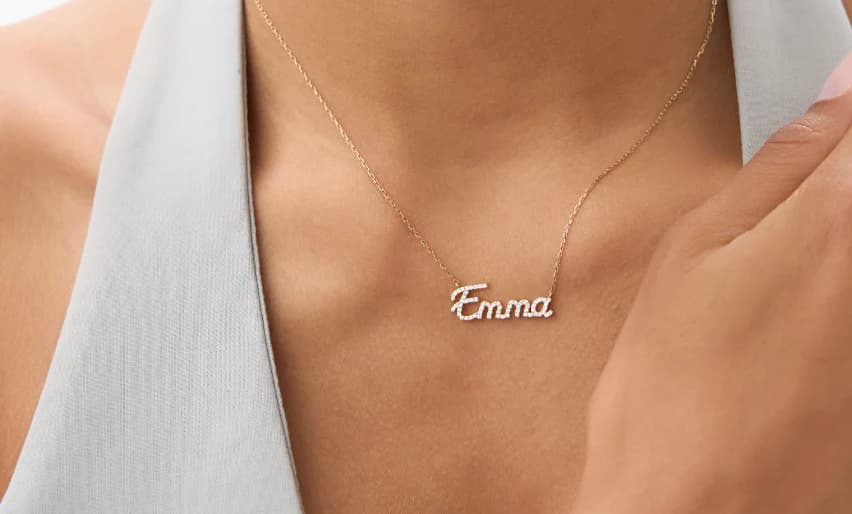
In everyday gold jewelry, 10k, 14k, and 18k are the main options for a name necklace, and that choice shapes how it wears more than the font. For a piece you plan to reach for often, 10k is the hardest and most budget-friendly option, 14k usually hits the best balance, and 18k brings a richer color with a softer feel around fine script and cutouts. The smartest purchase matches how you dress, layer, and live.
Start with the metal, not the script
Ten-karat gold can be the right call if the necklace will take regular wear, since its greater hardness helps with durability and cost. Fourteen-karat gold is often the sweet spot for personalized pieces because it balances color, strength, and long-term wearability, while 18k gives a more luxurious tone but asks for more care.
GIA advises choosing jewelry by weighing durability and wearability alongside appearance. A name necklace is a small engineered object that has to survive daily movement, stacking, and the tug of clothing. Verifying karat gold content is a real industry issue, which is why clear metal descriptions are more than sales language.
Build the name so it can survive daily wear
A nameplate is not just a decorative outline. Longer names, looping cursive, and thin letter connections create weak points if the design is too delicate, so the thickness of the plate or script matters as much as the font. A shorter name can support a lighter construction, but a longer name often needs larger proportions or a more open layout so the letters stay legible and the piece does not look cramped.
Buyers often fall in love with a script before checking whether the letters can actually hold their shape, and that is how a necklace ends up looking fragile instead of refined. If the letters are too thin, too tightly joined, or squeezed into a plate that is too small, the piece can bend, twist, or simply read poorly from a normal distance.
Match the chain to the pendant weight
The chain should support the pendant, not fight it. Chain thickness should match pendant weight so the necklace hangs properly and does not overwhelm a fine chain, because a heavy nameplate on a delicate link can pull unevenly and sit awkwardly at the neckline. A fine cable chain can work for a small pendant, but a more substantial chain is better suited to a heavier nameplate that needs to hang straight.
Length matters just as much as strength. Eighteen inches is a standard chain length, and longer lengths can make the piece wear more like a pendant. At 18 inches, the necklace sits close enough to feel like a signature layer, while longer chains move the name farther down the chest and give it more space against other necklaces.

Choose the personalization that reads best
A full first name is the classic choice, but it is not always the smartest one. Initials, a nickname, a child’s name, or a short word with emotional meaning can preserve the personal charge while improving balance and readability, especially if the name is long or contains letter shapes that need extra room. This is especially useful in multiple languages, where some names take up more horizontal space than shoppers expect.
When a name is very long, the best solution may be a more open script or a cleaner block style rather than trying to compress every letter onto a small plate. That keeps the necklace legible and prevents the customization from feeling crowded or precious in the wrong way.
Remember the cultural roots before the trend cycle
Nameplate necklaces carry documented cultural significance in Black and Latino communities. A cultural history published by Race in the Marketplace Network on 2020-10-05 traced the look through storefront displays in Brooklyn, New York. Contemporary fashion coverage has since framed the necklace as a revived Y2K-era style; by 2025-09-29 that framing had reached Forbes and cast it as a Los Angeles trend.
Check the metal claims before you buy
A custom gold name necklace should come with clear answers about what it is made from. Ask whether the piece is solid gold, gold-filled, or gold-plated, whether it has a visible hallmark, and how the pendant and chain are joined, because those details affect durability and resale value. Verifying gold content is not a trivial issue, and GIA’s 1992 study on karat-gold testing compared density testing through hydrostatic weighing, touchstone testing, capacitive decay testing, and X-ray fluorescence.
GIA’s 1992 study found the latter three methods useful within certain limitations.
This article was produced by Prism’s automated news system from verified source data, official records, and press releases, then run through automated quality and moderation checks before publishing. The system is built and supervised by the people who set the standards it runs under. Read our full AI policy.
Did this article answer your question?