Marco Bicego Links Artisanal Craft and Identity to Redefine Personalized Jewelry
Marco Bicego's 2026 campaign proves personalized jewelry is about provenance, not just initials — here's how to spot the real thing before you buy.
What "Personalized" Actually Means in Fine Jewelry
Here is a finding that cuts through every name-stamped bracelet, laser-etched pendant, and monogram charm currently flooding the personalized jewelry market: the most meaningful personalization has nothing to do with your name. It happens before a piece ever reaches your wrist, in the hands of a goldsmith who has spent years learning to move a single engraving tool across 18-karat gold with the controlled precision of a surgeon. Marco Bicego's 2026 brand campaign, "The Art of Craft," arrives with a message that is less a marketing slogan than a provocation: "Identity Creates Value." After celebrating 25 years in 2025, the Italian house is not introducing a new customization service or a monogram collection. It is arguing that personalization, done right, is already embedded in the making.
That argument is worth understanding in full before you spend money on anything described as "personalized jewelry," because the word has been stretched to cover everything from a machine-stamped sterling disc to a hand-engraved 18-karat boule that takes more than 500 precise hand movements to complete.
The Three Technique Pillars That Define the Campaign
The campaign's visual language centers on three specific techniques, each documented with behind-the-scenes imagery: the coil, hand engraving with the bulino tool, and curated colored gemstone selection. These are not decorative chapters in a lookbook. They are production realities that distinguish a piece made by trained human hands from one produced at volume.
The bulino is an ancient carving tool, and its use at the Trissino atelier in the Veneto region of Northern Italy is the brand's most recognizable signature. An artisan using it does not stamp or press; they etch hundreds of miniature lines into the gold's surface by hand, building a fine, brushed texture that shifts in the light between matte and luminous. The finish is sometimes described as silk-like, which is accurate: up close, the surface has a soft directionality, a grain that catches light without glare. The Lunaria collection, with its moon-shaped gold discs, and the Africa collection, with its sculptural boules, both depend entirely on this technique for their character.
The coil is equally labor-intensive. An ultra-fine 18-karat gold strand is spiraled by hand around a golden core, a process that gives the resulting piece its springy, organic drape. The Masai and Marrakech collections built their identity on this technique, with Marrakech also incorporating the "Chorda di Chitarra" process: gold hammered by hand and then twisted into its final form. Neither can be replicated by machine without losing the slight, human irregularity that makes each piece distinct.
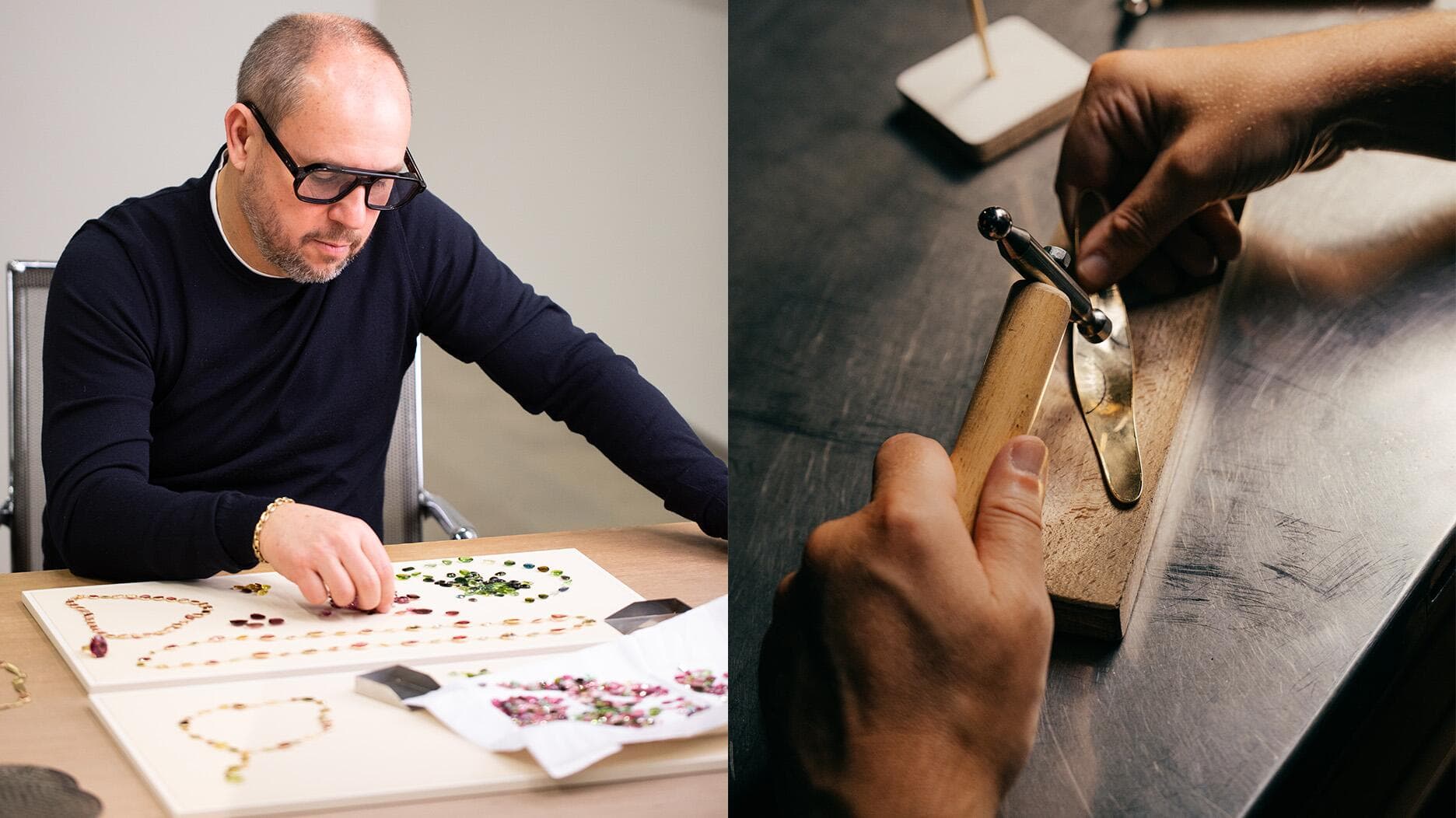
Gemstone selection is the third pillar, and it is the one most easily overlooked when shopping online. Marco Bicego himself is photographed in the campaign selecting colored stones, a deliberate visual choice. Stones are chosen for their individual inclusions and color gradations, not simply sorted by category. Natural gemstones carry inclusions as evidence of geological time, and a brand that treats those inclusions as features rather than flaws is telling you something important about its philosophy.
The Share-Worthy Number: 500 Hand Movements per Piece
Engraving a single boule from the Africa collection requires more than 500 precise hand movements. That figure is worth sitting with. At the rate a skilled goldsmith works, those movements represent significant concentrated time, and they produce a surface that cannot be exactly replicated, not even by the same artisan on the following day. This is the functional definition of personalization that Marco Bicego's campaign is advancing: not customization applied after the fact, but individuality built into the production method itself. It is also the clearest possible contrast to a name-stamped pendant produced by a laser cutter in under sixty seconds.
Six Buying Cues to Check on Any Personalized Jewelry Listing
The "Identity Creates Value" framework translates directly into a checklist. Before purchasing any piece described as personalized, handmade, or artisan-crafted, run through these six cues:
- Process proof. Does the brand show the actual making? Campaign imagery from Marco Bicego depicts a human hand holding a bulino tool against gold, not a finished product against a marble surface. If a brand cannot show you how something is made, treat that silence as information.
- Maker attribution. Is there a named artisan, a named atelier, or at minimum a named country of manufacture? All Marco Bicego jewelry is made at the Trissino headquarters, which employs more than 60 specialized goldsmiths who work exclusively from the local Veneto region. "Handcrafted" without location is a phrase worth questioning.
- Metal sourcing and specification. Every Marco Bicego piece is made in 18-karat gold, and the brand melts and processes the gold in-house. A listing that describes metal as "gold-tone," "gold-filled," or simply "gold" without a karat designation is not the same category of object, regardless of how it is styled.
- Finishing details. The bulino's brushed finish and the coil's spiraled texture are both tactile as well as visual, and both are apparent in close-up photography. For any personalized piece, look for finishing detail that goes beyond polishing: texture, patina variation, hand-applied surface treatment. These are signs that a human hand was involved at the final stage.
- Time-to-make transparency. Mass production is fast. Artisan production is not. If a brand offers unlimited personalization with two-day shipping, the math on handwork does not hold. Genuine craft takes time, and a brand confident in its process will say so, either in production timelines or in narrative content about its methods.
- Care and repair support. The bulino finish on Marco Bicego pieces requires specific maintenance: a soft dry cloth, no abrasive cleaners, separate storage to protect the satin texture. A brand that gives you detailed care instructions tied to a specific technique is demonstrating accountability for the object it made. A brand that offers no care guidance likely offers no repair path either.
Why This Matters Beyond One Brand's Campaign
Marco Bicego's "The Art of Craft" campaign is brand-specific, but the question it raises belongs to the broader personalized jewelry market. As birthstone jewelry, name necklaces, and initial pieces have surged in popularity, the category has become crowded with products that use the word "personalized" to mean "customized with your text" rather than "made with individual intention." The distinction matters financially: a piece produced by a named technique in a traceable atelier holds its character over time, while a laser-stamped disc holds its novelty for roughly one season.
"True value lies in authenticity, in the beauty that comes from the hands, and in jewelry that is instantly recognizable for its unique character," the brand stated at the campaign's launch. That position is not sentimental. It is a coherent theory of value, and one that applies whether you are considering a Marco Bicego boule or any other personalized piece at any price point. Identity, in the most durable jewelry, is not written on the surface. It is built into the structure itself, one deliberate hand movement at a time.
This article was produced by Prism’s automated news system from verified source data, official records, and press releases, then run through automated quality and moderation checks before publishing. The system is built and supervised by the people who set the standards it runs under. Read our full AI policy.
Did this article answer your question?