Smart Buyers Guide to Spotting Quality Issues in Personalized Jewelry
Jewelry has ranked as the #1 counterfeited import seized at U.S. borders for three straight years. Here's the exact verification flow to use before buying any personalized piece.
The Statistic No Gift-Giver Wants to Hear
For three consecutive years, jewelry has ranked as the number-one commodity seized by U.S. Customs and Border Protection for intellectual property rights violations, outpacing watches, handbags, and electronics. In fiscal year 2024 alone, roughly 90 percent of those counterfeit goods originated from China and Hong Kong, sold overwhelmingly through third-party e-commerce platforms. That means the name necklace, birthstone stack, or initial ring you are browsing this gifting season may be traveling a far murkier supply chain than its glossy product photo suggests. Knowing exactly what to look for before you click "buy" is not overcaution. It is the price of admission for buying well.
Why Personalized Pieces Carry Extra Risk
Customized and engraved jewelry occupies a genuinely awkward position in the consumer protection landscape. Once a seller laser-engraves a name or sets a specific birthstone, most return windows shrink or close entirely, and the visual presentation of a personal piece, your initials worked into a delicate gold script, a ring stacked with your children's stones, can make it nearly impossible to spot a metal substitution or a treated stone from product photography alone. The FTC's guidelines for the jewelry industry explicitly prohibit misrepresenting the metallic content, quality, weight, or grade of a piece, but enforcement is reactive. By the time a complaint is filed, the order has arrived, the engraving is done, and the return policy has expired. Your best protection is front-loaded verification, before money changes hands.
Your 5-Minute Verification Flow
Think of this as a pre-purchase checklist you run in the order shown, stopping only when you have satisfactory answers at each step.
Step 1: Find the Hallmark
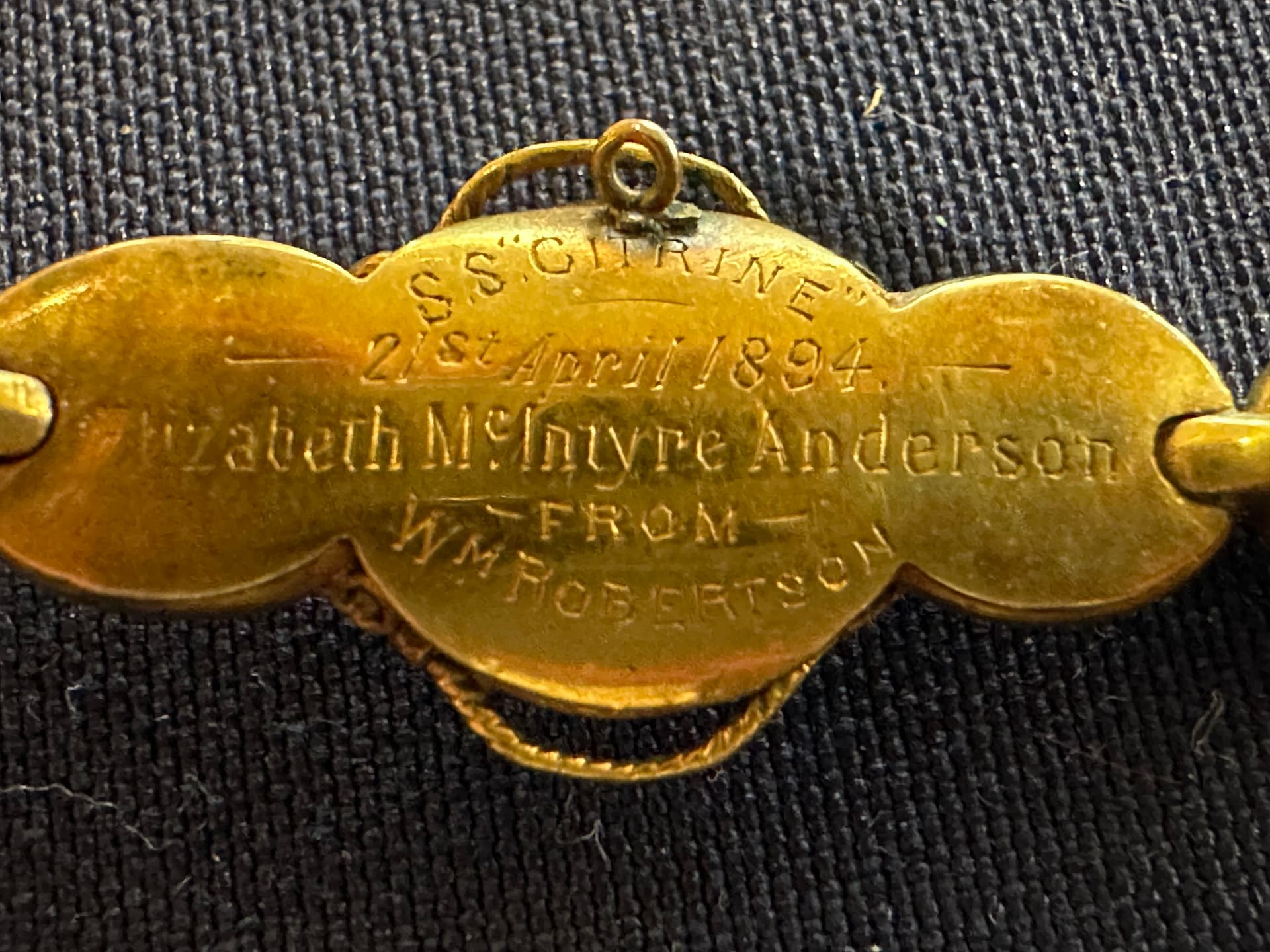
Start with the karat stamp. On a finished piece, it lives on the inside of a ring band, near the clasp of a necklace, or on the back of a pendant bail. In the United States, look for a stamp reading 10K, 14K, 18K, or 22K. European pieces use numeric fineness marks instead: 417 (10-karat), 585 (14-karat), 750 (18-karat), and 916 (22-karat), expressing the gold content as parts per thousand. Sterling silver should carry a 925 stamp. Platinum is typically marked PT950 or PLAT. If a listing describes a piece as "gold" or "silver" without specifying the karat or fineness, that is not a description of a precious metal. It is a description of a color.
Step 2: The Magnet Test (and Its Limits)
A basic neodymium magnet, available for a few dollars at any hardware store, will tell you whether a piece contains ferrous (iron-based) metal. Genuine gold, silver, and platinum are not magnetic. If a piece snaps to a magnet, it is base metal regardless of what the listing claims. This test takes roughly three seconds. What it cannot do is distinguish between solid 14-karat gold and gold-plated brass, both of which will fail the magnet test. For that level of certainty, you need a professional.
Step 3: Ask for Testing Documentation or Get It Yourself
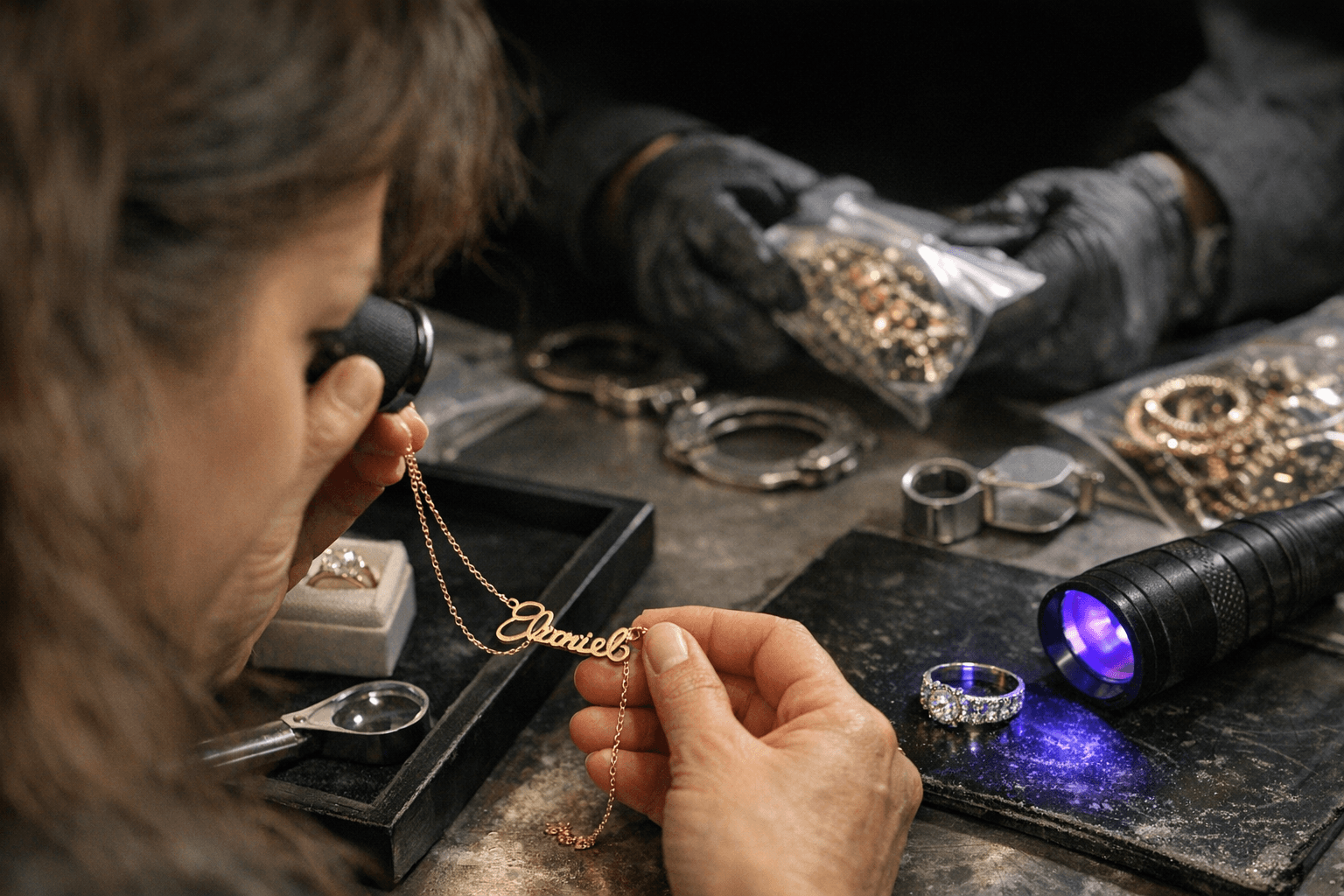
Reputable sellers of fine personalized jewelry should be able to provide documentation of the metal they are using, whether that is a mill certificate from their supplier or a statement of the karat and method of construction (solid, filled, or plated). For pieces already in your possession, a local jeweler can perform an acid test, in which a small scratch is made on a touchstone and a series of acid solutions are applied to confirm karat purity. For high-value pieces or situations where you want non-destructive confirmation, XRF (X-ray fluorescence) analysis reads the elemental composition of a metal surface in seconds without scratching it. Many pawn shops, estate jewelers, and independent appraisers offer XRF testing for a nominal fee. This single step resolves more disputes than any other.
Step 4: Understand the Return and Warranty Policy Before You Order
Read the policy in full, not the marketing summary. Look specifically for: whether personalized or custom items are excluded from returns; what the window is for reporting a defect; whether the seller offers any warranty on plating (relevant for gold-filled and gold-plated pieces, which will wear); and whether disputes are handled through a formal arbitration process or left to platform mediation. A seller who cannot clearly articulate their return policy for engraved pieces is a seller who has not thought carefully about standing behind their product.
Step 5: Research Seller History
On marketplace platforms, filter reviews specifically for the product type you are buying, not the seller's overall rating. A seller with 4.8 stars across thousands of sticker and print-on-demand orders may have two reviews for fine metal work. Check whether the business has a verifiable physical address, a working phone number, and a history of responding to negative reviews constructively rather than defensively. eBay's Authenticity Guarantee program now requires third-party expert authentication for jewelry priced at $500 or above, which adds a meaningful layer of verification for higher-investment purchases, but the program does not cover every platform or every price point.
When Gemstones Enter the Picture
Birthstone jewelry, the fastest-growing subcategory in personalized fine jewelry, introduces a separate layer of complexity. The gemstone industry relies on treatments to improve the appearance of natural stones, and many of those treatments are entirely standard practice. The disclosure of those treatments is not.
Fracture filling is common in diamonds and rubies: a glass-like resin or lead-glass compound is injected into surface-reaching cracks to make them less visible. Heat treatment is near-universal for sapphires and rubies and entirely acceptable, but it affects value. Emerald oiling, the practice of filling surface-reaching fractures with cedar oil or resin to mask inclusions, is so prevalent that most commercial emeralds are oiled to some degree. The issue is not treatment itself. The issue is whether a seller discloses it. An untreated ruby of fine color can be worth multiples of a heat-treated stone of identical appearance. A heavily fracture-filled diamond represents a fundamentally different product than a lightly included stone of the same stated carat weight.
For any colored stone above a few hundred dollars, ask directly: Is this stone treated? If so, what treatment, and to what degree? A seller who cannot answer that question should not be selling fine gemstones.
Independent Gem Reports: When to Require Them
For diamonds and significant colored stones, a grading report from an independent laboratory is the single most reliable form of buyer protection available. The Gemological Institute of America, known as GIA, sets the global standard for diamond grading reports, and their assessments of cut, color, clarity, and carat weight are considered the industry benchmark for credibility. Other reputable laboratories include the American Gem Society Laboratories (AGSL) and, for colored stones, Gübelin Gem Lab and SSEF Swiss Gemmological Institute. A report costs the seller a modest fee and should be passed along with the piece at no additional charge. If a seller of a "natural sapphire" birthstone ring cannot provide any laboratory documentation, you should assume the stone's quality has not been independently verified, which means you are relying entirely on the seller's word.
The Exact Questions to Send a Seller
Before purchasing any personalized fine jewelry online, send these questions in writing and save the responses:
- What is the exact metal content of this piece (karat and construction: solid, filled, or plated)?
- Is there a hallmark or karat stamp, and where is it located on the finished piece?
- Are the gemstones natural, lab-grown, or simulants?
- Have the stones been treated in any way (heat, fracture fill, oiling)?
- Do you provide a grading report or certificate for the stone(s)?
- What is your return or exchange policy for custom/engraved pieces specifically?
- How do you handle a piece that arrives with a quality defect?
A seller of genuine quality will answer every one of these questions without hesitation. Delays, deflections, or generic responses are information.
The Red-Flag Checklist: Print This Before Gifting Season
Save this list and check it before any personalized jewelry purchase:
- Price is dramatically below comparable pieces from established retailers (below market almost never means a deal in fine metal)
- Listing describes metal as "gold tone," "gold colored," or "real gold look" rather than stating a karat
- No visible hallmark or stamp shown or described in the listing
- Seller cannot confirm stone treatment history
- Return policy excludes all custom or engraved items with no exception for defects
- Product photos show only the finished piece with no close-up of clasps, backs, or stamps
- Weight is not listed, or listed weight seems low for the stated metal (solid 14K gold is dense; a hollow-feeling piece at a suspiciously light gram weight is a warning)
- Reviews are clustered around non-jewelry products, or the account was created recently
- No response to direct messages about documentation within 48 hours
Personalized jewelry, precisely because it carries emotional weight, deserves the same scrutiny you would apply to any fine purchase. A name engraved in genuine 14-karat gold is a keepsake that holds its meaning and its value for decades. The same name pressed into gold-plated brass will fade within a season, and no amount of sentiment will put the metal back. The five minutes you spend verifying a piece before you buy it is the most direct investment you can make in what it will mean ten years from now.
Let me now format this into the required response structure:
The Statistic No Gift-Giver Wants to Hear
For three consecutive years, jewelry has ranked as the number-one commodity seized by U.S. Customs and Border Protection for intellectual property rights violations, outpacing watches, handbags, and electronics. In fiscal year 2024 alone, roughly 90 percent of those counterfeit goods originated from China and Hong Kong, sold overwhelmingly through third-party e-commerce platforms. That means the name necklace, birthstone stack, or initial ring you're browsing this gifting season may be traveling a far murkier supply chain than its glossy product photo suggests. Knowing exactly what to look for before you click "buy" is not overcaution. It is the price of admission for buying well.
Why Personalized Pieces Carry Extra Risk
Customized and engraved jewelry occupies a genuinely awkward position in the consumer protection landscape. Once a seller laser-engraves a name or sets a specific birthstone, most return windows shrink or close entirely, and the visual presentation of a personal piece, your initials worked into a delicate gold script, a ring stacked with your children's stones, can make it nearly impossible to spot a metal substitution or a treated stone from product photography alone. The FTC's guidelines for the jewelry industry explicitly prohibit misrepresenting the metallic content, quality, weight, grade, or color of a piece, but enforcement is reactive. By the time a complaint is filed, the order has arrived, the engraving is done, and the return policy has expired. Your best protection is front-loaded verification, before money changes hands.
Your 5-Minute Verification Flow
Think of this as a pre-purchase checklist you run in the order shown, stopping only when you have satisfactory answers at each step.
Step 1: Find the Hallmark
Start by checking for a hallmark stamp near the clasp, and look for 10K, 14K, 18K, or numeric equivalents like 417, 585, or 750. These numbers show gold content by parts-per-thousand: 916 equals 22-karat, 750 equals 18-karat, 585 equals 14-karat, and 417 equals 10-karat. Sterling silver should carry a 925 stamp; platinum is typically marked PT950 or PLAT. If a listing describes a piece as "gold" or "silver" without specifying the karat or fineness, that is not a description of a precious metal. It is a description of a color.
Step 2: The Magnet Test (and Its Limits)
Perform the magnet test: a genuine gold piece should not stick. A basic neodymium magnet will tell you in roughly three seconds whether a piece contains ferrous (iron-based) metal. What it cannot do is distinguish between solid 14-karat gold and gold-plated brass, both of which will pass. For that level of certainty, you need a professional.
Step 3: Ask for Testing Documentation, or Get It Yourself
For complete certainty, have the piece tested by a professional jeweler using acid testing or XRF analysis. Jewelers use acid testing, applying different acids to scratch marks, and XRF (X-ray fluorescence) analysis to confirm the metal content. XRF reads the elemental composition of a metal surface in seconds without scratching it, and many estate jewelers and independent appraisers offer it for a nominal fee. Reputable sellers should also be able to provide supplier documentation, such as a mill certificate, confirming the karat and method of construction (solid, filled, or plated) before you ever need to test anything yourself.
Step 4: Understand the Return and Warranty Policy Before You Order
Read the policy in full, not the marketing summary. Look specifically for whether personalized or custom items are excluded from returns, what the window is for reporting a defect, whether the seller offers any warranty on plating (relevant for gold-filled and gold-plated pieces, which will wear), and whether disputes are handled through a formal arbitration process. A seller who cannot clearly articulate their return policy for engraved pieces is a seller who has not thought carefully about standing behind their product.
Step 5: Research Seller History
On marketplace platforms, filter reviews specifically for the product type you are buying, not the seller's overall rating. A seller with 4.8 stars across thousands of sticker and print-on-demand orders may have two reviews for fine metal work. Check whether the business has a verifiable physical address, a working phone number, and a history of responding to negative reviews constructively. eBay's Authenticity Guarantee program requires expert third-party verification for jewelry priced at $500 or above, which adds a meaningful layer of protection for higher-investment purchases, but the program does not cover every platform or every price point.
When Gemstones Enter the Picture
Birthstone jewelry, the fastest-growing subcategory in personalized fine jewelry, introduces a separate layer of complexity. The gemstone industry relies on treatments to improve the appearance of natural stones, and many of those treatments are entirely standard practice. The disclosure of those treatments, however, is not.
Fracture filling is common in diamonds and rubies: a glass-like resin or lead-glass compound is injected into surface-reaching cracks to make them less visible. Heat treatment is near-universal for sapphires and rubies and entirely acceptable by industry standards, but it affects resale value. Emerald oiling, the practice of filling surface fractures with cedar oil or resin to mask inclusions, is so prevalent that most commercial emeralds are treated to some degree. The issue is not treatment itself. The issue is whether a seller discloses it. An untreated ruby of fine color can be worth multiples of a heat-treated stone of identical appearance, and a heavily fracture-filled diamond represents a fundamentally different product than a lightly included stone of the same stated carat weight. For any colored stone above a few hundred dollars, ask directly: Is this stone treated? If so, what treatment, and to what degree?
Independent Gem Reports: When to Require Them
Independent gemstone certification provides objective quality assessment through third-party authentication, and GIA's grading reports remain the industry standard for credibility. Other reputable laboratories include the American Gem Society Laboratories (AGSL) and, for colored stones, Gübelin Gem Lab. A report costs the seller a modest fee and should be passed along with the piece at no additional charge. Red flags include unrealistic pricing and sellers refusing documentation. If the seller of a "natural sapphire" birthstone ring cannot provide any laboratory documentation, you are relying entirely on their word for the stone's quality.
The Exact Questions to Send a Seller
Before purchasing any personalized fine jewelry online, send these questions in writing and save the responses:
- What is the exact metal content of this piece (karat and construction: solid, filled, or plated)?
- Is there a hallmark or karat stamp, and where is it located on the finished piece?
- Are the gemstones natural, lab-grown, or simulants?
- Have the stones been treated in any way (heat, fracture fill, oiling)?
- Do you provide a grading report or certificate for the stone(s)?
- What is your return or exchange policy for custom and engraved pieces specifically?
- How do you handle a piece that arrives with a quality defect?
A seller of genuine quality will answer every one of these questions without hesitation. Delays, deflections, or generic responses are information.
The Red-Flag Checklist: Save This Before Gifting Season
- Price is dramatically below comparable pieces from established retailers (below market almost never means a deal in fine metal)
- Listing describes metal as "gold tone," "gold colored," or "real gold look" rather than stating a karat
- No visible hallmark or stamp shown or described in the listing
- Seller cannot confirm stone treatment history
- Return policy excludes all custom or engraved items with no exception for manufacturing defects
- Product photos show only the finished piece with no close-up of clasps, backs, or stamps
- Weight is not listed, or the listed gram weight seems implausibly low for solid metal (genuine 14-karat gold is dense; a piece that feels hollow at a suspiciously light weight is a warning sign)
- Reviews are clustered around non-jewelry products, or the account was created recently
- No response to direct questions about documentation within 48 hours
Pick up the piece and feel its weight: solid gold is noticeably heavy and dense. That physical reality, weight, density, and a visible stamp, is the fastest shortcut to separating a genuine personalized piece from a plated imitation. A name engraved in genuine 14-karat gold is a keepsake that holds its meaning and its metal for decades. The same name pressed into gold-plated brass will fade within a season, and no sentimental inscription will put the metal back. The five minutes you invest in verification before purchasing is the most direct investment you can make in what the piece will still mean ten years from now.
This article was produced by Prism’s automated news system from verified source data, official records, and press releases, then run through automated quality and moderation checks before publishing. The system is built and supervised by the people who set the standards it runs under. Read our full AI policy.
Did this article answer your question?